Spherical representations of unitary groups at ramified places and the arithmetic inner product formula
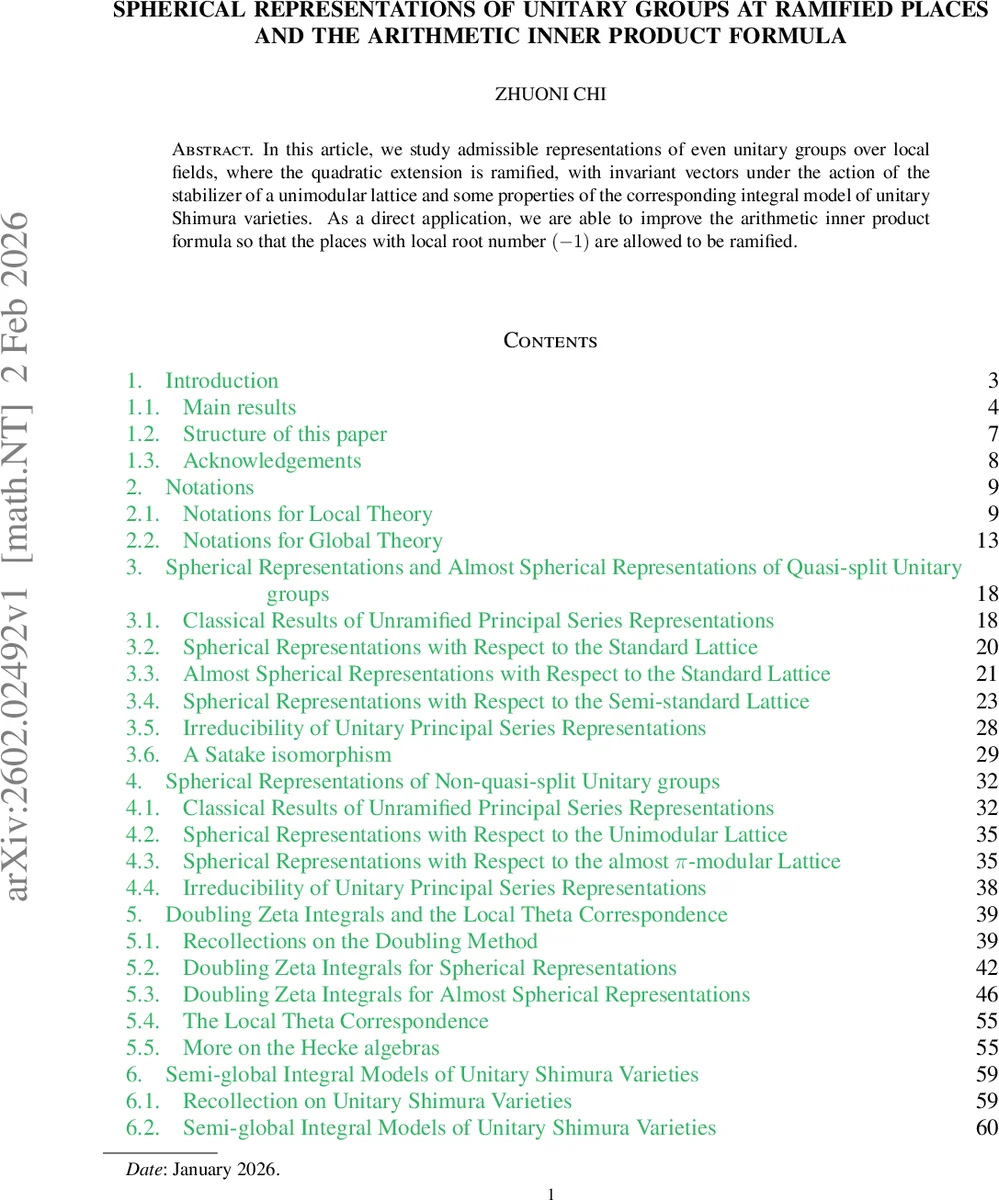
In this article, we study admissible representations of even unitary groups over local fields, where the quadratic extension is ramified, with invariant vectors under the action of the stabilizer of a unimodular lattice and some properties of the corresponding integral model of unitary Shimura varieties. As a direct application, we are able to improve the arithmetic inner product formula so that the places with local root number ((-1)) are allowed to be ramified.
💡 Research Summary
The paper “Spherical representations of unitary groups at ramified places and the arithmetic inner product formula” addresses two intertwined problems. First, it develops a systematic classification of spherical and almost‑spherical admissible representations of even‑dimensional unitary groups over local fields when the underlying quadratic extension (E/F) is ramified. Second, it uses this local representation theory to extend the arithmetic inner product formula (AIPF) to cases where the local root number (\epsilon_v(\pi)=-1) at ramified places, a situation previously excluded from the literature.
Main Setting.
Let (E/F) be a CM extension of number fields, (n=2r) an even integer, and (W_r=E^n) equipped with the standard skew‑Hermitian form. The quasi‑split unitary group (G_r=U(W_r)) is considered over (F). For each finite place (v) of (F) the stabilizer (K_{r,v}\subset G_r(F_v)) of a unimodular lattice (or an almost (\pi)-modular lattice) is taken as a special maximal compact subgroup. The authors introduce the set (V^{\heartsuit}_F) of places that are either split or inert and satisfy a mild unramifiedness condition on a certain subfield; this set controls the ramified places that will be allowed in the global applications.
Local Representation Theory.
Sections 3 and 4 treat spherical and almost‑spherical representations for both quasi‑split and non‑quasi‑split unitary groups. The key novelty is the treatment of representations that are spherical with respect to the stabilizer of a unimodular lattice rather than the usual (\mathfrak p)-modular lattice. The authors prove irreducibility of the corresponding principal series, construct a Satake isomorphism for the Hecke algebra (\mathcal H(G_r(F_v),K_{r,v})), and identify the Satake parameters in terms of the local Langlands correspondence. In the ramified setting, they define “regularly almost spherical” representations (Definition 3.24) and show that, under mild constraints on the Satake parameters, these coincide with the usual spherical representations attached to a special maximal compact subgroup.
Doubling Zeta Integrals.
Section 5 revisits the doubling method of Piatetski‑Shapiro and Rallis. For each spherical or almost‑spherical representation (\pi_v) the authors define a local zeta integral (Z_v(s,\phi_v,\Phi_v)) and compute it explicitly. The computation works uniformly for unramified, ramified‑unramified, and ramified‑ramified places, the latter case being new. The local integrals are normalized so that they equal 1 for almost all places, and the product over all places reproduces the global doubling (L)-function (L(s,\pi)).
Integral Models of Unitary Shimura Varieties.
Section 6 constructs semi‑global integral models of unitary Shimura varieties of dimension (n-1). The authors combine the “exotic smooth” model (Li–Liu) with the Krämer model (He–Li–Shi–Yang) to obtain a model that is regular enough to apply vanishing theorems for coherent cohomology. A key geometric input is a cohomology‑vanishing lemma (Lemma 6.4) which ensures that the Hecke algebra (\mathbb T_{R,\mathbb Q^{\mathrm{ac}}}) acts semisimply on the Chow group of zero‑cycles. This allows the definition of a maximal ideal (\mathfrak m_\pi) attached to a cuspidal automorphic representation (\pi).
Arithmetic Inner Product Formula.
The global results are assembled in Sections 7 and 8. Under the standing assumption that
\
Comments & Academic Discussion
Loading comments...
Leave a Comment