Talking Inspiration: A Discourse Analysis of Data Visualization Podcasts
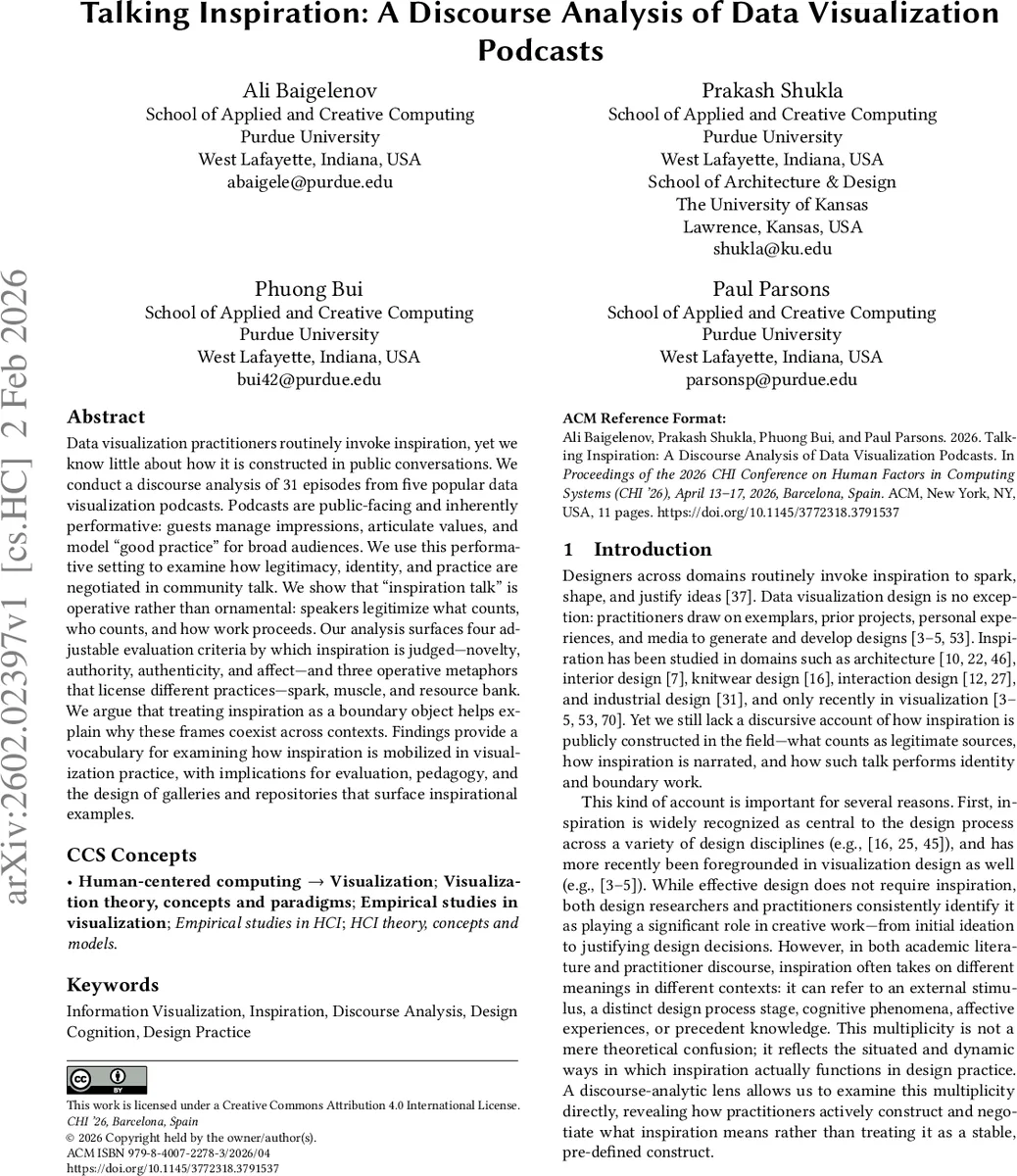
Data visualization practitioners routinely invoke inspiration, yet we know little about how it is constructed in public conversations. We conduct a discourse analysis of 31 episodes from five popular data visualization podcasts. Podcasts are public-facing and inherently performative: guests manage impressions, articulate values, and model “good practice” for broad audiences. We use this performative setting to examine how legitimacy, identity, and practice are negotiated in community talk. We show that “inspiration talk” is operative rather than ornamental: speakers legitimize what counts, who counts, and how work proceeds. Our analysis surfaces four adjustable evaluation criteria by which inspiration is judged-novelty, authority, authenticity, and affect-and three operative metaphors that license different practices-spark, muscle, and resource bank. We argue that treating inspiration as a boundary object helps explain why these frames coexist across contexts. Findings provide a vocabulary for examining how inspiration is mobilized in visualization practice, with implications for evaluation, pedagogy, and the design of galleries and repositories that surface inspirational examples.
💡 Research Summary
This paper investigates how the concept of “inspiration” is socially constructed and operationalized in the public discourse of data‑visualization practitioners. While prior work has treated inspiration as a psychological or cognitive phenomenon, or as a set of design resources, little is known about how practitioners talk about it, what counts as legitimate sources, and how such talk shapes professional identity and community norms. To address this gap, the authors conduct a discourse analysis of 31 interview‑style episodes drawn from five popular data‑visualization podcasts (Data Viz Today, Explore Explain, The Data Journalism Podcast, Data Stories, and The PolicyViz Podcast) recorded between 2019 and 2025. Podcasts are chosen because they are public, performative venues where prominent designers present themselves to a broad audience, thereby revealing how legitimacy, expertise, and “good practice” are negotiated.
Using Gee’s framework as a sensitizing lens, the analysis focuses on “ways of saying, doing, and being.” The authors code for metaphors, stance, narrative structures, and legitimation strategies. Their findings coalesce around two inter‑related dimensions.
First, inspiration is judged according to four adjustable evaluation criteria: (1) Novelty – the degree to which an idea or visual approach is perceived as new or differentiating; (2) Authority – the reliance on socially recognized credentials such as publications, awards, or affiliation with high‑profile organizations; (3) Authenticity – the alignment of an inspirational source with the speaker’s personal experience, project history, or “real‑world” practice; and (4) Affect – the emotional resonance that an example elicits in listeners, often used to motivate or engage the audience. These criteria are not static; speakers shift emphasis depending on context, thereby making inspiration an operative, decision‑making tool rather than decorative rhetoric.
Second, the discourse is organized around three operative metaphors that the authors label spark, muscle, and resource‑bank. The “spark” metaphor frames inspiration as a sudden, catalytic idea that ignites a design direction. The “muscle” metaphor emphasizes the need for sustained practice, skill development, and the “strength” that comes from repeated engagement with visual problems. The “resource‑bank” metaphor treats inspiration as a curated collection of exemplars, case studies, and visual artifacts that designers can draw upon, store, and remix over time. Importantly, these metaphors coexist and intersect within the same conversations, reflecting the multi‑layered nature of inspiration.
The authors argue that treating inspiration as a boundary object explains why these diverse criteria and metaphors can operate simultaneously across different sub‑communities (academia, industry, journalism). As a boundary object, inspiration is shared across groups but is interpreted and used in ways that suit each group’s practices and values.
Implications are threefold. For education, making the four criteria explicit can help students develop more flexible design identities and navigate critique sessions with a clearer vocabulary. For design review and critique, structuring feedback around novelty, authority, authenticity, and affect can lead to more transparent and constructive discussions. For tool and repository design, incorporating the three metaphors suggests interfaces that support rapid “spark” discovery (e.g., recommendation engines), long‑term “muscle” building (e.g., skill‑tracking dashboards), and “resource‑bank” management (e.g., searchable galleries of annotated visual examples).
Methodologically, the study demonstrates the value of discourse analysis in HCI and visualization research, showing how public media such as podcasts can serve as rich data sources for uncovering the rhetorical work that underlies professional practice. By illuminating how inspiration is talked about, legitimized, and performed, the paper contributes a nuanced vocabulary for future studies of design cognition, community formation, and the sociology of visualization.
Comments & Academic Discussion
Loading comments...
Leave a Comment