Sequential Quadratic Sum-of-squares Programming for Nonlinear Control Systems
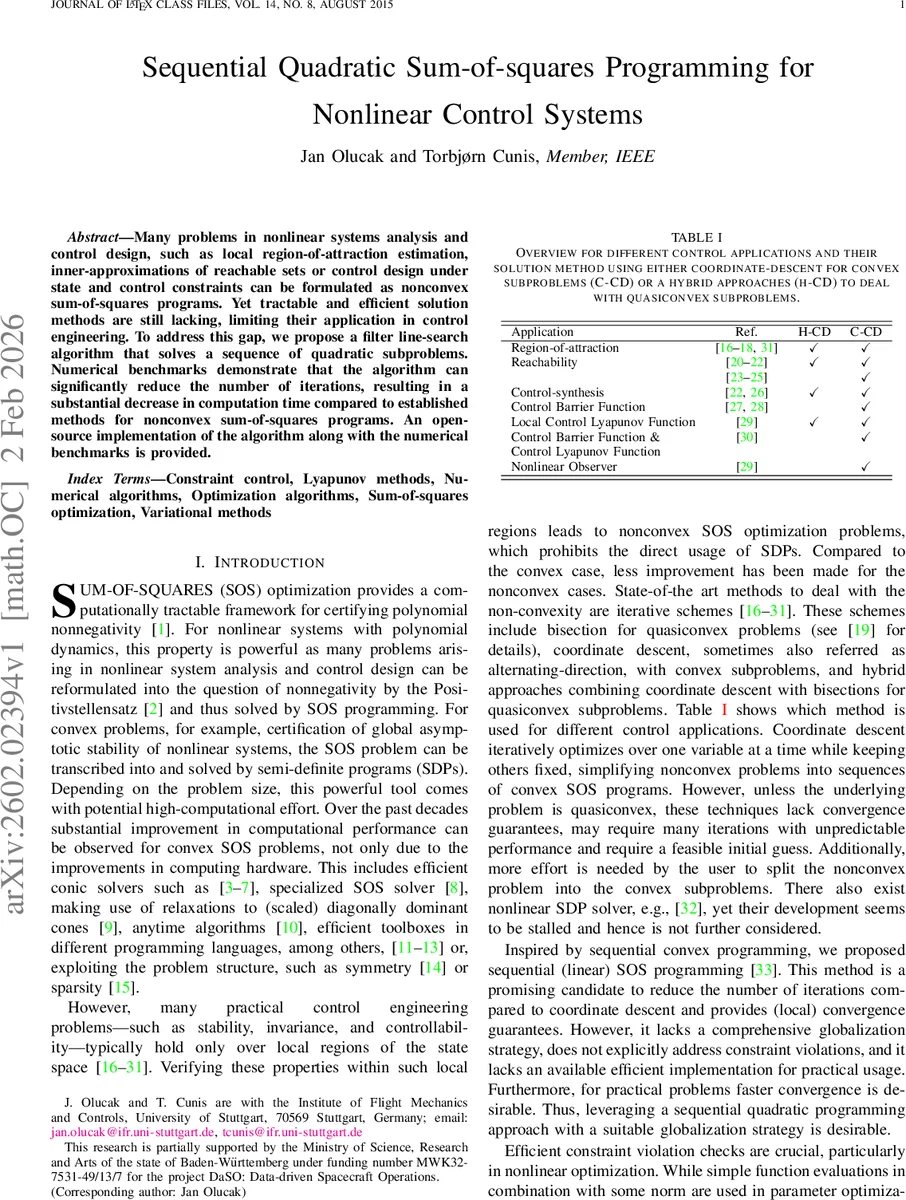
Many problems in nonlinear systems analysis and control design, such as local region-of-attraction estimation, inner-approximations of reachable sets or control design under state and control constraints can be formulated as nonconvex sum-of-squares programs. Yet tractable and efficient solution methods are still lacking, limiting their application in control engineering. To address this gap, we propose a filter line-search algorithm that solves a sequence of quadratic subproblems. Numerical benchmarks demonstrate that the algorithm can significantly reduce the number of iterations, resulting in a substantial decrease in computation time compared to established methods for nonconvex sum-of-squares programs. An open-source implementation of the algorithm along with the numerical benchmarks is provided
💡 Research Summary
The paper addresses a critical bottleneck in modern nonlinear control engineering: the solution of non‑convex sum‑of‑squares (SOS) programs that arise when polynomial dynamics are used to model stability, reachability, safety, and performance specifications. While convex SOS problems can be reduced to semidefinite programs (SDPs) and solved efficiently, many practically relevant control tasks lead to bilinear or higher‑order non‑convexities, making direct SDP formulations impossible. Existing approaches—coordinate descent, bisection, hybrid schemes, or ad‑hoc nonlinear SDP solvers—suffer from a lack of convergence guarantees, high iteration counts, and a heavy dependence on a good initial guess.
To overcome these limitations, the authors propose a filter line‑search algorithm that solves a sequence of quadratic SOS subproblems. The method can be seen as a specialized Sequential Quadratic Programming (SQP) scheme for the SOS cone. At each iteration (k) a quadratic model of the Lagrangian is built: \
Comments & Academic Discussion
Loading comments...
Leave a Comment