An Efficient Power Management Unit With Continuous MPPT and Energy Recycling for Wireless Millimetric Biomedical Implants
Biomedical implants offer transformative tools to improve medical outcomes. To realize minimally invasive implants with miniaturized volume and weight, wireless power transfer has been extensively studied to replace bulky batteries that dominate the volume of traditional implants and require surgical replacements. Ultra-sonic and magnetoelectric WPT modalities, which leverage low frequency acoustic electrical coupling for energy transduction, become viable solutions for mm-scale receivers. This work presents a fully integrated power management unit for ME WPT in millimetric implants. The PMU achieves load independent maximum power extraction and usage by continuously matching the impedance of the transducer, dynamically optimizing the power stage across varying input divided by load conditions, and reusing the storage energy to sustain the system when input power drops. Its parallel-input regulation and storing stages architecture prevent the cascading power loss. With the skewed-duty-cycle MPPT technique and regulation efficiency optimizer, the PMU achieves a peak MPPT efficiency of 98.5 percent and a peak system overall efficiency of 73.33 percent. Additionally, the PMU includes an adaptive high-voltage charging stage that charges the stimulation capacitor up to 12 V with an improved efficiency of 37.88 percent.
💡 Research Summary
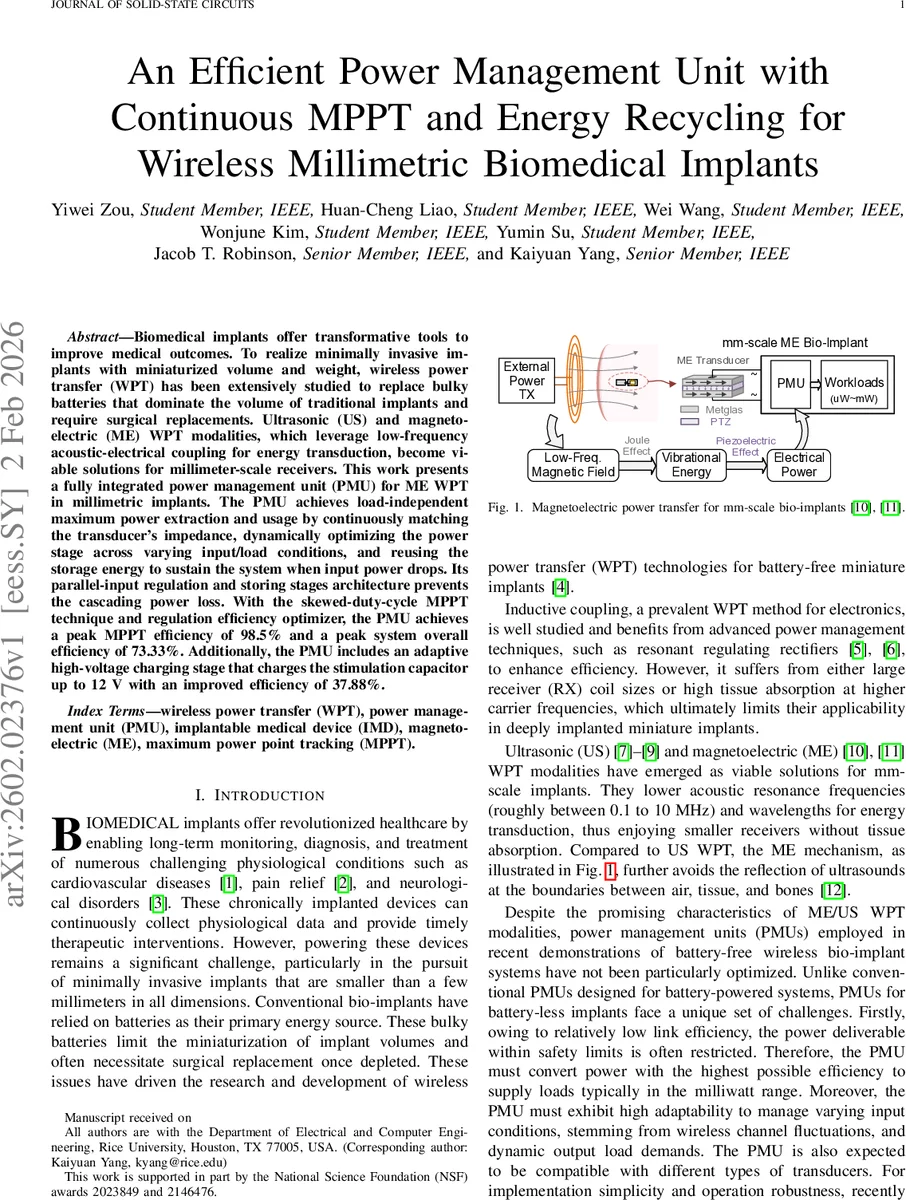
This paper presents a fully integrated power‑management unit (PMU) designed for millimeter‑scale biomedical implants powered by magnetoelectric (ME) wireless power transfer (WPT). The authors first model the ME transducer with a Butterworth‑Van Dyke equivalent circuit, extracting parameters such as series resistance, inductance, and parallel capacitance from impedance measurements. Using this model they derive an analytical expression for the output power of a full‑bridge rectifier as a function of the rectifier duty cycle (θ). By differentiating the power expression, they obtain the condition for the maximum‑power point (MPP) and implement a continuous “skewed‑duty‑cycle” MPPT (SD‑MPPT) that adjusts θ in real time without interrupting power delivery. This approach yields an MPPT efficiency of 98.5 %.
To avoid the cascading losses typical of conventional rectifier‑DC‑DC‑LDO chains, the PMU adopts a parallel‑input architecture: the rectifier output feeds both a regulation stage (REG) and a storage stage (STO) simultaneously. A miniature on‑chip super‑capacitor serves as an energy buffer, smoothing out power fluctuations caused by body motion and allowing excess power at the MPP to be recycled.
A real‑time regulation‑efficiency optimizer monitors input and output voltages and dynamically selects the conversion ratio of the REG stage (LDO or buck‑boost) to keep its own loss minimal. This regulator‑efficiency optimizer contributes to a system‑wide efficiency of 73.33 % at the transducer’s MPP.
For neuro‑stimulation applications, the PMU includes an adaptive high‑voltage charging block that can raise a stimulation capacitor to 12 V. By varying the conversion ratio according to the instantaneous input voltage, the charger achieves a 37.88 % efficiency, more than double that of a conventional fixed‑ratio boost converter.
The entire solution is fabricated in a 5 × 2 × 0.2 mm³ tri‑layer ME transducer together with on‑chip capacitors (1 µF for REG and STO, 100 nF for decoupling) and packaged in a 7 × 3.8 × 2.4 mm³ implant. Experimental results confirm the analytical models, demonstrate continuous operation under varying load and frequency conditions, and validate wireless communication, electrical stimulation, and signal recording capabilities.
In summary, the work delivers a compact, high‑efficiency PMU that continuously tracks the MPP, minimizes conversion loss through parallel regulation and storage, recycles excess energy, and provides adaptive high‑voltage charging—addressing the key power challenges of ultra‑miniature, battery‑free biomedical implants.
Comments & Academic Discussion
Loading comments...
Leave a Comment