Geometric properties and flux of locally conformally symplectic diffeomorphisms
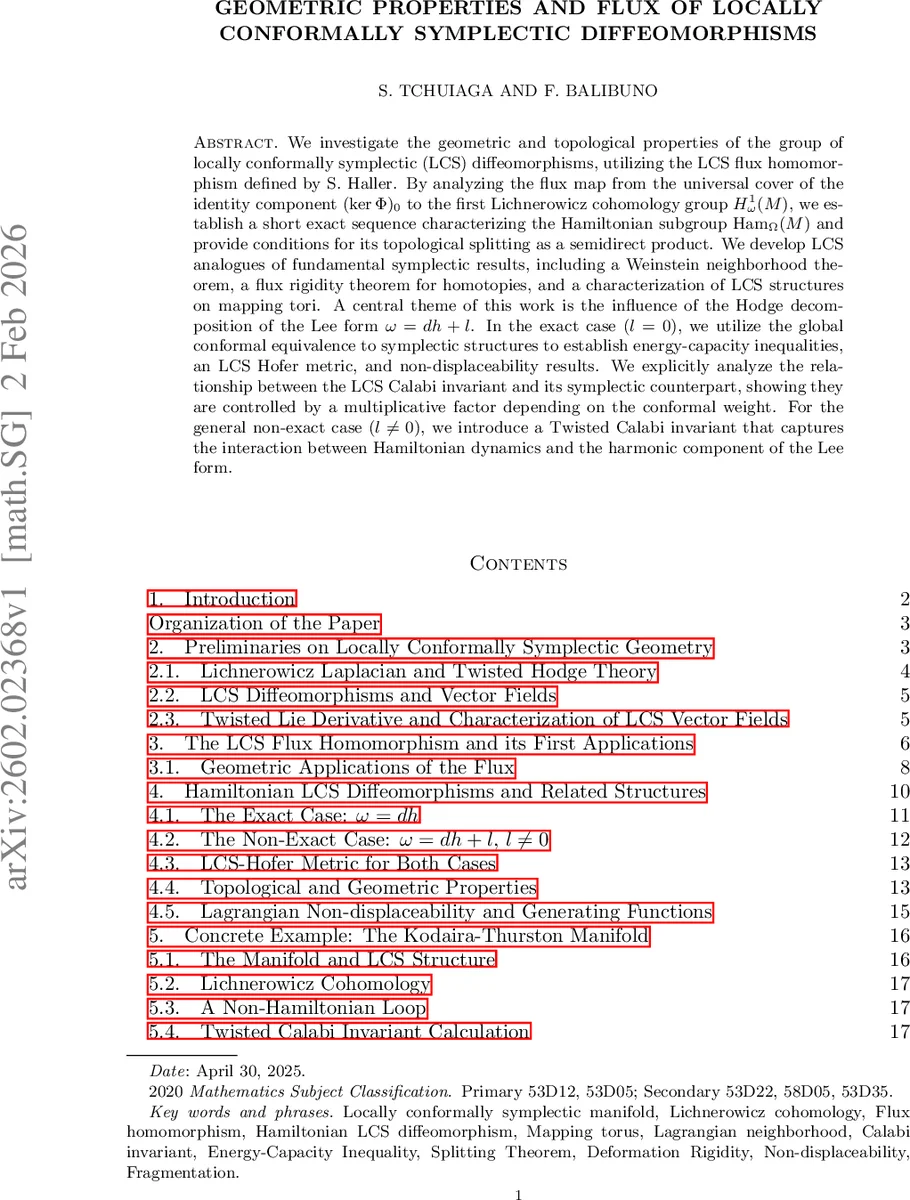
We investigate the geometric and topological properties of the group of locally conformally symplectic (LCS) diffeomorphisms, utilizing the LCS flux homomorphism defined by S. Haller. By analyzing the flux map from the universal cover of the identity component $(\ker Φ)_0$ to the first Lichnerowicz cohomology group $H_ω^1(M)$, we establish a short exact sequence characterizing the Hamiltonian subgroup $\Ham_Ω(M)$ and provide conditions for its topological splitting as a semidirect product. We develop LCS analogues of fundamental symplectic results, including a Weinstein neighborhood theorem, a flux rigidity theorem for homotopies, and a characterization of LCS structures on mapping tori. A central theme of this work is the influence of the Hodge decomposition of the Lee form $ω= dh + l$. In the exact case ($l=0$), we utilize the global conformal equivalence to symplectic structures to establish energy-capacity inequalities, an LCS Hofer metric, and non-displaceability results. We explicitly analyze the relationship between the LCS Calabi invariant and its symplectic counterpart, showing they are controlled by a multiplicative factor depending on the conformal weight. For the general non-exact case ($l \neq 0$), we introduce a Twisted Calabi invariant that captures the interaction between Hamiltonian dynamics and the harmonic component of the Lee form.
💡 Research Summary
The paper develops a comprehensive theory of locally conformally symplectic (LCS) diffeomorphisms, focusing on the LCS flux homomorphism introduced by S. Haller. An LCS manifold (M, Ω, ω) consists of a non‑degenerate 2‑form Ω and a closed 1‑form ω (the Lee form) satisfying dΩ = − ω∧Ω. The authors begin by recalling the Hodge decomposition of the Lee form, ω = dh + l, where h is a smooth function and l is a harmonic 1‑form. This decomposition separates the “exact” case (l = 0) – where the LCS structure is globally conformally symplectic via Ω_h = e^{h}Ω – from the genuinely LCS “non‑exact” case (l ≠ 0), in which the harmonic component represents a non‑trivial de Rham cohomology class.
Section 2 introduces the Morse‑Novikov (or Lichnerowicz) differential d_ω = d + ω∧· and its adjoint, leading to the twisted Laplacian Δ_ω. The twisted Hodge decomposition Ω^p(M) = d_ωΩ^{p−1} ⊕ d_ω^*Ω^{p+1} ⊕ H^p_ω(M) provides a canonical harmonic representative for each class in the Lichnerowicz cohomology H^p_ω(M). In particular, H^1_ω(M) is the target of the LCS flux map.
Section 3 reviews Haller’s flux homomorphism Ψ : \widetilde{(ker Φ)}_0 → H^1_ω(M), where (ker Φ)_0 is the identity component of the subgroup of LCS diffeomorphisms whose infinitesimal conformal factor satisfies a certain linear condition. For a path {g_t} generated by X_t∈ker Φ, the flux is the class
Comments & Academic Discussion
Loading comments...
Leave a Comment