PRISMS. UNCOVER-26185, a metal-poor SFG at z=10.05 with no evidence for a X-ray-luminous AGN
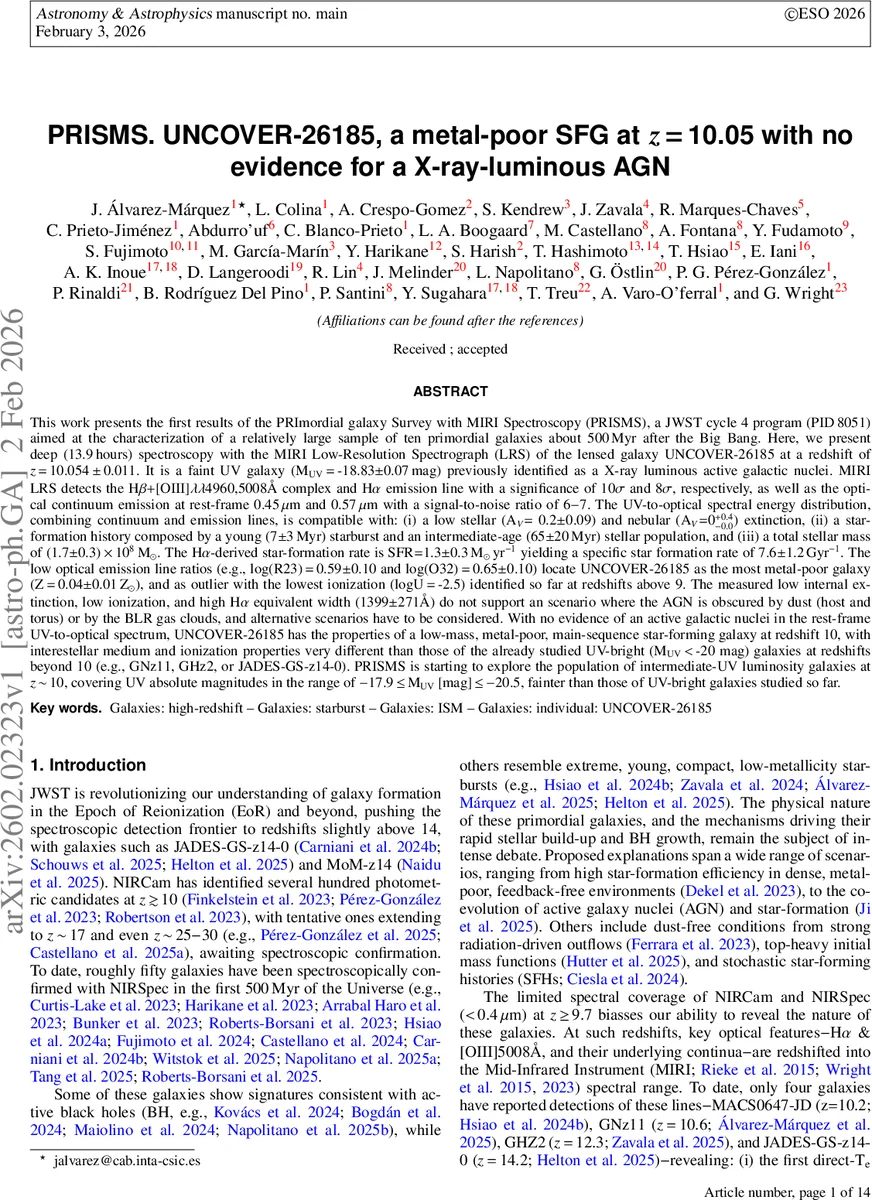
This work presents the first results of the PRImordial galaxy Survey with MIRI Spectroscopy (PRISMS), a JWST cycle 4 program (PID 8051) aimed at the characterization of a relatively large sample of ten galaxies about 500 Myr after the Big Bang. Here, we present deep (13.9 hours) spectroscopy with the MIRI LRS of the lensed galaxy UNCOVER-26185 at a redshift of z=10.054. It is a faint UV galaxy (UV absolut magnitude of -18.83 mag) previously identified as a X-ray luminous AGN. MIRI LRS detects the H$β$+[OIII]4960,5008 complex and H$α$ emission line with a significance of 10$σ$ and 8$σ$, respectively, as well as the optical continuum emission at rest-frame 0.45 $μ$m and 0.57 $μ$m with a signal-to-noise ratio of 6-7. The UV-to-optical spectral energy distribution, combining continuum and emission lines, is compatible with: (i) a low stellar (A$V$= 0.2) and nebular (A$V$=0.0) extinction, (ii) a SFH composed by a young (7 Myr) starburst and an intermediate-age (65 Myr) stellar population, and (iii) a total stellar mass of 1.7$\times$10$^{8}$ M${\odot}$. The H$α$-derived star-formation rate is 1.3 M${\odot}$ yr$^{-1}$. The low optical emission line ratios locate UNCOVER-26185 as the most metal-poor (Z = 0.04 Z$_{\odot}$), and as outlier with the lowest ionization (logU=-2.5) galaxy identified so far at redshifts above 9. With no evidence of an active galactic nuclei in the rest-frame UV-to-optical spectrum, UNCOVER-26185 has the properties of a metal-poor, main-sequence star-forming galaxy at redshift 10, with ISM and ionization properties very different than those of the already studied UV-bright galaxies at redshifts beyond 10. PRISMS is starting to explore the population of intermediate-UV luminosity galaxies at z=10, covering UV absolute magnitudes in the range of -17.9 to -20.5, fainter than those of UV-bright galaxies studied so far.
💡 Research Summary
This paper presents the first results of the PRImordial galaxy Survey with MIRI Spectroscopy (PRISMS), a JWST Cycle 4 program (PID 8051) designed to study a sample of ten galaxies at the epoch roughly 500 Myr after the Big Bang. The focus is on the lensed galaxy UNCOVER‑26185 (hereafter U26185), which lies at a spectroscopic redshift of z = 10.054 ± 0.011. Earlier NIRSpec observations and a strong Chandra X‑ray detection had suggested that the source might host a heavily obscured, X‑ray‑luminous active galactic nucleus (AGN). To test this hypothesis, the authors obtained 13.9 hours (≈ 49 000 s) of deep spectroscopy with the Mid‑Infrared Instrument (MIRI) Low‑Resolution Spectrograph (LRS), covering 4.85–14 µm and thus accessing the rest‑frame optical regime (≈ 0.45–0.57 µm) at this redshift.
Observations and Data Reduction
The MIRI LRS data were processed with the JWST calibration pipeline (v1.20.2) and then refined with a series of custom steps: wavelength masking, master background subtraction, residual background modeling (row‑by‑row polynomial fitting), and sigma‑clipping to remove cosmic‑ray artifacts. Because the target is not detected in individual exposures, a global background model was essential to recover the faint emission lines. The final 1‑D spectrum was extracted with a 0.44″ aperture and aperture‑corrected assuming a point‑source profile.
Cross‑instrument Flux Calibration
To place the spectra on a common absolute scale, the authors first normalized the NIRSpec R100 spectrum to NIRCam photometry, deriving a factor of 0.75 ± 0.09. The MIRI LRS spectrum was then matched to the normalized NIRSpec spectrum over the overlapping 4.85–5.30 µm region, yielding a scaling factor of 1.24 ± 0.27. These normalizations account for slit‑loss uncertainties; absolute calibration errors (≈ 1–2 % for NIRCam, 15 % for NIRSpec, 3–8 % for MIRI) are not included in the quoted uncertainties.
Spectral Measurements
The combined spectrum shows clear detections of the Hβ +
Comments & Academic Discussion
Loading comments...
Leave a Comment