A new Energy Equation Derivation for the Shallow Water Linearized Moment Equations
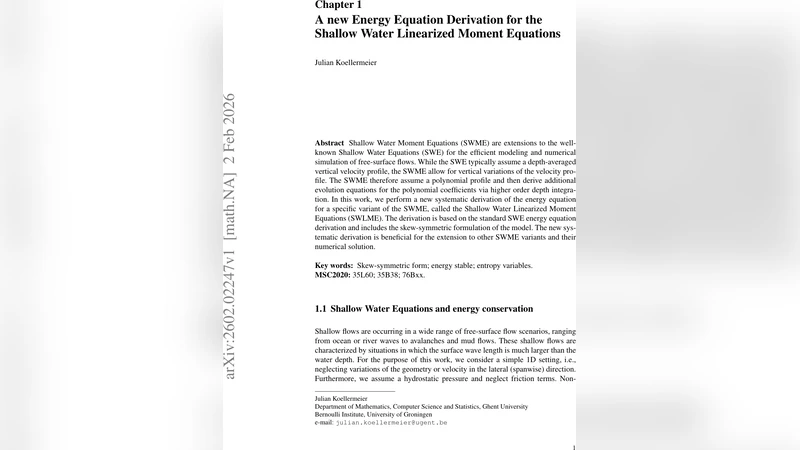
Shallow Water Moment Equations (SWME) are extensions to the well-known Shallow Water Equations (SWE) for the efficient modeling and numerical simulation of free-surface flows. While the SWE typically assume a depth-averaged vertical velocity profile, the SWME allow for vertical variations of the velocity profile. The SWME therefore assume a polynomial profile and then derive additional evolution equations for the polynomial coefficients via higher order depth integration. In this work, we perform a new systematic derivation of the energy equation for a specific variant of the SWME, called the Shallow Water Linearized Moment Equations (SWLME). The derivation is based on the standard SWE energy equation derivation and includes the skew-symmetric formulation of the model. The new systematic derivation is beneficial for the extension to other SWME variants and their numerical solution.
💡 Research Summary
The paper addresses a fundamental gap in the modeling of free‑surface flows: traditional shallow‑water equations (SWE) assume a depth‑averaged velocity and therefore cannot capture vertical variations of the flow field. Shallow‑water moment equations (SWME) overcome this limitation by representing the vertical velocity profile as a polynomial and deriving additional evolution equations for the polynomial coefficients (moments) through higher‑order depth integration. The authors focus on a particular linearized variant, the Shallow‑Water Linearized Moment Equations (SWLME), and present a completely systematic derivation of its energy equation.
The derivation starts from the well‑known energy balance for the SWE, which is obtained by multiplying the momentum equations by the velocity, adding the gravitational potential term, and arranging the result into a conservation law ∂tE + ∇·F = 0. The authors then substitute the polynomial expansion of the vertical velocity u(z)=∑_{k=0}^N α_k φ_k(z) into the SWLME, where α_k are the moment variables and φ_k(z) are prescribed basis functions. By performing depth integration of the continuity and momentum equations weighted with the same basis functions, they obtain a coupled system of N+1 equations: one for the depth‑averaged mass and N equations for the higher‑order moments.
A key technical contribution is the introduction of a skew‑symmetric formulation of the moment system. The coefficient matrices are arranged such that A = –A^T, which guarantees that the inter‑modal energy exchange terms cancel pairwise when the energy balance is formed. The authors explicitly compute the inner product of each moment equation with its associated velocity component, sum over all modes, and show that all cross‑terms vanish because of the skew‑symmetry. Consequently, the total energy density E consists of the usual kinetic term (½ h |ū|²) plus additional quadratic contributions from the higher‑order moments, and the flux F contains the classical gravity‑wave flux together with moment‑dependent corrections.
The resulting energy equation retains the same conservative structure as the SWE but now includes the influence of vertical shear through the extra moment terms. This structure is crucial for numerical schemes: it provides a clear diagnostic for energy conservation, helps to design stable discretizations, and prevents non‑physical energy growth that can arise from poorly treated higher‑order modes.
The paper also discusses the assumptions required for the derivation: the polynomial basis must be complete up to the chosen order N, the flow remains hydrostatic in the vertical pressure distribution, and appropriate boundary conditions (no‑slip at the bottom, free‑surface kinematic condition) are imposed. Under these conditions the energy balance holds exactly at the continuous level.
Finally, the authors argue that the systematic approach is readily extensible. For other SWME variants—such as those employing non‑polynomial vertical profiles, nonlinear moment coupling, or variable‑order expansions—the same skew‑symmetric strategy can be applied by redefining the weighting functions and ensuring the resulting coefficient matrices remain skew‑symmetric. This opens the door to a unified theoretical framework for energy‑consistent high‑order shallow‑water models.
In conclusion, the paper delivers a rigorous, transparent derivation of the energy equation for SWLME, clarifies the role of skew‑symmetry in guaranteeing energy conservation, and provides a blueprint for extending the methodology to more complex moment‑based shallow‑water formulations. The work is poised to improve the reliability of numerical simulations that require accurate representation of vertical shear while preserving the fundamental physical invariant of total energy.
Comments & Academic Discussion
Loading comments...
Leave a Comment