New polar-finite forms of generalized Euler identities for $A_{1}^{(1)}$-string functions and mock theta conjecture-like identities
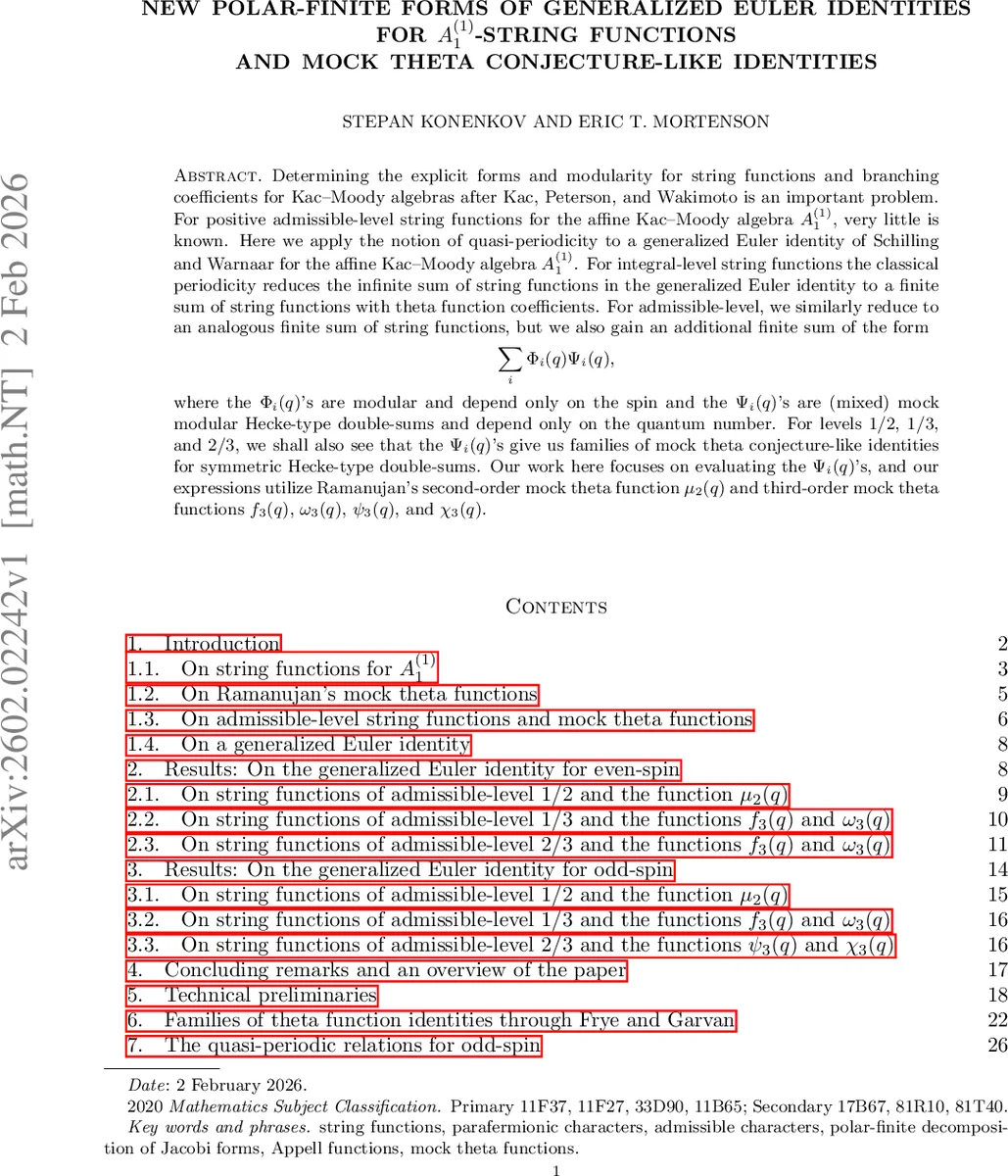
Determining the explicit forms and modularity for string functions and branching coefficients for Kac–Moody algebras after Kac, Peterson, and Wakimoto is an important problem. For positive admissible-level string functions for the affine Kac–Moody algebra $A_{1}^{(1)}$, very little is known. Here we apply the notion of quasi-periodicity to a generalized Euler identity of Schilling and Warnaar for the affine Kac–Moody algebra $A_{1}^{(1)}$. For integral-level string functions the classical periodicity reduces the infinite sum of string functions in the generalized Euler identity to a finite sum of string functions with theta function coefficients. For admissible-level, we similarly reduce to an analogous finite sum of string functions, but we also gain an additional finite sum of the form \begin{equation*} \sum_{i}Φ_{i}(q)Ψ_{i}(q), \end{equation*} where the $Φ_i(q)$’s are modular and depend only on the spin and the $Ψ_{i}(q)$’s are (mixed) mock modular Hecke-type double-sums and depend only on the quantum number. For levels $1/2$, $1/3$, and $2/3$, we shall also see that the $Ψ_{i}(q)$’s give us families of mock theta conjecture-like identities for symmetric Hecke-type double-sums. Our work here focuses on evaluating the $Ψ_{i}(q)$’s, and our expressions utilize Ramanujan’s second-order mock theta function $μ_2(q)$ and third-order mock theta functions $f_{3}(q)$, $ω_3(q)$, $ψ_{3}(q)$, and $χ_3(q)$.
💡 Research Summary
The paper addresses a long‑standing gap in the explicit description and modularity of string functions for the affine Kac–Moody algebra A₁^{(1)} at positive admissible (fractional) levels. While the theory for integral levels is classical—thanks to the work of Kac, Peterson, and Wakimoto—very little is known for admissible levels such as ½, ⅓, and ⅔. The authors build on the generalized Euler identity of Schilling and Warnaar and introduce the concept of quasi‑periodicity to this setting.
For integral levels the ordinary periodicity C_{N,m,ℓ}(q)=C_{N,m+2N,ℓ}(q) collapses the infinite sum appearing in the generalized Euler identity to a finite sum of string functions multiplied by theta‑function coefficients. The main novelty of the paper is that an analogous reduction works for admissible levels, but an extra finite sum of the form
∑_{i} Φ_i(q) Ψ_i(q)
appears. Here each Φ_i(q) is a genuine modular form depending only on the spin ℓ, while each Ψ_i(q) is a (mixed) mock‑modular Hecke‑type double sum depending only on the quantum number m. By exploiting the quasi‑periodic relations derived in earlier work of Borozenets and Mortenson, the authors obtain explicit expressions for Φ_i and Ψ_i for the three admissible levels ½, ⅓, and ⅔, and for both even and odd spin.
The Ψ_i(q) are identified with Ramanujan’s mock theta functions: the second‑order function μ₂(q) and the third‑order functions f₃(q), ω₃(q), ψ₃(q), and χ₃(q). The identification proceeds via the Hecke‑type double‑sum representation
f_{a,b,c}(x,y;q)=∑_{r,s≥0} (−1)^{r+s} x^{r} y^{s} q^{a r²+ b rs+ c s²}
and the Hickerson–Mortenson theorem that expands such double sums into Appell–Lerch series m(x,z;q) and theta functions. The Appell–Lerch series are precisely the building blocks of Ramanujan’s mock theta functions, and the authors use Zwegers’ theory of mock modularity to write the Ψ_i as linear combinations of μ₂, f₃, ω₃, ψ₃, χ₃ together with explicit theta‑quotients.
The paper is organized as follows. Section 1 reviews the necessary background on string functions, theta functions, q‑Pochhammer symbols, and Ramanujan’s mock theta functions. Section 2 presents the main results for even spin: Theorems 2.4, 2.7, 2.8, 2.11–2.14 give the explicit polar‑finite decompositions for levels ½, ⅓, and ⅔ respectively, each displaying the Φ·Ψ structure. Section 3 treats odd spin, with analogous theorems (3.5, 3.7, 3.10). Sections 4 and 5 contain technical preliminaries and a collection of theta‑function identities (Fry–Garvan) needed for the proofs. Sections 6 and 7 develop the quasi‑periodic relations for even and odd spin, respectively, and show how they lead to the polar‑finite expansions. Sections 10 and 11 extract the mock theta conjecture‑like identities: for each admissible level the Ψ_i are rewritten as symmetric Hecke‑type double sums, and then identified with μ₂, f₃, ω₃, ψ₃, χ₃. This yields twelve new families of identities, extending the earlier results of Borozenets–Mortenson (which covered only the ½‑level case).
The authors also discuss the modular properties of the Φ_i: they are explicit products of Dedekind eta‑functions and Jacobi theta‑functions, thus transforming as modular forms of specific weight and level. The Ψ_i, being mock modular, possess non‑holomorphic shadows given by unary theta series, in accordance with Zwegers’ completion. Consequently, the full string function χ_{N,ℓ}(z;q) is a meromorphic Jacobi form whose polar part is captured by the Ψ_i and whose finite part is a modular linear combination of theta functions.
In the concluding section the authors highlight several directions for future work: (i) extending the method to higher‑order mock theta functions (fifth, seventh order), (ii) investigating connections with logarithmic parafermionic vertex algebras and their representation theory, and (iii) applying the polar‑finite decompositions to compute characters of logarithmic conformal field theories and to study quantum modular phenomena. Overall, the paper provides a comprehensive framework that unifies quasi‑periodicity, polar‑finite decomposition, and mock modularity, delivering explicit and verifiable formulas for admissible‑level string functions of A₁^{(1)}.
Comments & Academic Discussion
Loading comments...
Leave a Comment