Gromov hyperbolic domains in Minkowski space
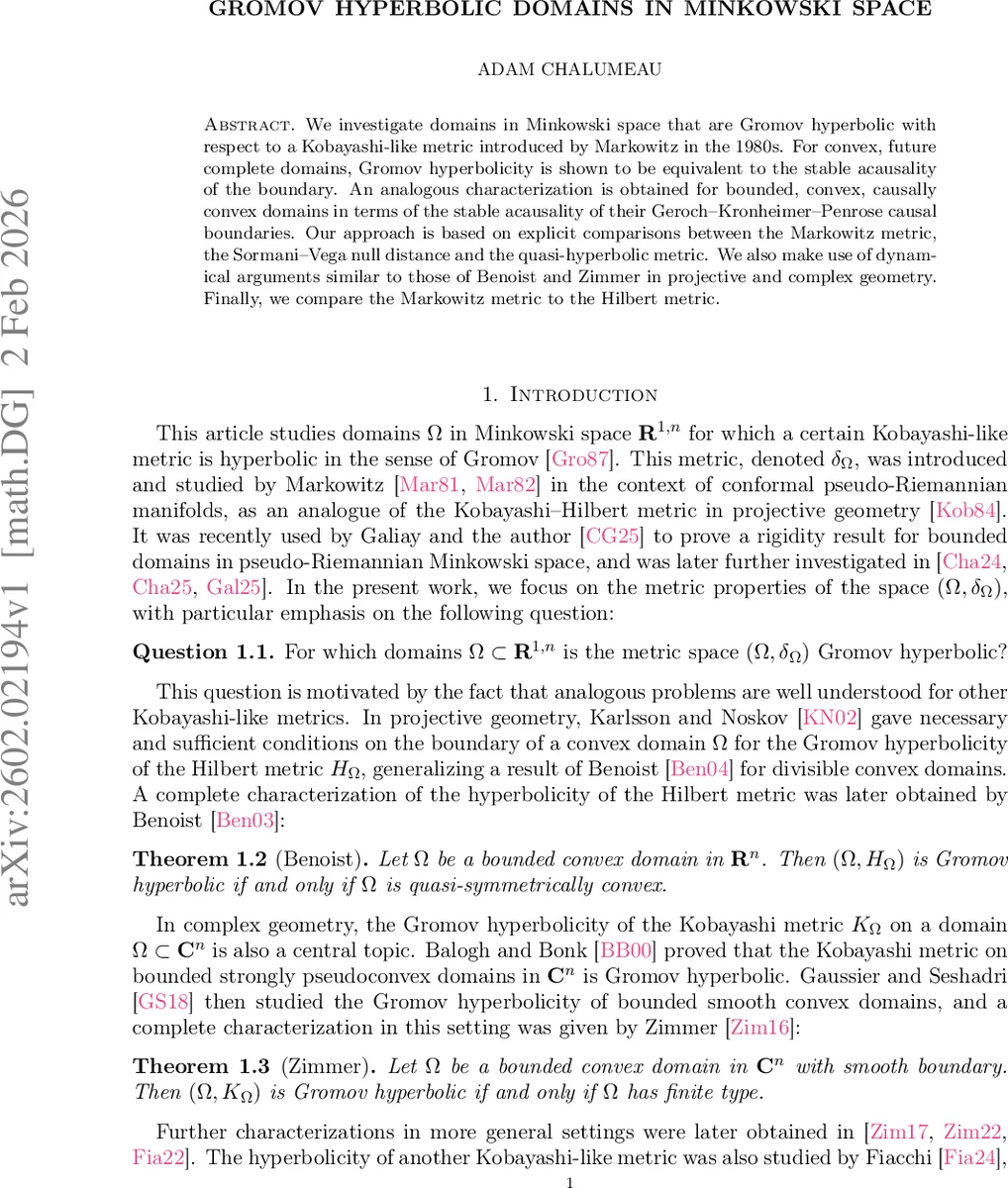
We investigate domains in Minkowski space that are Gromov hyperbolic with respect to a Kobayashi-like metric introduced by Markowitz in the 1980s. For convex, future complete domains, Gromov hyperbolicity is shown to be equivalent to the stable acausality of the boundary. An analogous characterization is obtained for bounded, convex, causally convex domains in terms of the stable acausality of their Geroch–Kronheimer–Penrose causal boundaries. Our approach is based on explicit comparisons between the Markowitz metric, the Sormani–Vega null distance and the quasi-hyperbolic metric. We also make use of dynamical arguments similar to those of Benoist and Zimmer in projective and complex geometry. Finally, we compare the Markowitz metric to the Hilbert metric.
💡 Research Summary
The paper investigates when domains Ω in Minkowski space ℝ¹,ⁿ equipped with the Markowitz distance δΩ are Gromov‑hyperbolic. The Markowitz distance, introduced by Markowitz in the 1980s, is defined via light‑like chains and a logarithmic cross‑ratio on the interval (−1,1). Although it shares symmetry and the triangle inequality with a metric, it may fail to be definite unless every light‑like line in Ω is complete.
The central question is: for which Ω does (Ω, δΩ) become a Gromov‑hyperbolic metric space? The authors answer this in two principal settings.
Theorem A treats bounded, convex, causally convex domains. Such a domain has two canonical causal boundaries, the future boundary ∂⁺ᶜΩ and the past boundary ∂⁻ᶜΩ. The authors introduce the notion of stable acausality: a set is stably acausal if any two of its points can be joined by a space‑like segment even after a small perturbation of the flat metric. They prove that (Ω, δΩ) is Gromov‑hyperbolic iff both ∂⁺ᶜΩ and ∂⁻ᶜΩ are stably acausal. This result is striking because, unlike the Hilbert metric, the boundary need not be C¹; indeed, many non‑smooth examples satisfy the condition (Corollary 10.1).
Theorem B addresses convex, future‑complete domains that contain no complete light‑like line. In this unbounded setting, the whole boundary ∂Ω must be stably acausal for δΩ to be Gromov‑hyperbolic, and this condition is also necessary. The theorem yields concrete examples such as the Einstein–de Sitter half‑space, whose Markowitz metric is bi‑Lipschitz equivalent to real hyperbolic space Hⁿ⁺¹. Conversely, any future‑complete domain whose boundary contains a light‑like segment fails to be hyperbolic (e.g., regular domains).
A major technical tool is the comparison with the null distance introduced by Sormani–Vega. For a time function τ, the null distance (\hat d_{ln(τ_-/τ_+)}) measures the logarithmic ratio of τ along causal curves. The authors show that, under the hypotheses of Theorems A and B, causal curves are (2,0)‑quasi‑geodesics for δΩ, and the null distance is quasi‑isometric to δΩ (Section 6). This comparison yields two important consequences: (i) any Gromov‑hyperbolic domain cannot contain broken light‑like segments in its boundary (Theorem 7.3), and (ii) the same hyperbolicity criteria hold when δΩ is replaced by the null distance (Theorem C).
For the “if” direction, the paper leverages the quasi‑hyperbolic metric kΩ, whose Gromov‑hyperbolicity is well understood through the work of Bonk–Koskela–Heinonen and Balogh–Buckley. The authors prove quantitative equivalence between δΩ and kΩ when the boundary is stably acausal (Theorem 4.1). Consequently, hyperbolicity of kΩ transfers to δΩ, completing the proof of Theorems A and B.
Additional results include Theorem D, which states that a Gromov‑hyperbolic Ω cannot be C‑maximal (i.e., it admits a non‑trivial Cauchy extension), and a discussion of how hyperbolic domains are not dual‑convex in Zimmer’s sense.
Finally, the paper compares the Markowitz metric with the classical Hilbert metric. While the Hilbert metric requires a C¹ boundary for hyperbolicity (Benoist, Karlsson–Noskova), the Markowitz metric does not; in dimension two the two metrics are not comparable at all, underscoring a fundamental difference between Lorentzian and projective geometries.
Methodologically, the authors overcome the lack of explicit Markowitz geodesics by (a) using null‑distance comparisons to produce quasi‑geodesics, (b) applying dynamical arguments reminiscent of Benoist and Zimmer to enforce stable acausality, and (c) establishing quantitative bounds linking δΩ to both the null distance and the quasi‑hyperbolic metric.
In summary, the paper provides a complete geometric characterization of Gromov‑hyperbolicity for the Markowitz distance on a broad class of Minkowski domains, reveals deep connections with causal boundary theory, and situates the Markowitz metric within the broader landscape of Lorentzian, null, and projective distance geometries. These insights open avenues for extending hyperbolicity criteria to more general Lorentzian manifolds, non‑convex domains, and spacetimes with curvature.
Comments & Academic Discussion
Loading comments...
Leave a Comment