Relative Rota-Baxter operators and crossed homomorphisms on Lie 2-groups
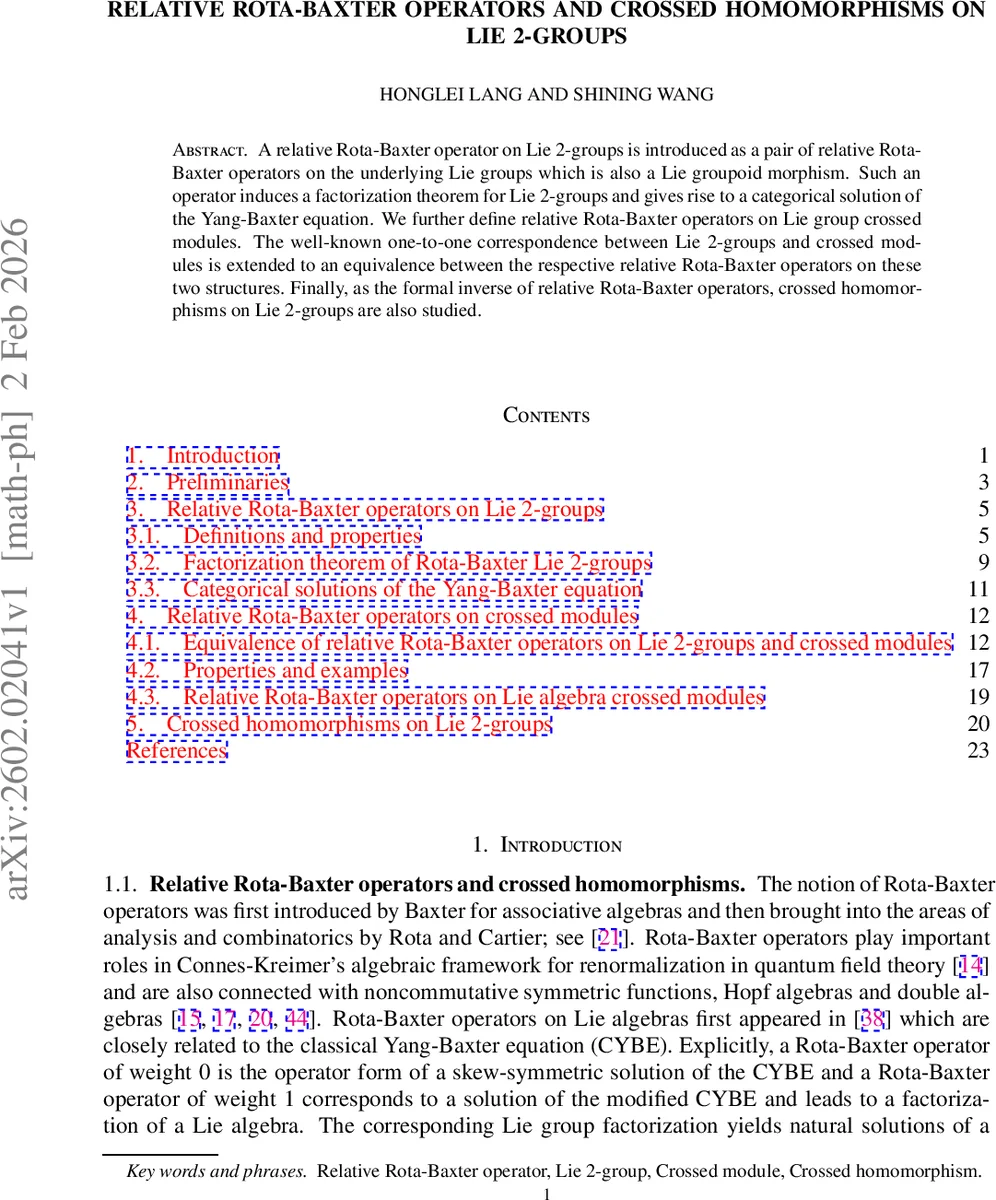
A relative Rota-Baxter operator on Lie 2-groups is introduced as a pair of relative Rota-Baxter operators on the underlying Lie groups which is also a Lie groupoid morphism. Such an operator induces a factorization theorem for Lie 2-groups and gives rise to a categorical solution of the Yang-Baxter equation. We further define relative Rota-Baxter operators on Lie group crossed modules. The well-known one-to-one correspondence between Lie 2-groups and crossed modules is extended to an equivalence between the respective relative Rota-Baxter operators on these two structures. Finally, as the formal inverse of relative Rota-Baxter operators, crossed homomorphisms on Lie 2-groups are also studied.
💡 Research Summary
The paper introduces and develops the theory of relative Rota‑Baxter operators on Lie 2‑groups, extending the well‑known concepts from Lie groups and Lie algebras to the categorical setting of strict Lie 2‑groups. A relative Rota‑Baxter operator on a Lie 2‑group (P\rightrightarrows P_{0}) with respect to a Lie 2‑group action ((\phi,\phi_{0})) on another Lie 2‑group (Q\rightrightarrows Q_{0}) is defined as a pair of smooth maps ((B,B_{0})) where (B:Q\to P) and (B_{0}:Q_{0}\to P_{0}) are ordinary relative Rota‑Baxter operators on the underlying Lie groups and, simultaneously, ((B,B_{0})) forms a Lie groupoid morphism from (Q\rightrightarrows Q_{0}) to (P\rightrightarrows P_{0}). This definition (Definition 3.3) captures three compatibility conditions: (i) the group‑level Rota‑Baxter identities, (ii) the object‑level identities, and (iii) preservation of source, target, and multiplication in the groupoid.
The authors prove that such a pair ((B,B_{0})) can be characterized by the graph (\operatorname{Gr}(B)) being a Lie 2‑subgroup of the semi‑direct product Lie 2‑group (Q\rtimes P\rightrightarrows Q_{0}\rtimes P_{0}) (Theorem 3.9). Consequently, a “descendant” Lie 2‑group (Q_{B}) is constructed, whose multiplication is twisted by the action (\phi) and the operator (B). This mirrors the classical construction of a descendant Lie group from a relative Rota‑Baxter operator on a Lie group.
A major result is the factorization theorem for Lie 2‑groups (Theorem 3.17). When a relative Rota‑Baxter operator exists, the original Lie 2‑group can be factorized as a product of two Lie 2‑subgroups, generalizing the factorization of Lie groups obtained from Rota‑Baxter operators of weight 1. Moreover, the operator (\widehat{B}) induced on the semi‑direct product provides a categorical solution of the Yang‑Baxter equation (Theorem 3.18). This yields a “categorical R‑matrix” living in the 2‑category of Lie groupoids, extending set‑theoretic and Hopf‑algebraic solutions.
The paper then turns to Lie group crossed modules, which are known to be equivalent to strict Lie 2‑groups. A relative Rota‑Baxter operator on a crossed module ((G_{1}\xrightarrow{\mu}G_{0})) is defined analogously (Definition 4.2) as a pair of maps ((B_{1},B_{0})) satisfying the relative Rota‑Baxter identities on the two groups and commuting with the crossed module structure. Theorem 4.6 establishes a bijection between relative Rota‑Baxter operators on a Lie 2‑group and those on its associated crossed module, showing that the categorical picture and the algebraic picture are fully compatible. The infinitesimal counterpart (Theorem 4.18) translates these results to Lie 2‑algebras and Lie algebra crossed modules, confirming that the construction respects differentiation.
Finally, the authors study crossed homomorphisms on Lie 2‑groups and crossed modules, interpreting them as formal inverses of relative Rota‑Baxter operators. Theorem 5.6 proves that given a relative Rota‑Baxter operator ((B,B_{0})), there exists a crossed homomorphism (\psi) such that (\psi\circ B=\mathrm{id}) and (B\circ\psi=\mathrm{id}). This mirrors the classical situation where a bijective Rota‑Baxter operator’s inverse is a crossed homomorphism, and it provides a new tool for constructing representations of mapping class groups and for analyzing Hopf‑Galois structures.
Throughout the paper, numerous examples illustrate the theory: trivial actions yielding ordinary Lie 2‑group homomorphisms, linear Lie 2‑groups (vector spaces) with additive actions, decompositions of Lie 2‑groups into sub‑2‑groups, and constructions of new Rota‑Baxter operators on semi‑direct product 2‑groups. The examples demonstrate how the abstract definitions translate into concrete algebraic data.
In summary, the work achieves three intertwined goals: (1) it lifts the concept of relative Rota‑Baxter operators to the 2‑categorical level, (2) it shows that this lift is compatible with the well‑established equivalence between Lie 2‑groups and crossed modules, and (3) it identifies crossed homomorphisms as the natural inverses of these operators. These contributions enrich the toolbox for studying higher‑dimensional symmetries, provide new categorical solutions to the Yang‑Baxter equation, and open avenues for applications in quantum groups, higher gauge theory, and the cohomology of 2‑group extensions.
Comments & Academic Discussion
Loading comments...
Leave a Comment