From Knowing to Doing Precisely: A General Self-Correction and Termination Framework for VLA models
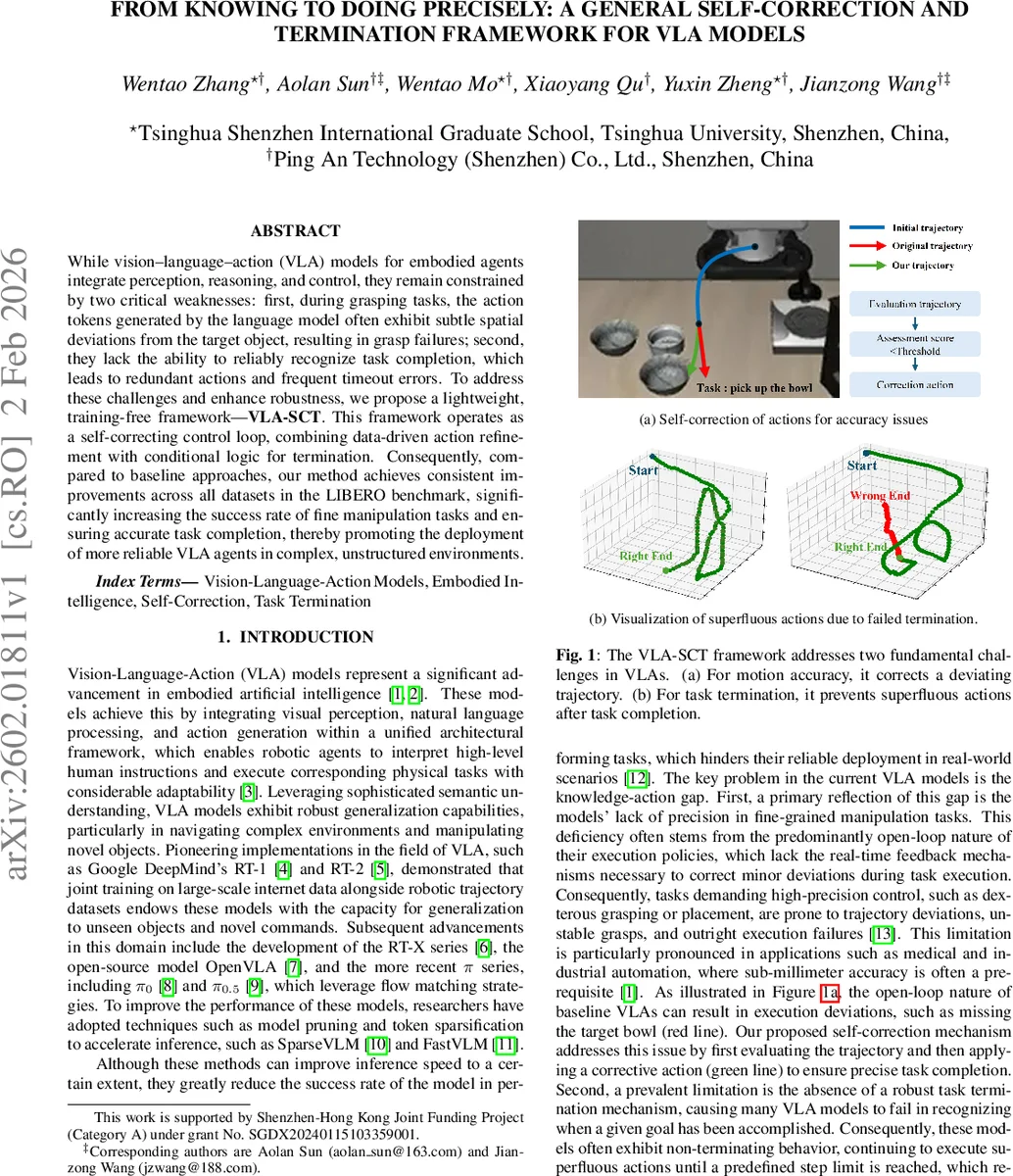
While vision-language-action (VLA) models for embodied agents integrate perception, reasoning, and control, they remain constrained by two critical weaknesses: first, during grasping tasks, the action tokens generated by the language model often exhibit subtle spatial deviations from the target object, resulting in grasp failures; second, they lack the ability to reliably recognize task completion, which leads to redundant actions and frequent timeout errors. To address these challenges and enhance robustness, we propose a lightweight, training-free framework, VLA-SCT. This framework operates as a self-correcting control loop, combining data-driven action refinement with conditional logic for termination. Consequently, compared to baseline approaches, our method achieves consistent improvements across all datasets in the LIBERO benchmark, significantly increasing the success rate of fine manipulation tasks and ensuring accurate task completion, thereby promoting the deployment of more reliable VLA agents in complex, unstructured environments.
💡 Research Summary
The paper addresses two critical shortcomings of current vision‑language‑action (VLA) models for embodied agents: subtle spatial deviations during fine‑grasping tasks and the inability to reliably detect task completion, which often leads to redundant actions and time‑out failures. To remedy these issues without additional training, the authors introduce VLA‑SCT, a lightweight, inference‑only framework that sits on top of any existing VLA model. VLA‑SCT implements a three‑stage feedback loop: (1) Trajectory Evaluation, which quantifies the initial motion plan using efficiency (inverse curvature and torsion), postural stability (geodesic distance on SO(3)), and smoothness (minimum‑jerk based jerk cost); (2) Grasp Perturbation, which activates when the trajectory quality falls below a threshold. It builds a weighted distribution of historically successful actions using an RBF similarity between the current visual feature vector and stored successes, computes a weighted mean and covariance, and generates a corrective action comprising a deterministic pull toward the mean, anisotropic noise sampled from the regularized covariance, and isotropic Gaussian noise. The resulting action is clipped to respect robot limits. (3) Termination Detection, which compares the current camera image to a memory bank of successful visual states using Pearson correlation, converting the correlation to a similarity score. If the score exceeds a tunable threshold, a stop signal is issued. Experiments on the LIBERO benchmark using OpenVLA‑7B as the base model show that VLA‑SCT raises the average success rate from 75.45 % to 81.55 % (a 6.1 % absolute gain) while achieving a 1.12× speed‑up. Ablation studies confirm that each module contributes positively, with the full system reaching 91.20 % success on the spatial suite, the highest among tested methods. Sensitivity analysis identifies a trajectory‑quality threshold of 0.75 as optimal, balancing intervention frequency and performance. Overall, VLA‑SCT demonstrates that a training‑free, modular control layer can substantially improve both precision and reliability of VLA agents, making them more suitable for real‑world, unstructured environments where sub‑millimeter accuracy and timely termination are essential.
Comments & Academic Discussion
Loading comments...
Leave a Comment