Newelski's Conjecture for $o$-Minimal and $p$-Adic Groups
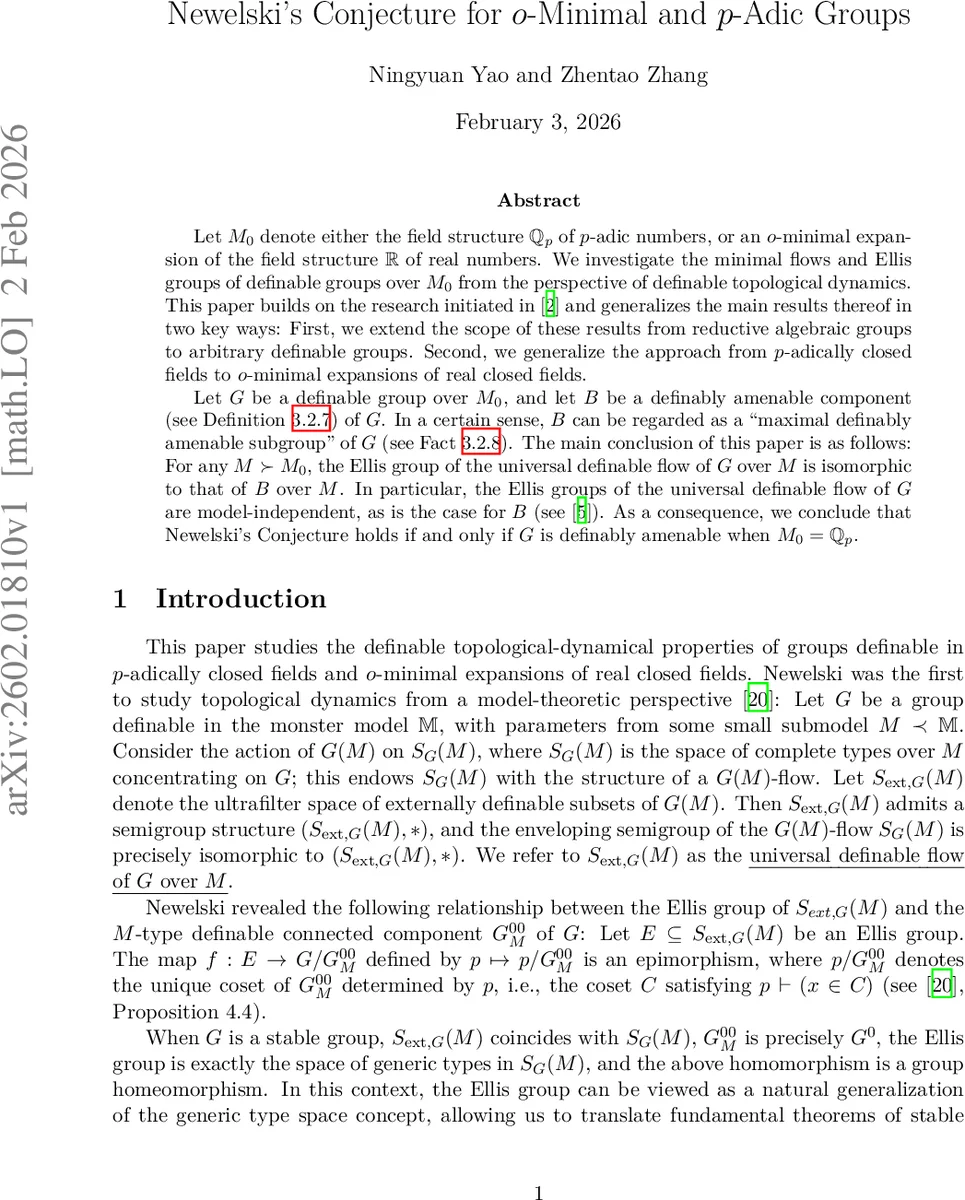
Let $ M_0 $ denote either the field structure $ \mathbb{Q}_p $ of $ p $-adic numbers, or an $o$-minimal expansion of the field structure $ \mathbb{R} $ of real numbers. We investigate the minimal flows and Ellis groups of definable groups over $ M_0 $ from the perspective of definable topological dynamics. This paper builds on the research initiated in \cite{BY-APAL} and generalizes the main results thereof in two key ways: First, we extend the scope of these results from reductive algebraic groups to arbitrary definable groups. Second, we generalize the approach from $ p $-adically closed fields to $o$-minimal expansions of real closed fields. Let $G$ be a definable group over $M_0$, and let $B$ be a definably amenable component (see Definition \ref{def-DAC}) of $G$. In a certain sense, $B$ can be regarded as a ``maximal definably amenable subgroup’’ of $G$ (see Fact \ref{fact-max-DA-subgroup}). The main conclusion of this paper is as follows: For any $M \succ M_0$, the Ellis group of the universal definable flow of $G$ over $M$ is isomorphic to that of $B$ over $M$. In particular, the Ellis groups of the universal definable flow of $G$ are model-independent, as is the case for $B$ (see \cite{CS-Definably-Amenable-NIP-Groups}). As a consequence, we conclude that Newelski’s Conjecture holds if and only if $G$ is definably amenable when $M_0 = \mathbb{Q}_p$.
💡 Research Summary
The paper investigates Newellski’s conjecture in the setting of definable groups over two important NIP structures: the field of p‑adic numbers $\mathbb Q_{p}$ and any o‑minimal expansion of the real field $\mathbb R$. Newellski’s conjecture predicts that for a definable group $G$ in an NIP theory, the Ellis group of the universal definable flow $S_{G,\mathrm{ext}}(M)$ is abstractly isomorphic to the quotient $G/G^{00}$, and consequently independent of the choice of the ambient model $M$. While the conjecture holds for many tame groups, several counter‑examples are known (e.g., $SL(2,\mathbb R)$, $SL(2,\mathbb Q_{p})$), all of which are not definably amenable.
The authors extend previous work on reductive algebraic groups to arbitrary definable groups and replace the “definably extremely amenable–fsg” decomposition used in earlier papers with a decomposition based on definably amenable components and dfg (definably f‑generic) components. The central object is the definably amenable component $B\le G$, defined as a maximal definably amenable subgroup of $G$. They prove that such a $B$ always exists and that $G$ admits a short exact sequence \
Comments & Academic Discussion
Loading comments...
Leave a Comment