Cost-Aware Bayesian Optimization for Prototyping Interactive Devices
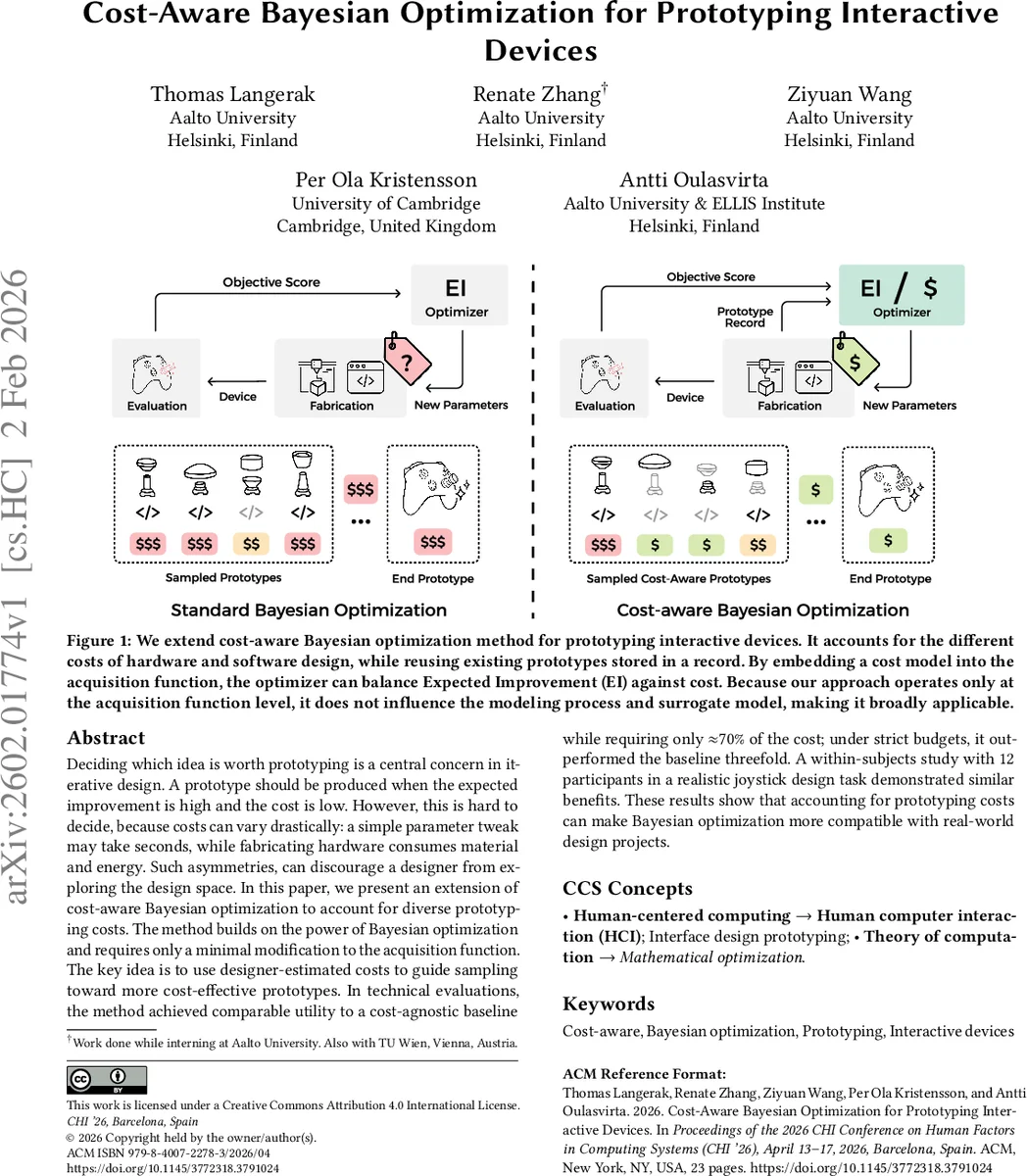
Deciding which idea is worth prototyping is a central concern in iterative design. A prototype should be produced when the expected improvement is high and the cost is low. However, this is hard to decide, because costs can vary drastically: a simple parameter tweak may take seconds, while fabricating hardware consumes material and energy. Such asymmetries, can discourage a designer from exploring the design space. In this paper, we present an extension of cost-aware Bayesian optimization to account for diverse prototyping costs. The method builds on the power of Bayesian optimization and requires only a minimal modification to the acquisition function. The key idea is to use designer-estimated costs to guide sampling toward more cost-effective prototypes. In technical evaluations, the method achieved comparable utility to a cost-agnostic baseline while requiring only ${\approx}70%$ of the cost; under strict budgets, it outperformed the baseline threefold. A within-subjects study with 12 participants in a realistic joystick design task demonstrated similar benefits. These results show that accounting for prototyping costs can make Bayesian optimization more compatible with real-world design projects.
💡 Research Summary
The paper tackles a fundamental problem in iterative interactive‑device design: deciding which ideas merit a prototype when the cost of building a prototype can vary by orders of magnitude. While Bayesian optimization (BO) has become a popular tool for balancing exploration and exploitation in HCI, existing BO approaches treat every evaluation as equally expensive. This assumption breaks down in real‑world prototyping where a simple software tweak may take seconds and cost a few dollars, whereas fabricating a new hardware enclosure can require hours, materials, and hundreds of dollars. Ignoring such asymmetries can lead designers to waste limited budgets on expensive, low‑value evaluations, or to avoid promising ideas altogether.
The authors extend cost‑aware Bayesian optimization (originally proposed in the broader optimization literature) to the specific needs of interactive‑device prototyping. Their method, called CABO (Cost‑Aware Bayesian Optimization for Prototyping Interactive Devices), introduces two key innovations:
-
Explicit Cost Model – Each design parameter is assigned a designer‑estimated cost c(x). Costs are grouped into three intuitive categories: “tweak” (low‑cost adjustments), “swap” (reusing an existing sub‑design), and “create” (building a brand‑new component). This model captures the heterogeneous nature of prototyping expenses and allows designers to input realistic cost estimates before any evaluation is performed.
-
Prototype Record – The optimizer maintains a record of all previously fabricated prototypes (hardware parts, software modules, tested templates). When a new candidate reuses an existing artifact, its effective cost is reduced accordingly. Thus, the cost function is not static; it dynamically depends on the current state of the prototype library, reflecting the sunk‑cost benefit of reusing existing work.
With these components, the acquisition function is modified from the classic Expected Improvement (EI) to EI per unit cost:
\
Comments & Academic Discussion
Loading comments...
Leave a Comment