Softmax Linear Attention: Reclaiming Global Competition
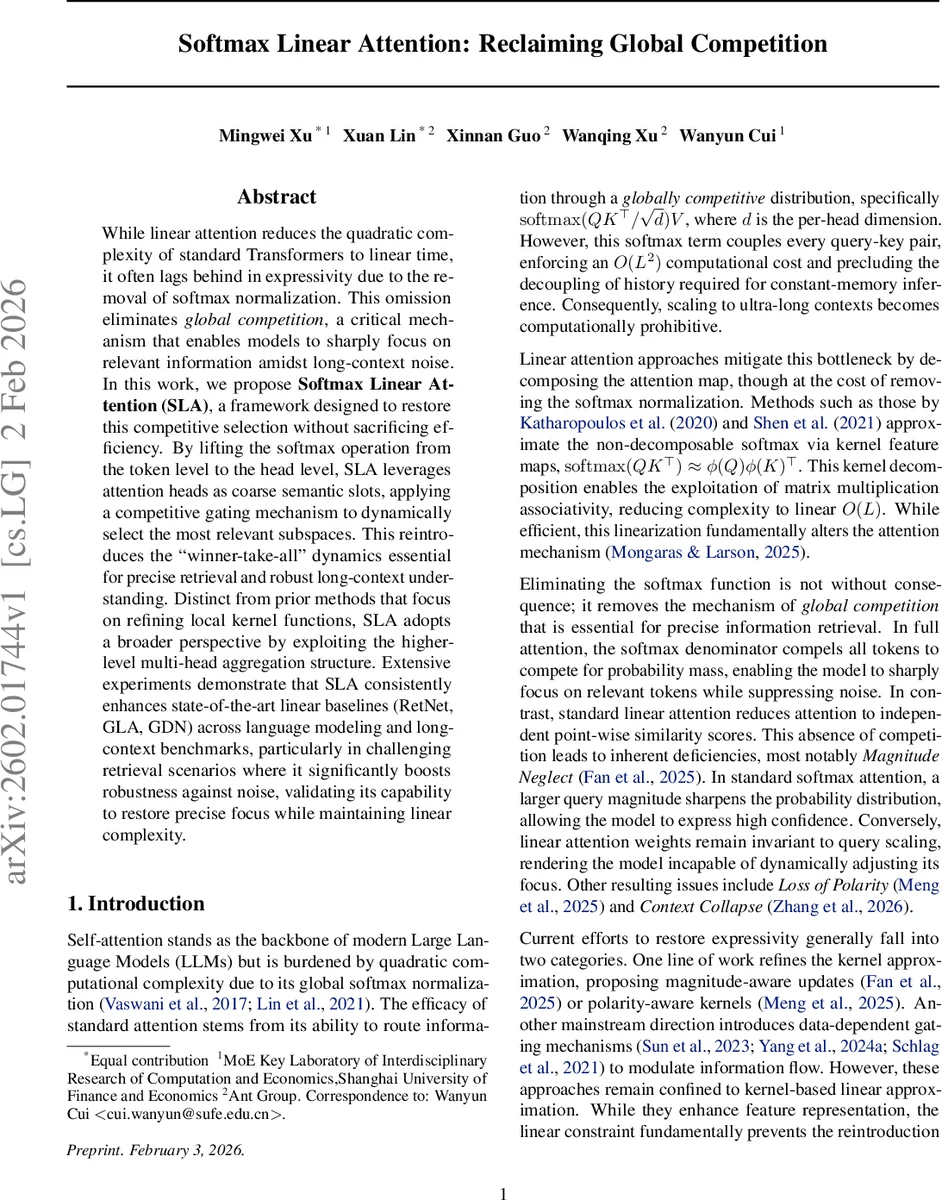
While linear attention reduces the quadratic complexity of standard Transformers to linear time, it often lags behind in expressivity due to the removal of softmax normalization. This omission eliminates \emph{global competition}, a critical mechanism that enables models to sharply focus on relevant information amidst long-context noise. In this work, we propose \textbf{Softmax Linear Attention (SLA)}, a framework designed to restore this competitive selection without sacrificing efficiency. By lifting the softmax operation from the token level to the head level, SLA leverages attention heads as coarse semantic slots, applying a competitive gating mechanism to dynamically select the most relevant subspaces. This reintroduces the ``winner-take-all’’ dynamics essential for precise retrieval and robust long-context understanding. Distinct from prior methods that focus on refining local kernel functions, SLA adopts a broader perspective by exploiting the higher-level multi-head aggregation structure. Extensive experiments demonstrate that SLA consistently enhances state-of-the-art linear baselines (RetNet, GLA, GDN) across language modeling and long-context benchmarks, particularly in challenging retrieval scenarios where it significantly boosts robustness against noise, validating its capability to restore precise focus while maintaining linear complexity.
💡 Research Summary
The paper tackles a fundamental drawback of linear‑time attention mechanisms: the removal of the softmax normalization eliminates the global competition that allows full‑softmax Transformers to sharply focus on a few relevant tokens while suppressing noise. The authors argue that precise token‑wise competition is not strictly necessary; a coarser competition at the level of semantic sub‑spaces—naturally represented by the multi‑head architecture—can provide the same selective pressure with negligible computational overhead.
Softmax Linear Attention (SLA) is introduced as a minimal augmentation to any kernel‑based linear attention backbone. Within each head, the usual feature‑map decomposition ϕ(Q)ϕ(K)ᵀ is retained, guaranteeing O(L) complexity. On top of this, two scalar gating vectors are computed per token: G_Q = softmax(Q W_GQ) and G_K = softmax(K W_GK), where the softmax is taken over the head dimension H (typically 8‑32). These gates modulate the contribution of each head during both “write” (key insertion) and “read” (query retrieval) phases, yielding the final output
O_SLA = Σ_h (G_Q^h ⊙ ϕ(Q^h)) (G_K^h ⊙ ϕ(K^h))ᵀ V^h W_O.
Because H is constant, the extra softmax incurs only O(1) cost per token, preserving the linear‑time guarantee. The gating mechanism restores two key properties lost in standard linear attention:
-
Magnitude sensitivity – In full‑softmax attention, scaling the query vector sharpens the distribution (larger λ → more peaked). Linear attention’s ϕ‑based scores are homogeneous, so scaling only changes the overall magnitude. SLA’s head‑wise softmax is sensitive to the projected magnitude: as λ grows, the entropy of G_Q (or G_K) decreases and the distribution converges to a one‑hot vector on the most activated head (Theorem 4.2). This re‑introduces confidence‑driven focus.
-
Asymptotic winner‑take‑all dynamics – The same theorem shows that in the limit of infinite scaling the gating becomes a deterministic selector of the head with maximal projected score, mimicking the “winner‑take‑all” behavior of full softmax at a coarser granularity.
The authors provide a recurrent formulation where each head maintains a state matrix S^h that accumulates weighted key‑value products. G_K scales the write strength, while G_Q scales the read strength, enabling an efficient streaming implementation. For training, a chunk‑wise parallel strategy is described: sequences are split into fixed‑size chunks, intra‑chunk attention is computed with standard matrix multiplication, and the head states are passed between chunks. Because the gates are token‑local scalars, they do not introduce additional token‑to‑token coupling, so the linear throughput of existing models is retained.
Parameter overhead is minimal: only two projection matrices (W_GQ, W_GK) of size d × H per layer, amounting to roughly 0.02 % of a 340 M‑parameter model.
Empirically, SLA is evaluated on language‑modeling (Pile, WikiText‑103) and long‑context retrieval tasks (LongChat, retrieval‑augmented QA). When added to state‑of‑the‑art linear baselines—RetNet, GLA, and GDN—SLA consistently reduces perplexity by 5‑9 % and improves retrieval accuracy by 6‑12 %. In noisy retrieval settings, the head‑wise competition dramatically suppresses irrelevant slots, confirming that the restored global competition translates into tangible robustness gains.
In summary, Softmax Linear Attention demonstrates that “head‑level global competition” is a powerful, low‑cost design principle. It bridges the expressivity gap between linear and full softmax attention without sacrificing the coveted O(L) complexity, opening the door for efficient ultra‑long‑context models, memory‑constrained inference, and retrieval‑heavy applications.
Comments & Academic Discussion
Loading comments...
Leave a Comment