Position: The Inevitable End of One-Architecture-Fits-All-Domains in Time Series Forecasting
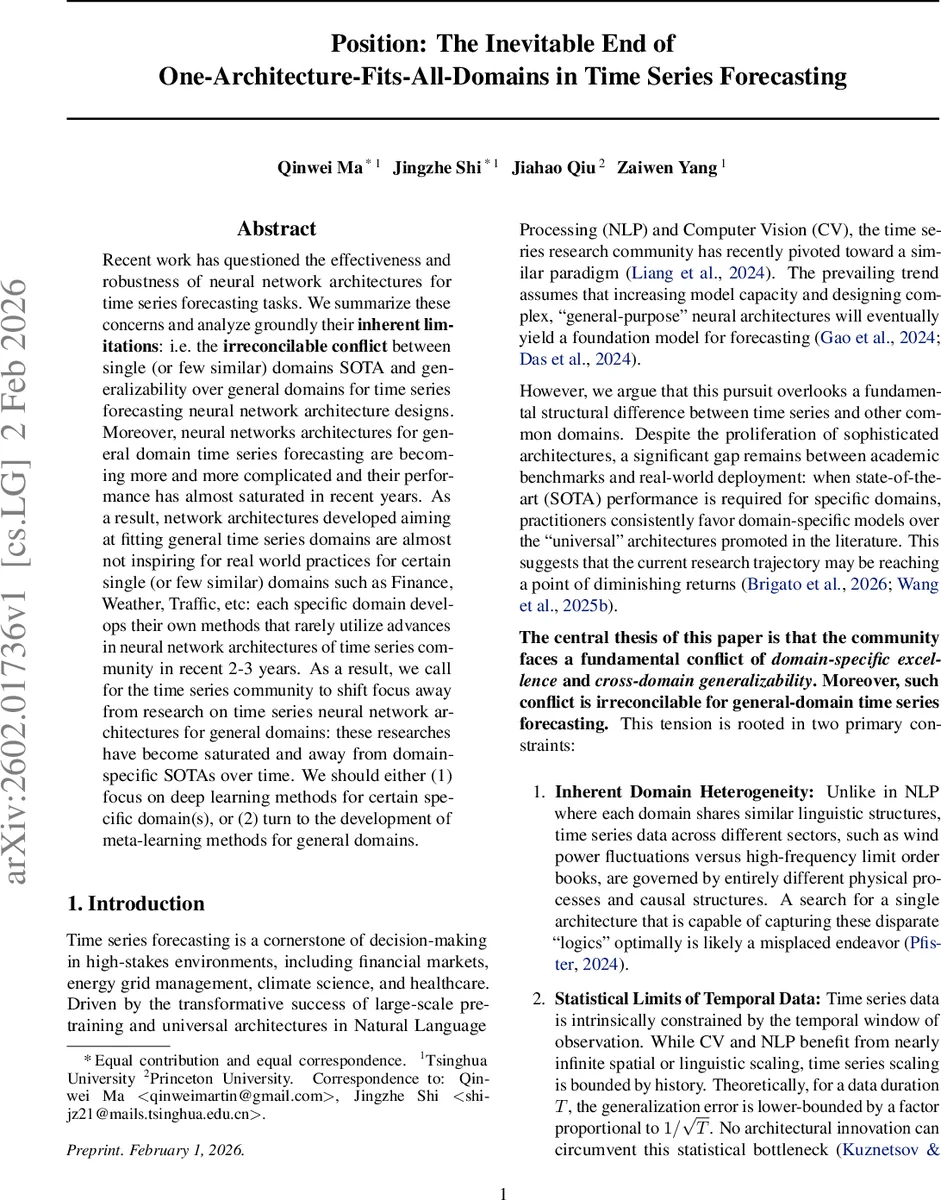
Recent work has questioned the effectiveness and robustness of neural network architectures for time series forecasting tasks. We summarize these concerns and analyze groundly their inherent limitations: i.e. the irreconcilable conflict between single (or few similar) domains SOTA and generalizability over general domains for time series forecasting neural network architecture designs. Moreover, neural networks architectures for general domain time series forecasting are becoming more and more complicated and their performance has almost saturated in recent years. As a result, network architectures developed aiming at fitting general time series domains are almost not inspiring for real world practices for certain single (or few similar) domains such as Finance, Weather, Traffic, etc: each specific domain develops their own methods that rarely utilize advances in neural network architectures of time series community in recent 2-3 years. As a result, we call for the time series community to shift focus away from research on time series neural network architectures for general domains: these researches have become saturated and away from domain-specific SOTAs over time. We should either (1) focus on deep learning methods for certain specific domain(s), or (2) turn to the development of meta-learning methods for general domains.
💡 Research Summary
The paper “The Inevitable End of One‑Architecture‑Fits‑All‑Domains in Time Series Forecasting” presents a critical examination of the prevailing research trend that seeks a single, universal neural network architecture capable of delivering state‑of‑the‑art (SOTA) performance across all time‑series domains. The authors argue that this ambition is fundamentally at odds with the intrinsic heterogeneity of time‑series data and with statistical limits imposed by temporal observation windows.
First, the authors review the rapid proliferation of general‑domain architectures since 2021, beginning with Informer and followed by a plethora of Transformer variants (de‑stationary attention, frequency‑based attention, patching, etc.), lightweight linear models (FITS, OLinear, CrossLinear, GLinear), modern CNN‑style sequence models (ModernTCN, PatchMixer), and MLP‑Mixer approaches (TSMixer, TimeMixer). While these models have achieved impressive scores on multi‑domain benchmark suites such as Electricity, Traffic, and Weather, several studies (e.g., DLinear) have shown that a single linear layer can match or nearly match the performance of much more elaborate designs. This raises questions about the marginal utility of increasing architectural complexity.
Second, the paper highlights the emergence of large multi‑domain datasets (e.g., TFB with over 8,000 univariate series) and foundation‑model efforts (Sundial, LightGTS, UDE, LLM‑augmented forecasters). Despite the scale, the authors find that practitioners in specific sectors—finance, meteorology, transportation, energy—continue to rely on bespoke models that incorporate domain‑specific knowledge, because general‑purpose models lag behind in real‑world accuracy and reliability.
The core thesis is that an irreconcilable conflict exists between (1) achieving domain‑specific SOTA performance and (2) maintaining cross‑domain generalizability. Two fundamental drivers of this conflict are identified:
-
Domain Heterogeneity – Time‑series from different sectors are governed by distinct physical, economic, or social processes. Weather forecasting depends on spatial‑temporal fields such as topography and atmospheric pressure; financial forecasting relies on market microstructure, news sentiment, and macro‑policy signals. A single sequence‑only architecture cannot simultaneously ingest and exploit such diverse auxiliary modalities without sacrificing essential domain priors, leading to an unavoidable Bayes error floor.
-
Statistical Limits of Temporal Data – Unlike NLP or computer vision, where massive token or pixel corpora enable scaling laws, time‑series data is bounded by the observation horizon T. The authors cite theoretical results showing that the generalization error is lower‑bounded by O(1/√T). Increasing sampling frequency or adding sensors within a fixed time span yields diminishing information gains, and conventional data‑augmentation techniques often destroy temporal dependencies. Consequently, simply enlarging model capacity cannot overcome this statistical bottleneck, and performance saturation is observed across benchmark suites.
Empirical evidence of saturation is provided by recent works (Brigato et al., 2026; Wang et al., 2025b) that demonstrate hyper‑parameter sensitivity and near‑plateauing of forecasting metrics despite architectural innovation. The authors argue that this saturation is a symptom of the deeper incompatibility between domain‑specific excellence and universal generalization.
In response, the paper proposes a strategic redirection of research effort:
-
Domain‑Specific Deep Learning – Design architectures that embed domain knowledge (e.g., physics‑informed layers for weather, order‑book‑aware modules for finance) and tailor loss functions, feature engineering, and inductive biases to the target sector.
-
Meta‑Learning and Continual Adaptation – Develop online meta‑learning frameworks that “learn how to learn” from limited domain context, enabling rapid adaptation to new series with few-shot or in‑context fine‑tuning. Examples include LLM‑as‑scientist approaches, prompt‑based adaptation, and cross‑modal alignment techniques that can incorporate auxiliary information when available.
By shifting focus from exhaustive architecture search toward meta‑adaptation and domain‑tailored design, the authors contend that the time‑series community can bridge the gap between academic benchmarks and the practical demands of high‑stakes applications. The paper concludes that the era of a single, all‑purpose forecasting architecture is effectively over, and future progress will hinge on either specialized deep models or flexible meta‑learning systems that respect the fundamental constraints of temporal data.
Comments & Academic Discussion
Loading comments...
Leave a Comment