Tilt-Ropter: A Novel Hybrid Aerial and Terrestrial Vehicle with Tilt Rotors and Passive Wheels
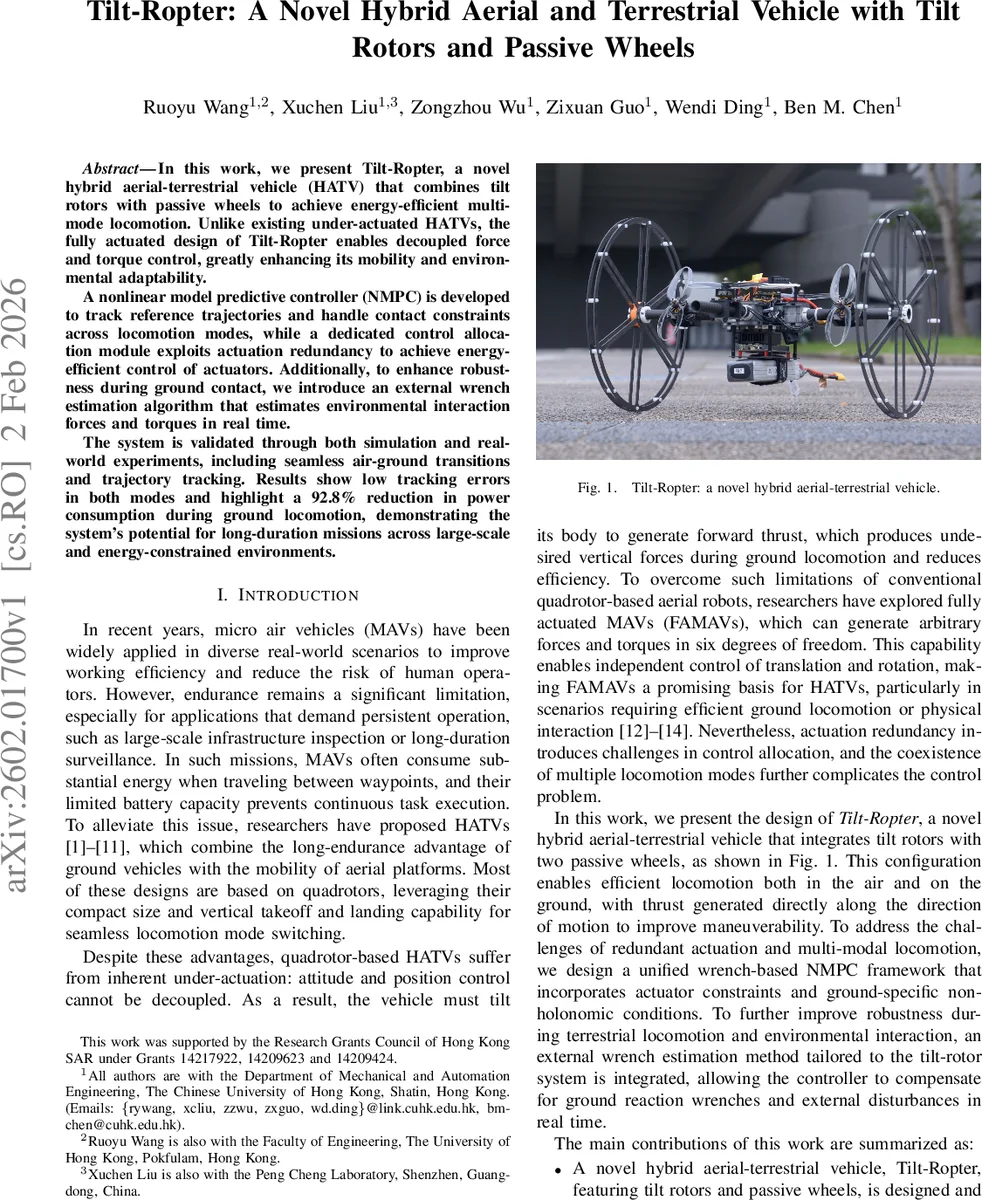
In this work, we present Tilt-Ropter, a novel hybrid aerial-terrestrial vehicle (HATV) that combines tilt rotors with passive wheels to achieve energy-efficient multi-mode locomotion. Unlike existing under-actuated HATVs, the fully actuated design of Tilt-Ropter enables decoupled force and torque control, greatly enhancing its mobility and environmental adaptability. A nonlinear model predictive controller (NMPC) is developed to track reference trajectories and handle contact constraints across locomotion modes, while a dedicated control allocation module exploits actuation redundancy to achieve energy-efficient control of actuators. Additionally, to enhance robustness during ground contact, we introduce an external wrench estimation algorithm that estimates environmental interaction forces and torques in real time. The system is validated through both simulation and real-world experiments, including seamless air-ground transitions and trajectory tracking. Results show low tracking errors in both modes and highlight a 92.8% reduction in power consumption during ground locomotion, demonstrating the system’s potential for long-duration missions across large-scale and energy-constrained environments.
💡 Research Summary
This paper presents the design, modeling, control, and experimental validation of “Tilt-Ropter,” a novel hybrid aerial-terrestrial vehicle (HATV). The core innovation lies in its fully actuated design, featuring four tiltable rotors and two passive wheels, which enables decoupled control of force and torque across six degrees of freedom. This stands in contrast to conventional underactuated quadrotor-based HATVs, where body tilting for forward motion induces undesirable vertical forces during ground locomotion, reducing efficiency.
The mechanical design strategically places the servo motors for rotor tilting centrally within the main body to minimize the moment of inertia. An innovative aspect is that two opposing tilt arms directly act as axles for the passive wheels, minimizing added weight and complexity. The hardware system integrates a flight controller for low-level control and an NVIDIA Jetson Orin NX for high-level computation, including control and planning.
For modeling, the paper derives the rigid-body dynamics and, crucially, a control allocation framework. This framework maps a desired six-dimensional wrench (combined force and torque) to feasible rotor speeds and servo tilt angles via a static allocation matrix. It also reveals the critical relationship between the commanded wrench rate and the required servo angular speed, highlighting a key dynamic constraint for controller design.
The control architecture is built around a unified Nonlinear Model Predictive Controller (NMPC). This NMPC tracks reference trajectories while handling the distinct dynamics and constraints of both aerial and terrestrial modes, including ground contact conditions and the servo rate limits identified in the modeling stage. It outputs an optimal wrench command, which is then converted into actuator commands via the control allocation module. To enhance robustness, particularly during ground interaction, an external wrench estimation algorithm that accounts for servo dynamics is implemented. This estimator provides real-time compensation for contact forces and external disturbances.
The system is validated through comprehensive simulations and real-world experiments. Results demonstrate low trajectory tracking errors in both flight and rolling modes. The most significant result is a 92.8% reduction in power consumption during ground locomotion compared to aerial flight for covering the same distance. This dramatic improvement in energy efficiency underscores the vehicle’s potential for long-duration missions in large-scale or energy-constrained environments, such as infrastructure inspection and prolonged surveillance.
In summary, Tilt-Ropter advances the field of hybrid vehicles by successfully integrating a fully actuated aerial platform with passive wheel-based terrestrial locomotion. Its co-design of novel mechanics, a unified model-based controller incorporating actuator constraints, and an external disturbance estimation scheme demonstrates a significant step towards practical, efficient, and versatile multi-modal robots.
Comments & Academic Discussion
Loading comments...
Leave a Comment