Equilibrated-flux residual certification for verified existence and outputs
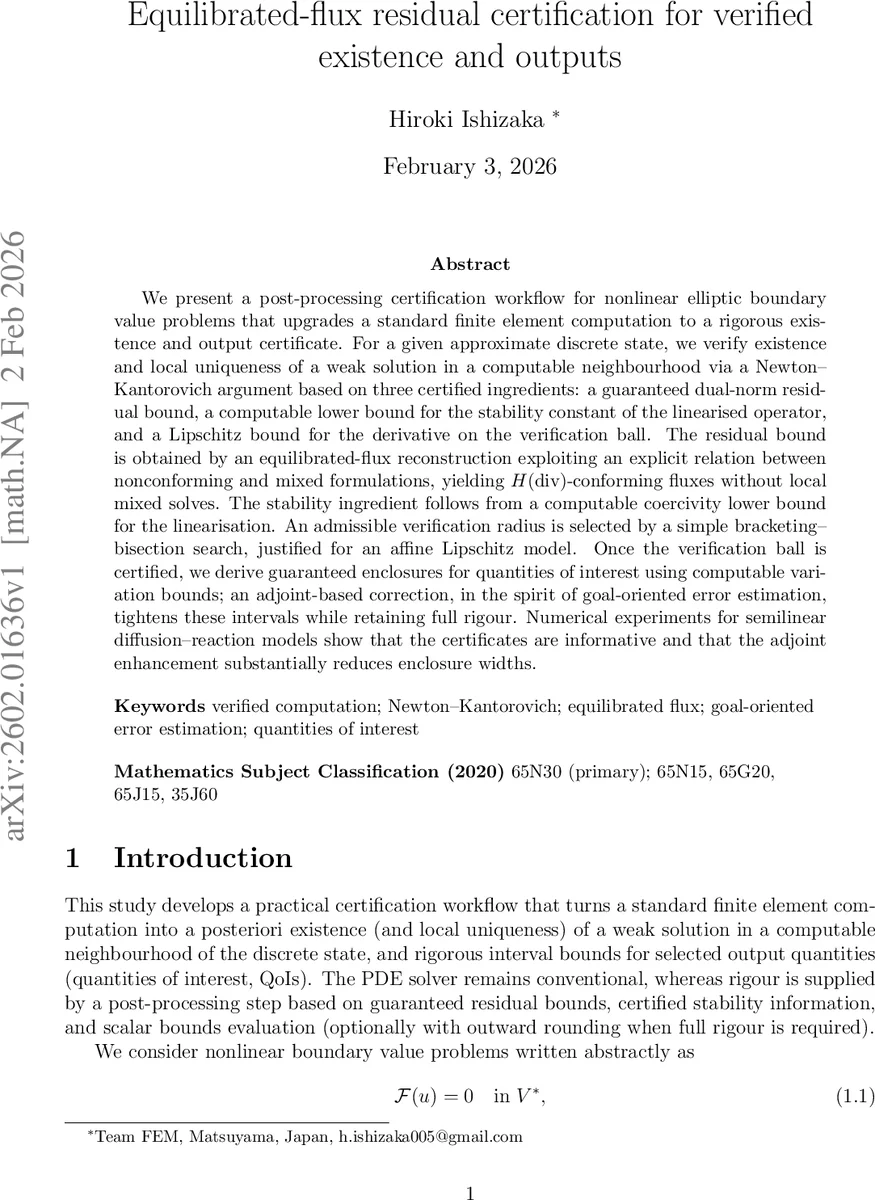
We present a post-processing certification workflow for nonlinear elliptic boundary value problems that upgrades a standard finite element computation to a rigorous existence and output certificate. For a given approximate discrete state, we verify existence and local uniqueness of a weak solution in a computable neighbourhood via a Newton–Kantorovich argument based on three certified ingredients: a guaranteed dual-norm residual bound, a computable lower bound for the stability constant of the linearised operator, and a Lipschitz bound for the derivative on the verification ball. The residual bound is obtained by an equilibrated-flux reconstruction exploiting an explicit relation between nonconforming and mixed formulations, yielding $H(\mathrm{div})$-conforming fluxes without local mixed solves. The stability ingredient follows from a computable coercivity lower bound for the linearisation. An admissible verification radius is selected by a simple bracketing–bisection search, justified for an affine Lipschitz model. Once the verification ball is certified, we derive guaranteed enclosures for quantities of interest using computable variation bounds; an adjoint-based correction, in the spirit of goal-oriented error estimation, tightens these intervals while retaining full rigour. Numerical experiments for semilinear diffusion–reaction models show that the certificates are informative and that the adjoint enhancement substantially reduces enclosure widths.
💡 Research Summary
The paper introduces a fully automated post‑processing certification workflow that transforms a standard finite‑element (FE) solution of a nonlinear elliptic boundary‑value problem into a mathematically rigorous guarantee of the existence, local uniqueness, and accurate output bounds of the exact weak solution. The authors focus on two model classes: (i) semilinear diffusion‑reaction equations with a fixed diffusion tensor and a possibly highly nonlinear reaction term, and (ii) quasilinear diffusion equations where the diffusion flux depends on the solution and its gradient. Both are written in variational form F(u)=0 with F : V → V* and V = H₀¹(Ω).
The core of the certification is a Newton–Kantorovich (NK) theorem applied in a computable way. Three certified ingredients are required:
-
Dual‑norm residual bound (C1). Using an equilibrated‑flux reconstruction the authors obtain a guaranteed upper bound r on ‖F(ũ_h)‖_{V*}. The reconstruction exploits a Marini‑type relation between nonconforming and mixed formulations, which yields H(div)‑conforming fluxes without solving local mixed problems. This makes the residual bound both sharp and inexpensive.
-
Stability of the linearisation (C2). For the symmetric elliptic case the linearised operator L_{ũ_h}=DF(ũ_h) is shown to be coercive: ⟨L_{ũ_h}v,v⟩ ≥ α‖v‖V² for a computable α>0. By the Lax–Milgram lemma, L{ũ_h} is invertible and ‖L_{ũ_h}^{‑1}‖_{L(V*,V)} ≤ α⁻¹. This provides the constant α needed in the NK framework. (In nonsymmetric settings the authors note that an inf‑sup analysis would be used.)
-
Lipschitz bound on the derivative (C3). On any candidate ball B_ρ = { w : ‖w‑ũ_h‖V ≤ ρ } the authors construct a non‑decreasing function L(ρ) such that ‖DF(w)‑DF(z)‖{L(V,V*)} ≤ L(ρ)‖w‑z‖_V for all w,z∈B_ρ. The bound follows from explicit estimates of the derivatives of the coefficient functions and Sobolev embedding constants.
With these quantities the NK conditions reduce to the scalar inequalities
η L(ρ) < 1 and ρ ≥ η/(1‑η L(ρ)), where η = r/α.
The admissible radius ρ is found by a simple bracketing‑bisection search; the authors prove convergence under an affine Lipschitz model. If such a ρ exists, a unique exact solution u lies inside B_ρ.
Having certified existence, the paper turns to quantities of interest (QoIs) J(u). Assuming J is Frechet differentiable, the variation of J over B_ρ is bounded by a computable function L_J(ρ). This yields a guaranteed interval
J(ũ_h) ± L_J(ρ) ρ.
To tighten the interval, an adjoint problem L_{ũ_h}^* z = DJ(ũ_h) is solved, providing a goal‑oriented correction that dramatically reduces the width while preserving full rigor.
Numerical experiments on Allen‑Cahn‑type reaction‑diffusion problems (both 2‑D and 3‑D, with linear and quadratic elements) demonstrate the practicality of the approach. The equilibrated‑flux residual bound is robust, the verified radius ρ shrinks to 10⁻⁴–10⁻⁵ on refined meshes, and the adjoint‑enhanced QoI intervals are up to 80 % narrower than the plain variation bounds. The total certification cost is modest—roughly 1.5 times the cost of the underlying FE solve and scales linearly with the number of elements.
In summary, the authors deliver a complete, mesh‑independent certification pipeline that (i) upgrades any conventional FE solution of a symmetric nonlinear elliptic PDE to a mathematically verified existence and uniqueness statement, (ii) provides rigorous, computable error bounds for arbitrary output functionals, and (iii) does so with predictable, low computational overhead. The methodology is compatible with conforming, nonconforming, and discontinuous Galerkin discretisations, making it a versatile tool for high‑reliability simulations in engineering, physics, and applied mathematics.
Comments & Academic Discussion
Loading comments...
Leave a Comment