Steady-state skin effect in bosonic topological edge states under parametric driving
Non-Hermitian systems have attracted significant theoretical interest due to their extreme properties. However, realizations have mostly been limited to classical applications or artificial setups. In this study, we focus on the quantum nature inherent in bosonic Bogoliubov-de Gennes (BdG) systems, which from the perspective of spectral theory corresponds to non-Hermiticity. Based on this insight, we propose a steady-state skin effect in quantum condensed matter utilizing such BdG non-Hermiticity. Specifically, we introduce BdG quantum terms arising from parametric pumping to the edge states of an underlying bosonic Hermitian Chern insulator, thereby realizing non-Hermiticity without dissipation. This system design has the advantage of being largely independent of microscopic model details. Through analysis using non-equilibrium Green’s functions, we find that under open boundary conditions, a steady state exhibiting the non-Hermitian skin effect is realized. The pronounced corner particle accumulation observed in this steady state shows quadrature anisotropy, which manifests the bosonic quantum nature. Our results bridge the gap between the fascinating mathematics of non-Hermitian matrices and practical quantum physical systems.
💡 Research Summary
This paper proposes a novel route to realize the non‑Hermitian skin effect in a genuinely quantum setting, without invoking external loss or openness. The authors exploit the intrinsic non‑Hermiticity of bosonic Bogoliubov‑de Gennes (BdG) Hamiltonians, which arises from pairing (anomalous) terms that break particle‑number conservation. By applying a site‑dependent parametric drive to the edge of a bosonic Chern insulator—specifically the Qi‑Wu‑Zhang (QWZ) model with Chern number +1—they generate on‑site σ_x pairing terms localized on the top and bottom edges (or on a single edge). In the rotating frame the time dependence disappears, and the BdG Hamiltonian takes the form H_BdG = ½(a†,a) ( h s* s h* ) (a,a†)ᵀ, where the symmetric matrix s encodes the parametric drive.
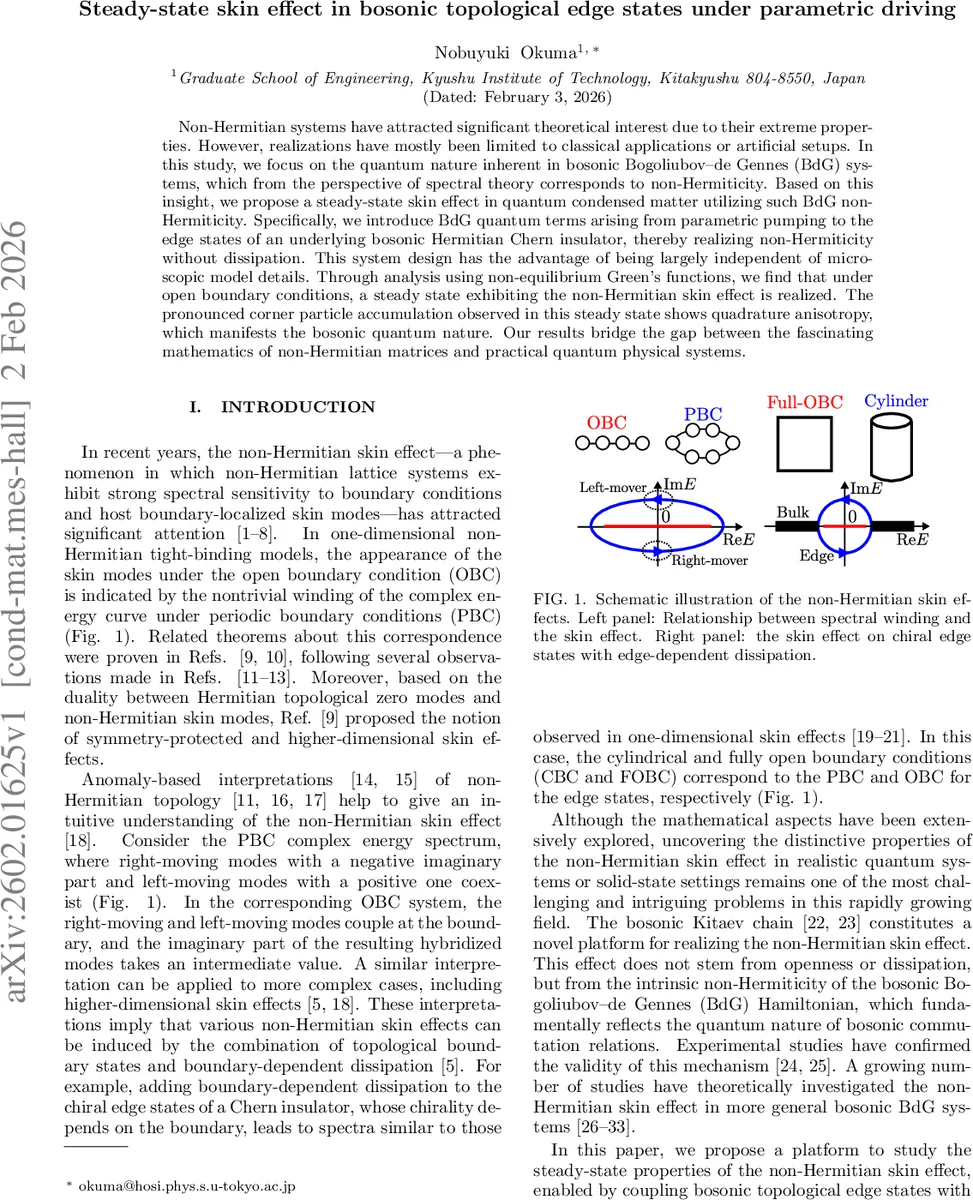
The key observation is that the effective non‑Hermitian matrix σ_z H_BdG possesses complex eigenvalues whose imaginary parts have opposite signs for right‑moving and left‑moving edge modes. Under periodic (cylindrical) boundary conditions (CBC) this leads to dynamical instability, whereas under fully open boundary conditions (FOBC) the imaginary parts cancel, producing a genuine non‑Hermitian skin effect: all edge states collapse onto one side of the sample (x = 1 or x = L_x). The presence of a unitary symmetry U = 1⊗τ_x⊗σ_x further classifies the spectrum into two sectors (U = ±1), each exhibiting opposite winding numbers. When U is weakly broken by a term ε σ_z, the skin modes gradually disappear, illustrating the symmetry‑protected nature of the effect.
To obtain a steady state despite the complex spectrum, the authors introduce a frequency‑independent dissipative self‑energy Σ_R = −i Γ Ⅰ, which preserves the BdG structure while shifting all eigenvalues uniformly in the complex plane. This constant loss can be justified only in a non‑equilibrium setting (e.g., a driven‑dissipative bosonic platform) and mimics the effect of a thermal bath in the rotating frame. Using non‑equilibrium Green’s functions, they construct the retarded Green’s function G_R(ω) and the lesser Green’s function G_< (ω), from which the one‑particle reduced density matrix ρ is obtained.
The steady‑state analysis reveals a pronounced accumulation of bosons at the system’s corners. This corner localization originates from the strong non‑normality of the effective Hamiltonian: the ε‑pseudospectrum has a large imaginary part, causing transient amplification of wave packets on one edge and damping on the opposite edge. Consequently, the skin modes funnel particles into the corners. Moreover, the quadrature fluctuations ⟨x_i,θ²⟩ display a clear anisotropy: fluctuations differ between bulk, edge, and corner sites, reflecting a quantum‑specific signature of the bosonic skin effect that has no analogue in classical non‑Hermitian systems.
The work demonstrates that parametric driving of bosonic topological edge states provides a versatile, model‑independent platform for exploring non‑Hermitian topology in genuine quantum matter. Because the mechanism relies only on on‑site pairing terms, it can be implemented in a wide range of experimental platforms, including photonic lattices, magnonic crystals, and phononic metamaterials, where parametric amplification is readily available. Importantly, the approach circumvents the need for engineered loss, preserving thermodynamic stability while still exhibiting the hallmark features of the non‑Hermitian skin effect—spectral winding, boundary‑dependent eigenmode localization, and a steady‑state with corner particle accumulation and quadrature anisotropy. This bridges the abstract mathematics of non‑Hermitian matrices with realistic quantum condensed‑matter systems, opening new avenues for non‑Hermitian topological physics in driven‑dissipative bosonic platforms.
Comments & Academic Discussion
Loading comments...
Leave a Comment