AgroFlux: A Spatial-Temporal Benchmark for Carbon and Nitrogen Flux Prediction in Agricultural Ecosystems
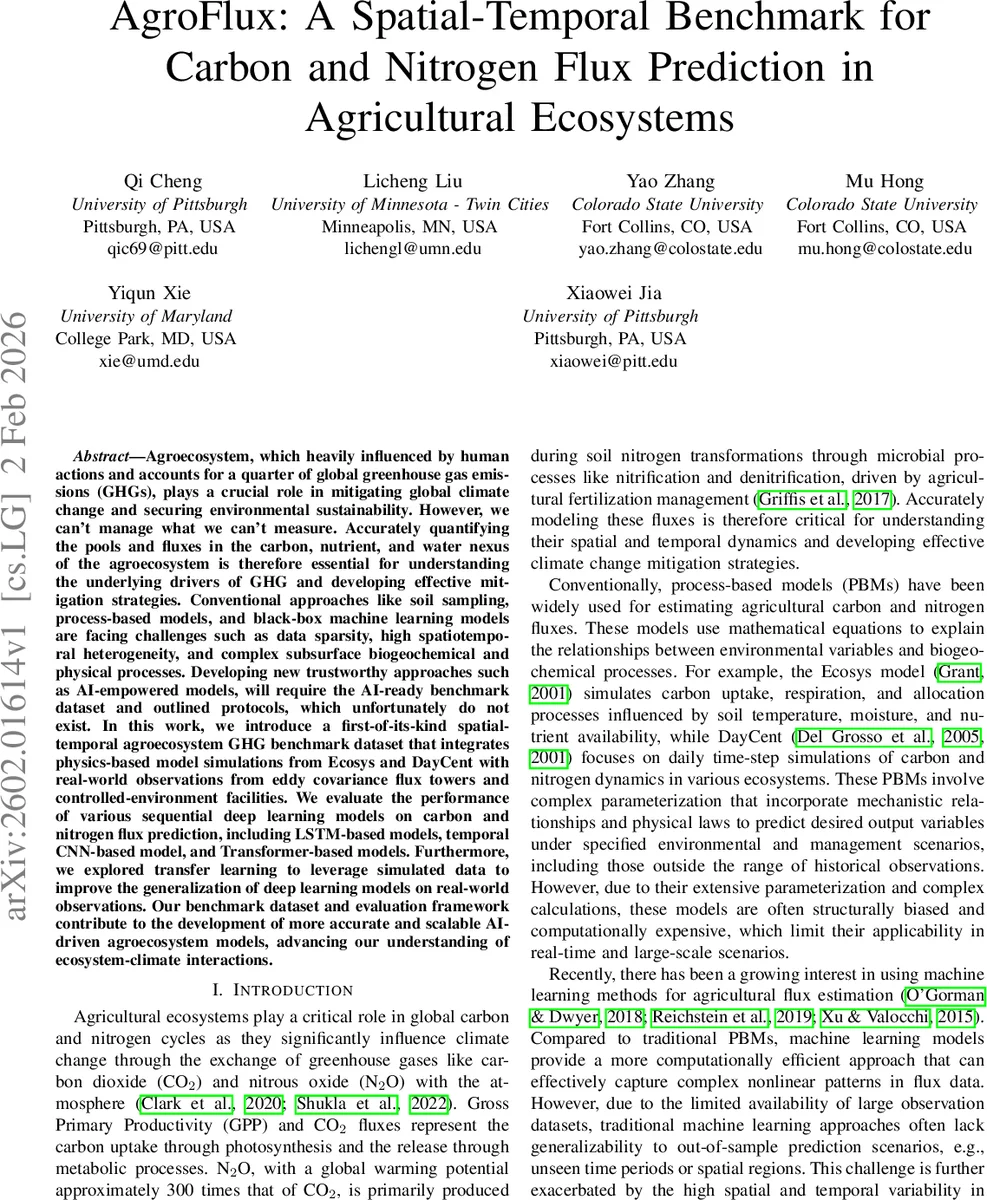
Agroecosystem, which heavily influenced by human actions and accounts for a quarter of global greenhouse gas emissions (GHGs), plays a crucial role in mitigating global climate change and securing environmental sustainability. However, we can’t manage what we can’t measure. Accurately quantifying the pools and fluxes in the carbon, nutrient, and water nexus of the agroecosystem is therefore essential for understanding the underlying drivers of GHG and developing effective mitigation strategies. Conventional approaches like soil sampling, process-based models, and black-box machine learning models are facing challenges such as data sparsity, high spatiotemporal heterogeneity, and complex subsurface biogeochemical and physical processes. Developing new trustworthy approaches such as AI-empowered models, will require the AI-ready benchmark dataset and outlined protocols, which unfortunately do not exist. In this work, we introduce a first-of-its-kind spatial-temporal agroecosystem GHG benchmark dataset that integrates physics-based model simulations from Ecosys and DayCent with real-world observations from eddy covariance flux towers and controlled-environment facilities. We evaluate the performance of various sequential deep learning models on carbon and nitrogen flux prediction, including LSTM-based models, temporal CNN-based model, and Transformer-based models. Furthermore, we explored transfer learning to leverage simulated data to improve the generalization of deep learning models on real-world observations. Our benchmark dataset and evaluation framework contribute to the development of more accurate and scalable AI-driven agroecosystem models, advancing our understanding of ecosystem-climate interactions.
💡 Research Summary
The paper introduces AgroFlux, the first comprehensive benchmark suite for predicting carbon and nitrogen greenhouse‑gas (GHG) fluxes in agricultural ecosystems. Recognizing that existing agricultural datasets focus on yield, land‑cover, or satellite‑derived variables and lack the biogeochemical measurements needed for accurate CO₂ and N₂O flux modeling, the authors construct a new “AI‑ready” dataset that fuses physics‑based model simulations with real‑world observations.
Data composition
- Simulated data: Generated by two process‑based models, Ecosys and DayCent. Both models are run daily from 2000 to 2018/2020 over thousands of sites in the US Midwest. Each site is simulated under multiple management scenarios (20–42 per site) that vary nitrogen fertilizer rates (0–33.6 g N m⁻²), planting dates, crop rotations (corn‑soybean vs. soybean‑corn), and drainage practices. Input drivers include weather (Tmax, Tmin, precipitation, radiation, humidity, wind), soil properties (bulk density, sand/silt fractions, pH, SOC), and management variables (fertilizer amount, planting day, crop type). Outputs comprise GPP, CO₂ flux, N₂O flux, ecosystem respiration, net ecosystem exchange, yield, soil organic carbon change, leaf area index, soil moisture, evapotranspiration, soil temperature at multiple depths, and nitrogen species concentrations.
- Observational data: (1) N₂O fluxes measured hourly in a controlled‑environment facility (continuous corn, 2016‑2018) and aggregated to daily scale, together with soil moisture, nitrate, ammonium, and weather. (2) CO₂ fluxes and derived GPP from 11 eddy‑covariance (EC) towers across major corn‑soybean regions (Illinois, Iowa, Michigan, Nebraska, Minnesota) covering 2000‑2020 with site‑specific operational periods (5–19 years). Complementary driver data (weather, gSSURGO soil maps, USDA Crop Data Layer) are provided for each observation.
All series are normalized, missing values are masked during loss computation, and the original multi‑year sequences are split into yearly sub‑sequences of 365 days to simplify model training.
Benchmark tasks and evaluation protocol
AgroFlux defines five core scenarios that reflect realistic challenges:
- Temporal extrapolation – train on early years, predict later years.
- Spatial extrapolation – train on a subset of sites, predict unseen locations.
- Simulated‑data prediction – evaluate models purely on the synthetic dataset.
- Observational‑data prediction – evaluate on real flux measurements.
- Transfer learning – pre‑train on simulated data then fine‑tune or apply adversarial domain adaptation to observational data.
Performance is measured uniformly with coefficient of determination (R²), root‑mean‑square error (RMSE), and mean absolute error (MAE).
Baseline models
Six sequential deep‑learning architectures are benchmarked:
- LSTM
- EA‑LSTM (enhanced with periodic embeddings)
- Temporal Convolutional Network (TCN)
- Standard Transformer
- iTransformer (incorporates explicit time‑encoding)
- Pyraformer (hierarchical token compression for long sequences)
Two transfer‑learning strategies are examined: (a) conventional pre‑train‑fine‑tune, and (b) adversarial training that aligns feature distributions between simulated and observed domains.
Key findings
- All deep models achieve reasonable skill on simulated data (R² ≈ 0.7‑0.85 for GPP, CO₂, N₂O).
- When applied directly to observational data, performance drops markedly (R² ≈ 0.3‑0.5), highlighting the domain gap.
- Pre‑training on the large simulated corpus and fine‑tuning on the limited real measurements improves R² by 5‑12 % across fluxes, with the greatest gains for N₂O, which suffers from sparse observations.
- Adversarial domain adaptation yields modest additional improvement but introduces training instability, suggesting further research on robust domain‑alignment techniques.
- Temporal extrapolation remains the hardest task; models tend to over‑fit to seasonal patterns present in the training years and struggle with inter‑annual climate variability.
Contributions and impact
AgroFlux delivers a unified, richly annotated dataset that couples mechanistic model outputs with field measurements, enabling systematic comparison of machine‑learning methods, assessment of generalization across time and space, and exploration of transfer learning from synthetic to real domains. By providing baseline results and a public leaderboard, the authors set a clear standard for future work in AI‑driven agroecosystem modeling.
Future directions suggested include:
- Incorporating high‑resolution remote‑sensing products (e.g., Sentinel‑2, hyperspectral) and soil microbiome data to enrich driver information.
- Developing multi‑task architectures that jointly predict carbon, nitrogen, and water fluxes, leveraging shared physical constraints.
- Embedding uncertainty quantification (e.g., Bayesian neural nets, ensembles) to support risk‑aware decision making.
- Optimizing models for edge deployment on farm‑level IoT platforms, enabling near‑real‑time GHG monitoring.
Overall, AgroFlux fills a critical gap in the agricultural AI ecosystem, providing the data infrastructure and evaluation framework needed to accelerate trustworthy, scalable, and climate‑relevant modeling of agroecosystem greenhouse‑gas dynamics.
Comments & Academic Discussion
Loading comments...
Leave a Comment