When Is Generalized Bayes Bayesian? A Decision-Theoretic Characterization of Loss-Based Updating
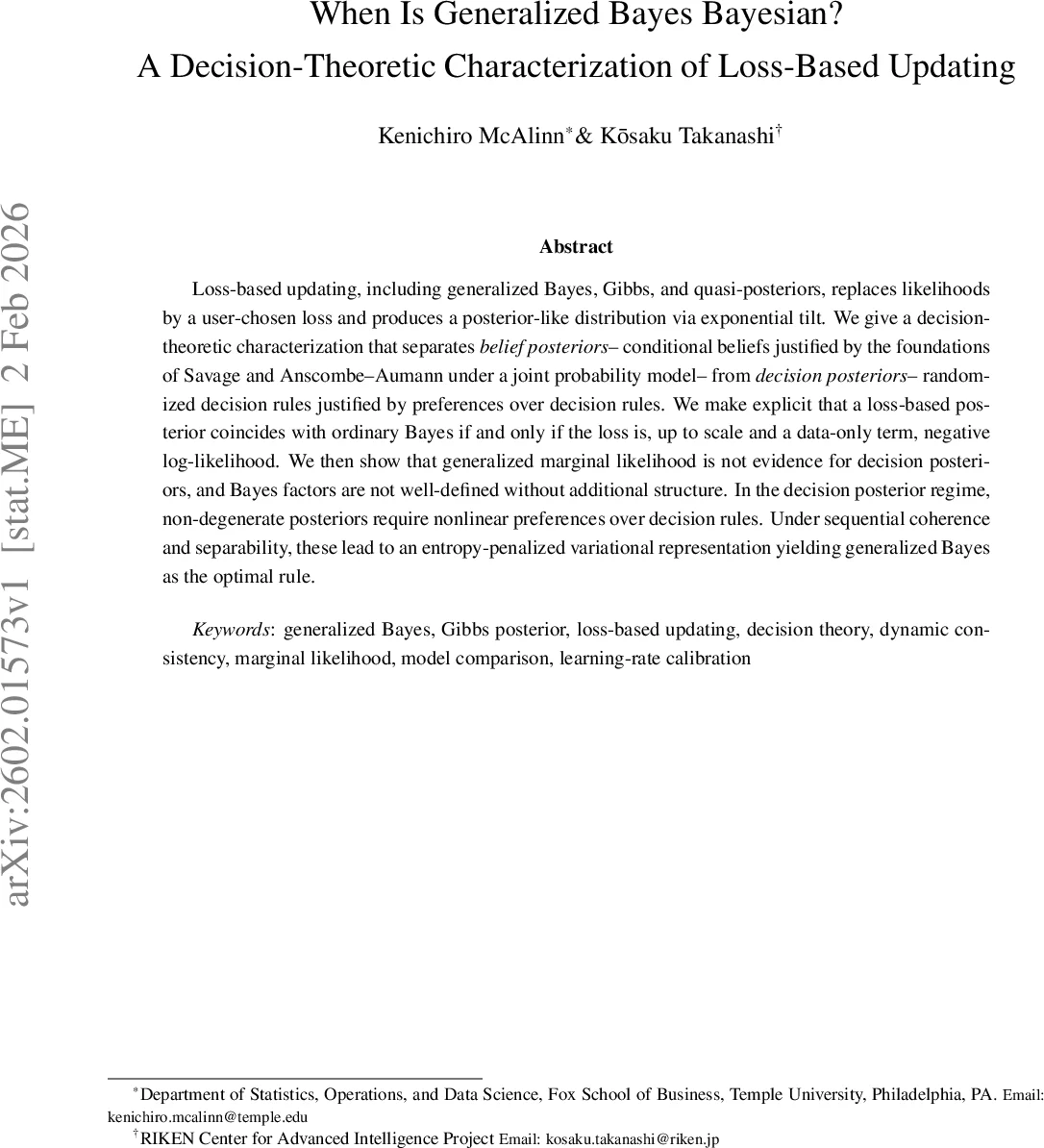
Loss-based updating, including generalized Bayes, Gibbs, and quasi-posteriors, replaces likelihoods by a user-chosen loss and produces a posterior-like distribution via exponential tilt. We give a decision-theoretic characterization that separates \emph{belief posteriors} – conditional beliefs justified by the foundations of Savage and Anscombe-Aumann under a joint probability mode l– from \emph{decision posteriors} – randomized decision rules justified by preferences over decision rules. We make explicit that a loss-based posterior coincides with ordinary Bayes if and only if the loss is, up to scale and a data-only term, negative log-likelihood. We then show that generalized marginal likelihood is not evidence for decision posteriors, and Bayes factors are not well-defined without additional structure. In the decision posterior regime, non-degenerate posteriors require nonlinear preferences over decision rules. Under sequential coherence and separability, these lead to an entropy-penalized variational representation yielding generalized Bayes as the optimal rule.
💡 Research Summary
The paper provides a rigorous decision‑theoretic analysis of loss‑based updating methods—generalized Bayes, Gibbs, and quasi‑posteriors—by distinguishing two fundamentally different objects that are often conflated in the literature.
Belief posteriors are conditional probability distributions derived from a joint model for data and parameters, grounded in the Savage–Anscombe–Aumann framework. Under standard axioms (completeness, transitivity, continuity) and a dynamic consistency requirement, Bayesian conditioning is the unique update rule that preserves coherence across stages. In this regime the posterior has the usual interpretations: betting odds, exchangeability, marginal likelihood as predictive probability, and Bayes factors for model comparison.
Decision posteriors, by contrast, are data‑dependent randomized decision rules. After observing data (x), the analyst selects a distribution (q(\cdot\mid x)) over an action space (\Theta). The rule is evaluated by a loss function (\ell(\theta;x)) and a baseline distribution (\pi) that may encode regularization or default behavior but need not be a prior belief. The generalized Bayes form
\
Comments & Academic Discussion
Loading comments...
Leave a Comment