How Notations Evolve: A Historical Analysis with Implications for Supporting User-Defined Abstractions
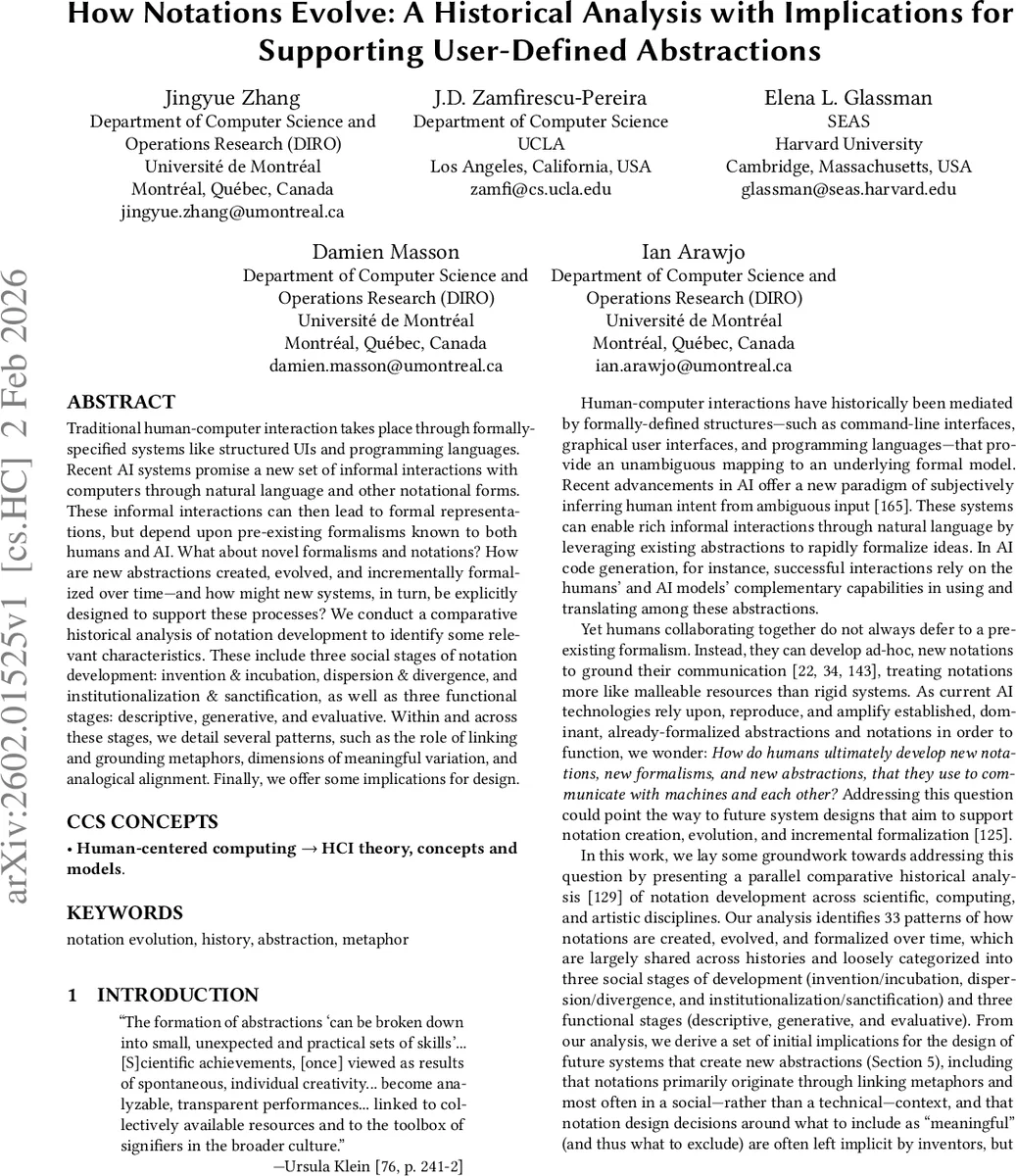
Traditional human-computer interaction takes place through formally-specified systems like structured UIs and programming languages. Recent AI systems promise a new set of informal interactions with computers through natural language and other notational forms. These informal interactions can then lead to formal representations, but depend upon pre-existing formalisms known to both humans and AI. What about novel formalisms and notations? How are new abstractions created, evolved, and incrementally formalized over time – and how might new systems, in turn, be explicitly designed to support these processes? We conduct a comparative historical analysis of notation development to identify some relevant characteristics. These include three social stages of notation development: invention & incubation, dispersion & divergence, and institutionalization & sanctification, as well as three functional stages: descriptive, generative, and evaluative. Within and across these stages, we detail several patterns, such as the role of linking and grounding metaphors, dimensions of meaningful variation, and analogical alignment. Finally, we offer some implications for design.
💡 Research Summary
The paper investigates how notations—formal or informal symbolic systems used to represent ideas—are created, spread, and institutionalized, with the goal of informing the design of future human‑computer interaction (HCI) technologies that can support user‑defined abstractions. The authors begin by contrasting traditional HCI, which relies on pre‑specified, formally defined interfaces such as command‑line shells, GUIs, and programming languages, with the emerging paradigm of large language models (LLMs) and other AI systems that can interpret ambiguous natural‑language input and quickly map it onto existing formal representations. While current AI systems excel at translating informal input into known formalisms, they do not yet facilitate the invention of entirely new notational systems that users might develop on the fly.
To uncover the underlying mechanisms, the authors conduct a parallel comparative‑historical analysis of 33 well‑documented notations drawn from scientific, computing, and artistic domains. Their methodology follows classic comparative‑historical research: selecting a broad set of cases, iteratively comparing them, and inductively extracting patterns that hold across contexts. The analysis yields a two‑dimensional stage model.
Social stages (the “life‑cycle” of a notation):
- Invention & Incubation – A small group of practitioners or an informal community creates a new notation to solve a concrete problem. This stage is driven by “linking” metaphors that ground abstract concepts in familiar experiences (e.g., arrows as “flows of force”).
- Dispersion & Divergence – The notation spreads to diverse users and domains, undergoing variations, forks, and sometimes controversies. Interaction with heterogeneous contexts forces the notation to adapt, leading to multiple dialects or extensions.
- Institutionalization & Sanctification – Formal bodies (academic societies, standards organizations, curricula) codify the notation, embed it in tools, and endow it with aesthetic and ideological significance. The notation becomes a “boundary object” that stabilizes communication across communities.
Functional stages (the purpose a notation serves at a given moment):
- Descriptive – Minimal symbols that record observations or ideas.
- Generative – Symbols that enable the creation of new constructs, support reasoning, and act as cognitive scaffolding.
- Evaluative – Symbols that allow the community to assess, compare, and legitimize the notation itself.
Cross‑referencing these dimensions, the authors identify 33 recurring patterns. The most salient include:
- Linking and grounding metaphors as the primary catalyst for invention.
- Dimensions of meaningful variation (form, structure, interpretation, context) that designers implicitly select when deciding what to include or exclude.
- Analogical alignment where new notations are mapped onto existing ones, facilitating rapid adoption.
- Social power, material constraints, and environmental factors that mediate uptake or resistance.
- Controversy and institutionalization that jointly fix not only the syntax but also the aesthetic values of a notation.
From these findings, the paper derives concrete design implications for AI‑enhanced HCI systems:
- Metaphor‑aware interfaces – Systems should detect users’ metaphorical language (e.g., “pipeline”, “bridge”) and suggest or instantiate corresponding visual or textual notations.
- Explicit manipulation of meaning‑variation – Provide a meta‑notation layer where users can declare, edit, and version‑control the semantics of newly created symbols, with immediate feedback on consistency.
- Dual pathways for formalization – Support both “horizontal” translation (mapping new symbols onto existing formal languages) and “vertical” creation (introducing genuinely novel syntactic forms) as illustrated by the “square of formality” in the paper.
- Collaborative institutional support – Offer shared repositories, community‑curated style guides, and lightweight governance mechanisms that allow emergent notations to be collectively refined and eventually standardized if desired.
- Power‑balanced tooling – By enabling users to define their own notations, systems can mitigate the designer‑centric power imbalance identified in prior work on creativity‑support tools.
In conclusion, the authors argue that future HCI should move beyond merely interpreting informal input within pre‑existing formalisms. Instead, it should actively facilitate the incremental creation, evolution, and institutionalization of user‑generated notations, turning them into first‑class objects that AI models can learn, reason about, and extend. Such capabilities would empower users to co‑design the symbolic scaffolding of their work, leading to more flexible, expressive, and equitable human‑computer collaboration.
Comments & Academic Discussion
Loading comments...
Leave a Comment