Are you going to finish that? A Practical Study of the Partial Token Problem
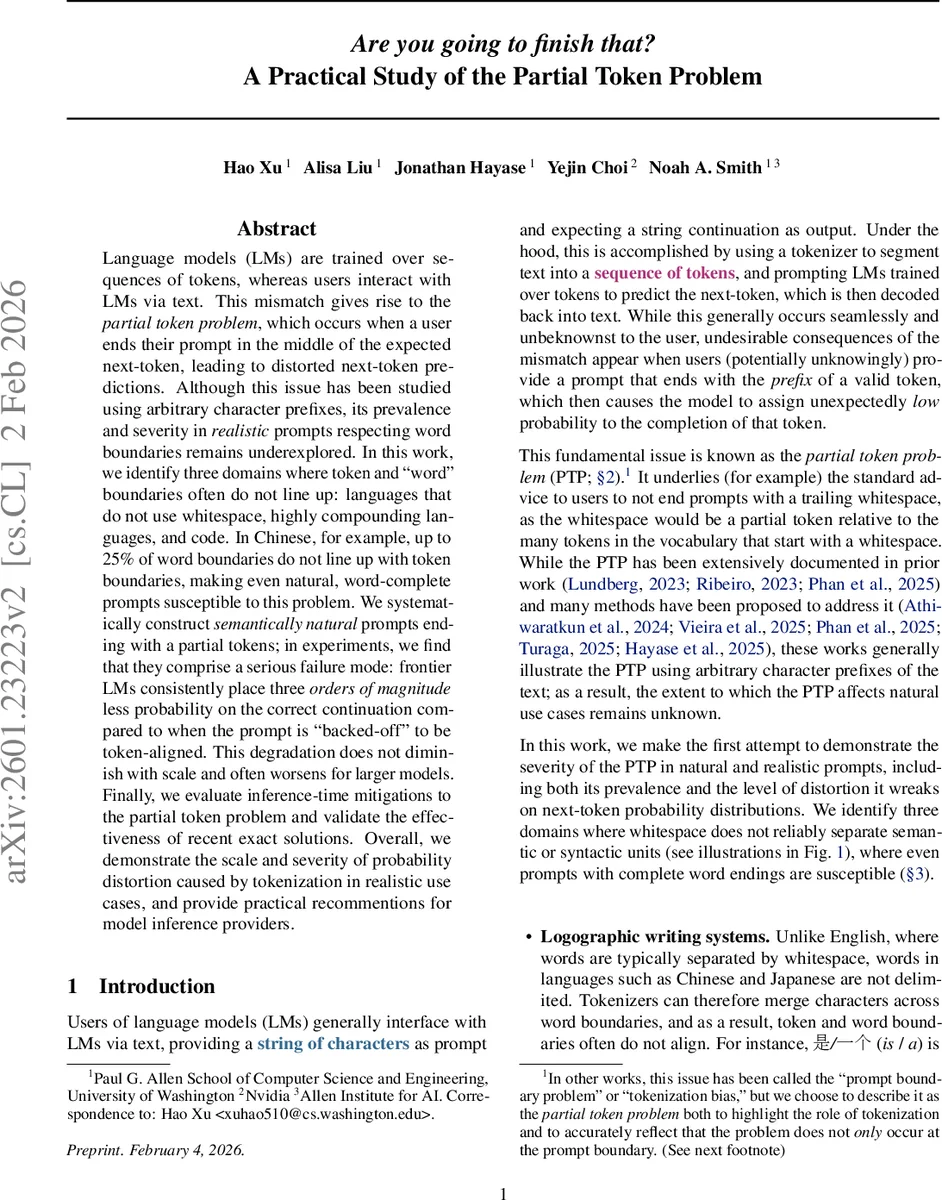
Language models (LMs) are trained over sequences of tokens, whereas users interact with LMs via text. This mismatch gives rise to the partial token problem, which occurs when a user ends their prompt in the middle of the expected next-token, leading to distorted next-token predictions. Although this issue has been studied using arbitrary character prefixes, its prevalence and severity in realistic prompts respecting word boundaries remains underexplored. In this work, we identify three domains where token and “word” boundaries often do not line up: languages that do not use whitespace, highly compounding languages, and code. In Chinese, for example, up to 25% of word boundaries do not line up with token boundaries, making even natural, word-complete prompts susceptible to this problem. We systematically construct semantically natural prompts ending with a partial tokens; in experiments, we find that they comprise a serious failure mode: frontier LMs consistently place three orders of magnitude less probability on the correct continuation compared to when the prompt is “backed-off” to be token-aligned. This degradation does not diminish with scale and often worsens for larger models. Finally, we evaluate inference-time mitigations to the partial token problem and validate the effectiveness of recent exact solutions. Overall, we demonstrate the scale and severity of probability distortion caused by tokenization in realistic use cases, and provide practical recommentions for model inference providers.
💡 Research Summary
The paper “Are you going to finish that? A Practical Study of the Partial Token Problem” investigates a subtle yet pervasive mismatch between how language models (LMs) are trained—on sequences of discrete tokens—and how end‑users interact with them—by typing raw text. This mismatch gives rise to the “partial token problem” (PTP): when a user’s prompt ends in the middle of a token that the model expects next, the model is forced to treat the incomplete token as a full token boundary, leading to dramatically distorted next‑token probabilities.
Prior work has demonstrated PTP using arbitrary character prefixes, but it remained unclear whether realistic prompts that respect natural word or syntactic boundaries are also vulnerable. The authors address this gap by focusing on three domains where token boundaries often do not align with semantic or syntactic units: (1) logographic languages without whitespace (e.g., Chinese, Japanese), (2) highly productive compounding languages (e.g., German), and (3) source code where punctuation and long identifiers are frequently merged into single tokens.
Quantifying Misalignment
The authors sampled 1,000 Chinese Wikipedia entries, 1,000 German Wikipedia entries, and 200 code snippets per language from the CodeXGLUE dataset. Using off‑the‑shelf word segmenters (Jieba for Chinese, CharSplit for German) and the tokenizers that accompany several state‑of‑the‑art LMs (LLaMA‑3, Hunyuan, DeepSeek‑V3, Mistral, Gemma, etc.), they measured the proportion of word (or syntactic) boundaries that do not coincide with token boundaries. Results show substantial misalignment: 14 %–25 % of Chinese word boundaries, about 6 %–9 % of German compound boundaries, and ≥50 % of punctuation boundaries in code (except for Gemini’s tokenizer at ~17 %). This demonstrates that even prompts that end on complete words can still trigger PTP in these settings.
Experimental Design – “Repeat‑After‑Me” Tasks
To isolate the effect of PTP, the authors construct a controlled “repeat‑after‑me” benchmark. For each selected sentence, they locate a word boundary that does not align with a token boundary, split the sentence at that point, and ask the model to repeat the full sentence while providing only the prefix (the part before the split) as the prompt. The continuation is unambiguous because the model is instructed to reproduce the exact original text. Two versions of each prompt are generated: (a) the partial‑token version ending at the misaligned boundary, and (b) a token‑aligned “back‑off” version that truncates to the previous token boundary. This design allows a direct comparison of model behavior under identical semantic context but differing tokenization constraints.
Findings – Probability Distortion and Scale Effects
Across a wide range of modern LMs, the partial‑token prompts cause a dramatic drop in the probability assigned to the correct next token. In many cases the probability is reduced by three to four orders of magnitude relative to the token‑aligned baseline. For Chinese, the correct token’s probability can fall from ~10⁻⁴ to ~10⁻⁸, a 10,000‑fold reduction. Accuracy on the repeat‑after‑me task drops from near‑perfect (when token‑aligned) to 60 %–95 % (when partial). Crucially, this degradation does not diminish with model size; larger models sometimes exhibit even larger probability gaps, suggesting that the issue is rooted in the token‑level training objective rather than model capacity.
Mitigation Strategies – Heuristics vs. Exact Solutions
The authors evaluate two families of mitigation techniques.
- Token Healing (heuristic) – This approach “backs off” the prompt by removing one or more tokens from the end and then constrains the generation to match the removed text. While it recovers some probability in low‑misalignment scenarios, its performance is inconsistent, especially for high‑misalignment domains like code and Chinese.
- Exact Methods (probability‑preserving) – Recent works (Vieira et al., Phan et al., Turaga, Hayase et al.) propose algorithms that enumerate all possible token sequences covering the given prefix, constructing a tree of alternatives and sampling a path that respects the original LM’s text‑level distribution. Implementing Hayase et al.’s tree‑sampling method, the authors achieve 100 % accuracy on the repeat‑after‑me benchmark across all domains, effectively eliminating the PTP.
Implications for Deployment
The study reveals that PTP is not a theoretical curiosity but a practical failure mode that can surface in everyday interactions with LLM APIs, especially for non‑English languages and code completion services. Relying on simple heuristics such as “don’t end prompts with a space” is insufficient. Service providers should consider integrating exact probability‑preserving post‑processing (e.g., tree‑based sampling) into their inference pipelines, or redesign tokenizers to better align with linguistic boundaries. Moreover, training data could be augmented with partial‑token contexts to make models more robust.
Conclusion
By systematically quantifying token‑word misalignment, constructing realistic partial‑token prompts, and rigorously evaluating both heuristic and exact mitigations, the paper demonstrates that the partial token problem can cause probability distortions of up to four orders of magnitude in realistic use cases. Exact, distribution‑preserving solutions fully resolve the issue, while heuristic methods provide only limited relief. The findings call for a re‑examination of tokenizer design, training data composition, and inference‑time handling of user prompts to ensure reliable behavior of large language models across diverse languages and code.
Comments & Academic Discussion
Loading comments...
Leave a Comment