Forming invariant stochastic differential systems with a given first integral
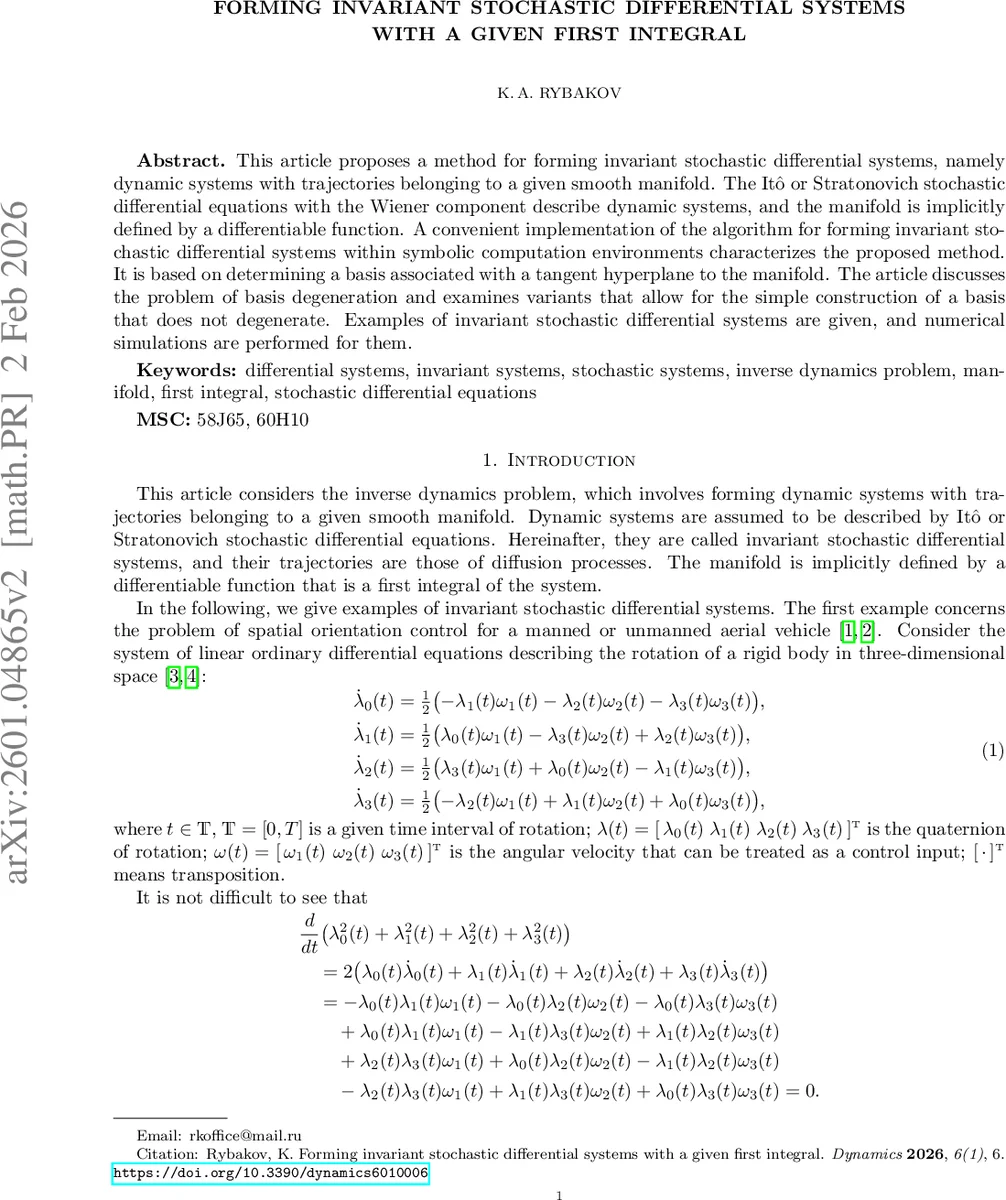
This article proposes a method for forming invariant stochastic differential systems, namely dynamic systems with trajectories belonging to a given smooth manifold. The Itô or Stratonovich stochastic differential equations with the Wiener component describe dynamic systems, and the manifold is implicitly defined by a differentiable function. A convenient implementation of the algorithm for forming invariant stochastic differential systems within symbolic computation environments characterizes the proposed method. It is based on determining a basis associated with a tangent hyperplane to the manifold. The article discusses the problem of basis degeneration and examines variants that allow for the simple construction of a basis that does not degenerate. Examples of invariant stochastic differential systems are given, and numerical simulations are performed for them.
💡 Research Summary
The paper addresses the inverse dynamics problem of constructing stochastic differential equations (SDEs) whose trajectories remain on a prescribed smooth manifold defined implicitly by a first integral M(t,x)=const. Both Itô and Stratonovich formulations are considered. The authors first recall the necessary and sufficient conditions for a function M(t,x) to be a first integral of an SDE: the diffusion columns must be orthogonal to the gradient ∇ₓM (Equation 7) and the drift must satisfy an orthogonality condition that includes a correction term involving the diffusion matrix (Equations 8 for Itô, 10 for Stratonovich).
To enforce these geometric constraints, the paper introduces an explicit construction of a basis for the tangent hyperplane of the manifold. Let G=∇ₓM and define N₁,…,N_{n‑1} as simple vectors that involve only two consecutive components of G (Equation 13). By design, each N_j is orthogonal to G, and non‑adjacent N_j and N_k are mutually orthogonal, yielding a tridiagonal Gram matrix. Proposition 1 shows that under mild non‑degeneracy assumptions (most components of G non‑zero) the set {G,N₁,…,N_{n‑1}} is linearly independent and its determinant has a closed‑form expression, guaranteeing a non‑degenerate basis.
With this basis, the diffusion matrix σ(t,x) is built as a linear combination of the N_j vectors: each column σ_{·l}=∑j φ{jl}(t,x) N_j, where the scalar functions φ_{jl} are freely chosen. This automatically satisfies the orthogonality condition (7). For the drift, the Stratonovich drift a(t,x) is taken as a scalar multiple of G or of any N_j, i.e., a=ψ(t,x) G or a=ψ(t,x) N_j, with ψ chosen to fulfill the remaining condition (10) (or its Itô counterpart (8) after adding the diffusion correction term Σ). Because the coefficients appear linearly, the method yields a minimal set of arbitrary functions needed to describe the whole family of invariant SDEs associated with the given first integral.
A major practical issue is basis degeneration when some components of G vanish. The authors discuss two remedies: (i) redefining the N_j vectors locally to avoid zero components, and (ii) applying a linear transformation (e.g., QR decomposition) to obtain an orthonormal basis that remains well‑conditioned. These strategies ensure that the algorithm works for high‑order systems (second, fourth, eighth order) without numerical instability.
Two illustrative examples are presented. The first concerns quaternion‑based attitude dynamics of an aircraft. The deterministic quaternion equations preserve the unit‑norm constraint |λ|²=1; by adding multiplicative Stratonovich noise (Equation 3) and using the proposed construction, the authors obtain σ and a that keep the quaternion on the three‑sphere. Numerical simulations (Milstein scheme) confirm that the stochastic trajectories stay on the sphere.
The second example deals with a four‑dimensional SDE driven by two independent Wiener processes (Equation 4). The first integral X₁X₃−X₂−X₄=0 defines a hypercylinder over a hyperbolic paraboloid. Using the tangent‑basis method, the authors derive σ and a that enforce this constraint, and they verify the invariant property with high‑order Rosenbrock‑type integrators.
Implementation details are provided for symbolic computation environments (Mathematica, Maple). The algorithm proceeds as: (1) compute ∇ₓM, (2) construct the N‑basis, (3) select arbitrary scalar functions φ and ψ, (4) assemble σ and a, (5) optionally orthonormalize the basis. This pipeline can be automated, allowing researchers to generate invariant SDEs for arbitrary manifolds without manual algebraic manipulation.
In conclusion, the paper offers a systematic, computationally tractable method for synthesizing stochastic differential systems that respect a prescribed first integral. By reducing the problem to linear algebra on the tangent space, it sidesteps the combinatorial explosion typical of determinant‑based coefficient formulas. The approach is applicable to control synthesis, robustness analysis, and validation of numerical schemes for SDEs with conserved quantities, and it opens avenues for extensions to non‑autonomous manifolds, degenerate diffusions, and data‑driven identification of first integrals.
Comments & Academic Discussion
Loading comments...
Leave a Comment