On (Newcomb-)Benford's law: a tale of two papers and of their disproportionate citations. How citation counts can become biased
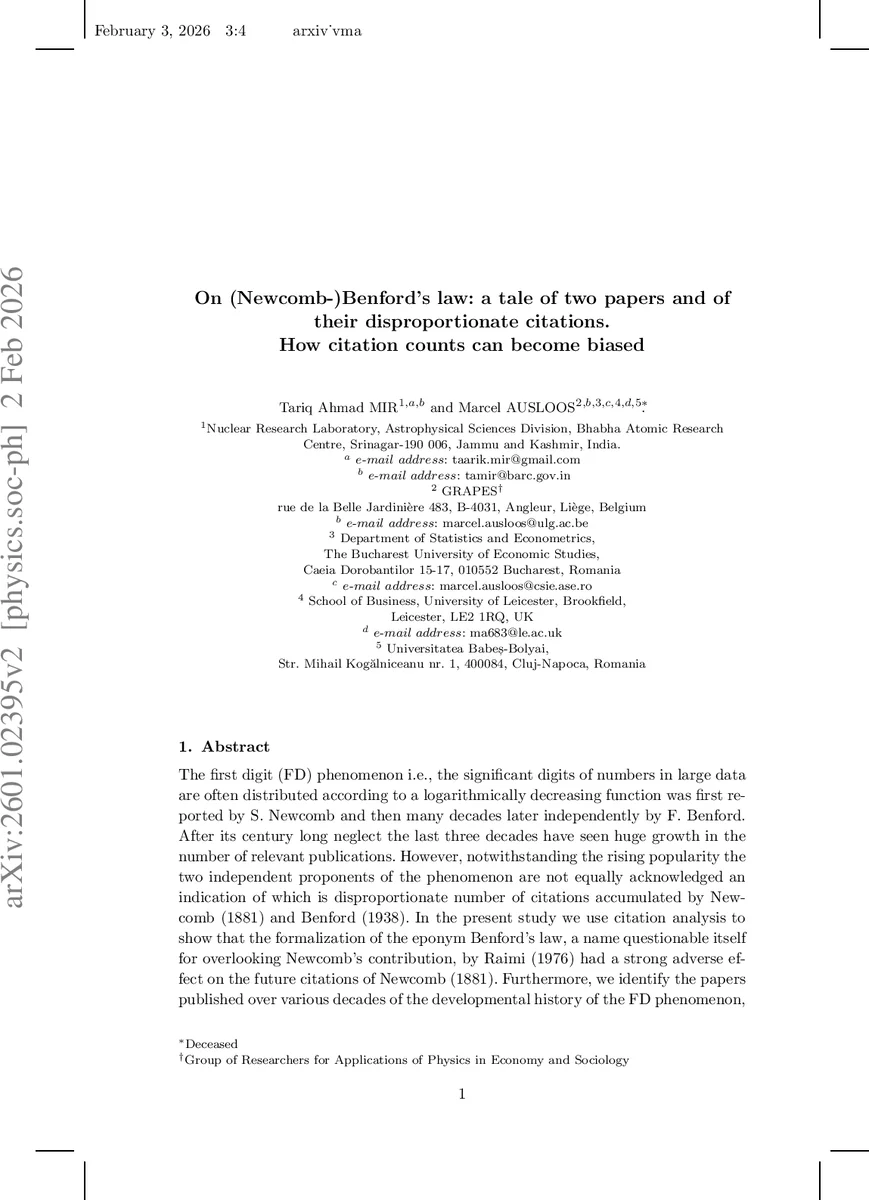
The first digit (FD) phenomenon i.e., the significant digits of numbers in large data are often distributed according to a logarithmically decreasing function was first reported by S. Newcomb and then many decades later independently by F. Benford. After its century long neglect the last three decades have seen huge growth in the number of relevant publications. However, notwithstanding the rising popularity the two independent proponents of the phenomenon are not equally acknowledged an indication of which is disproportionate number of citations accumulated by Newcomb (1881) and Benford (1938). In the present study we use citation analysis to show that the formalization of the eponym Benford’s law, a name questionable itself for overlooking Newcomb’s contribution, by Raimi (1976) had a strong adverse effect on the future citations of Newcomb (1881). Furthermore, we identify the papers published over various decades of the developmental history of the FD phenomenon, which latter turned out to be amongst the most cited ones in the field. We find that lack of its consideration, intentional or occasionally out of ignorance for referencing by the prominent papers, is responsible for a far lesser number of citations of Newcomb (1881) in comparison to Benford (1938).
💡 Research Summary
The paper investigates the citation dynamics surrounding the first‑digit phenomenon, historically discovered independently by Simon Newcomb in 1881 and Frank Benford in 1938. Although Newcomb’s original observation was a brief two‑page note, Benford’s later 20‑page article provided extensive empirical evidence across diverse fields and introduced the term “Benford’s Law.” The authors argue that the formalization of the eponym by Raimi in 1976, which largely ignored Newcomb’s contribution, created a structural bias that has persisted for decades.
Using the open‑access Benford Online Bibliography (BOB) – a curated database of over 2,300 items – and Google Scholar citation data, the study extracts a clean set of 2,028 scholarly records (excluding news items, blogs, and entries lacking reference lists). They track yearly publication counts, citation frequencies, and co‑citation patterns from 1938 to 2024. The analysis shows that the number of papers dealing with the first‑digit law grew dramatically after 1980, reaching over 100 per year in the 1990s, yet the proportion of citations to Benford’s 1938 paper consistently outstripped those to Newcomb’s 1881 note. By 2025, Google Scholar reported roughly 2,776 citations to Benford versus 1,483 to Newcomb – a disparity of nearly 90%.
Co‑citation analysis reveals that the two seminal works are cited together in only about 42% of the total citations. Benford’s paper is cited independently in roughly 21% of cases, whereas Newcomb’s paper appears alone in just about 2% of cases. The most highly cited contemporary papers (e.g., Hill 1995a, Nigrini 1996b) reference Benford’s law extensively but omit Newcomb entirely, illustrating a “citation cascade” where early authoritative sources shape subsequent referencing behavior.
The authors further demonstrate that even after Raimi’s 1976 review, which solidified the term “Benford’s Law,” many later highly cited papers either ignored Newcomb or were unaware of his contribution. This suggests that the bias is not merely due to ignorance but is reinforced by the naming convention itself, which influences literature searches, database indexing, and scholarly discourse.
In conclusion, the study provides quantitative evidence that the eponymous naming of the first‑digit phenomenon and the early citation network have entrenched a long‑standing citation imbalance. The authors call for more equitable citation practices, urging scholars to acknowledge all original contributors and to critically assess the impact of naming on scholarly visibility. This work highlights the broader informetric implications of citation bias and the need for systematic corrections in academic referencing systems.
Comments & Academic Discussion
Loading comments...
Leave a Comment