Discriminants and Large Pólya Groups in Septic Number Fields
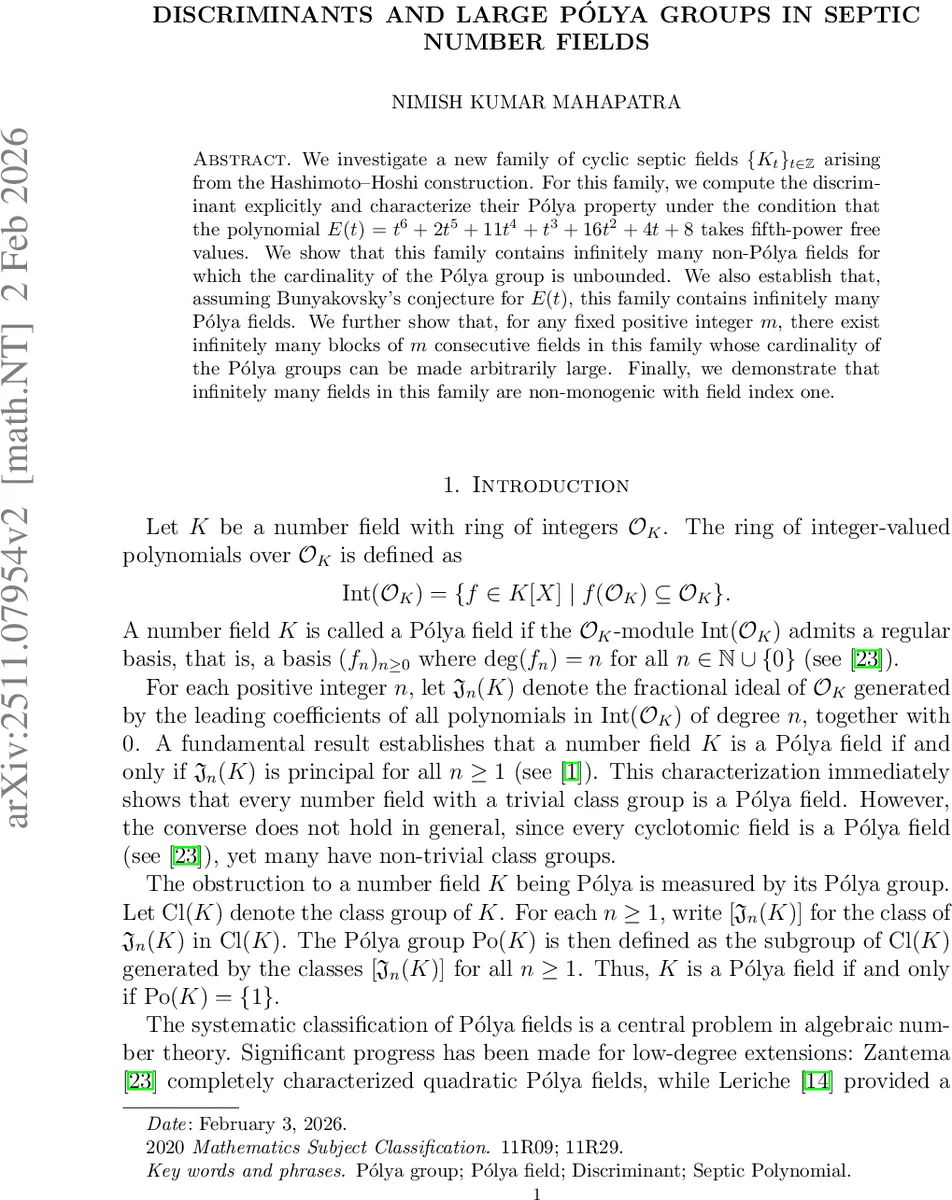
We investigate a new family of cyclic septic fields ${K_t}_{t\in\mathbb{Z}}$ arising from the Hashimoto–Hoshi construction. For this family, we compute the discriminant explicitly and characterize their Pólya property under the condition that the polynomial $E(t) = t^{6} + 2t^{5} + 11t^{4} + t^{3} + 16t^{2} + 4t + 8$ takes fifth-power free values. We show that this family contains infinitely many non-Pólya fields for which the cardinality of the Pólya group is unbounded. We also establish that, assuming Bunyakovsky’s conjecture for $E(t)$, this family contains infinitely many Pólya fields. We further show that, for any fixed positive integer $m$, there exist infinitely many blocks of $m$ consecutive fields in this family whose cardinality of the Pólya groups can be made arbitrarily large. Finally, we demonstrate that infinitely many fields in this family are non-monogenic with field index one.
💡 Research Summary
The paper studies a parametric family of cyclic septic fields {K_t} arising from the Hashimoto–Hoshi construction. For each integer t, let f_t(X) be the degree‑7 polynomial with coefficients a_i(t) given in the text and let K_t = ℚ(θ_t) where θ_t is a root of f_t. The authors first compute the discriminant of K_t explicitly. By applying a Tschirnhaus transformation and the theorem of Spiearman–Williams, they obtain a transformed polynomial g_t whose discriminant is
disc(g_t) = 7⁴²·E(t)⁶·(2t⁴−2t³+6t²−3t+4)²·(t⁵+t⁴+t³+2t²+t+1)² / m¹⁸,
where E(t)=t⁶+2t⁵+11t⁴+t³+16t²+4t+8 and m is a suitable integer divisor of the coefficients. From this they deduce the conductor
f(K_t) = 7^α·∏_{q≡1 (mod 7), q|E(t), v_q(E)≢0 (mod 7)} q,
with α = 0 unless t ≡ 2 (mod 7), in which case α = 2. This shows that the primes dividing the conductor are precisely the primes ≡1 (mod 7) that divide E(t) with exponent not a multiple of 7.
Using Chabert’s description of the Pólya group for cyclic extensions, they prove that the Pólya group Po(K_t) is a direct product of copies of ℤ/7ℤ, and its rank is governed solely by the number ω(E(t)) of distinct prime divisors of E(t). Precisely,
Po(K_t) ≅ (ℤ/7ℤ)^{ω(E(t))−2} if t is even, Po(K_t) ≅ (ℤ/7ℤ)^{ω(E(t))−1} if t is odd.
Consequently K_t is a Pólya field exactly when ω(E(t)) = 2 for even t or ω(E(t)) = 1 for odd t. The condition “E(t) is fifth‑power‑free” guarantees that the exponent of any prime divisor of E(t) is at most 4, which is needed for the conductor formula.
The authors then address the existence of infinitely many t satisfying the fifth‑power‑free condition. By invoking Erdős’s theorem on power‑free values of polynomials and a result of Halberstam–Richert on the distribution of ω(f(p)) for primes p, they show that there are infinitely many integers t for which E(t) is fifth‑power‑free and ω(E(t)) can be made arbitrarily large. Hence there are infinitely many non‑Pólya fields in the family whose Pólya groups have unbounded 7‑rank.
Assuming Bunyakovsky’s conjecture for the irreducible sextic E(t), the authors deduce that E(t) takes infinitely many prime values. For such t, ω(E(t)) = 1, and if t is odd the field K_t becomes a Pólya field. Thus, under this conjecture, the family contains infinitely many Pólya fields as well.
A further result concerns blocks of consecutive fields. For any fixed m ≥ 2 and any integer r > 1, the authors prove that there exist infinitely many integers t such that each of the m fields K_{t}, K_{t+1}, …, K_{t+m−1} has a Pólya group containing (ℤ/7ℤ)^r. The proof uses average‑order results for ω(E(t+i)) and a combinatorial pigeonhole argument to guarantee that each E(t+i) has at least r+1 distinct prime factors, all congruent to 1 modulo 7 and with exponents not divisible by 7.
Finally, the paper investigates monogenicity. By applying Gras’s criterion for monogenicity of cyclic extensions of prime degree, they note that a cyclic septic field can be monogenic only if 2·7+1 = 15 is prime, which is false. Consequently, for infinitely many t the field K_t has index 1 but is not generated by a single algebraic integer; i.e., it is non‑monogenic with field index one.
The manuscript includes an appendix with Maple scripts that verify the algebraic identities, compute discriminants, and test the power‑free condition for E(t). Overall, the work provides the first explicit infinite family of cyclic septic fields with a completely described Pólya group, demonstrates how to produce arbitrarily large Pólya groups within this family, and connects these phenomena to deep conjectures on prime values of polynomials and to monogenicity questions.
Comments & Academic Discussion
Loading comments...
Leave a Comment