Liouville properties for differential inequalities with $(p,q)$ Laplacian operator
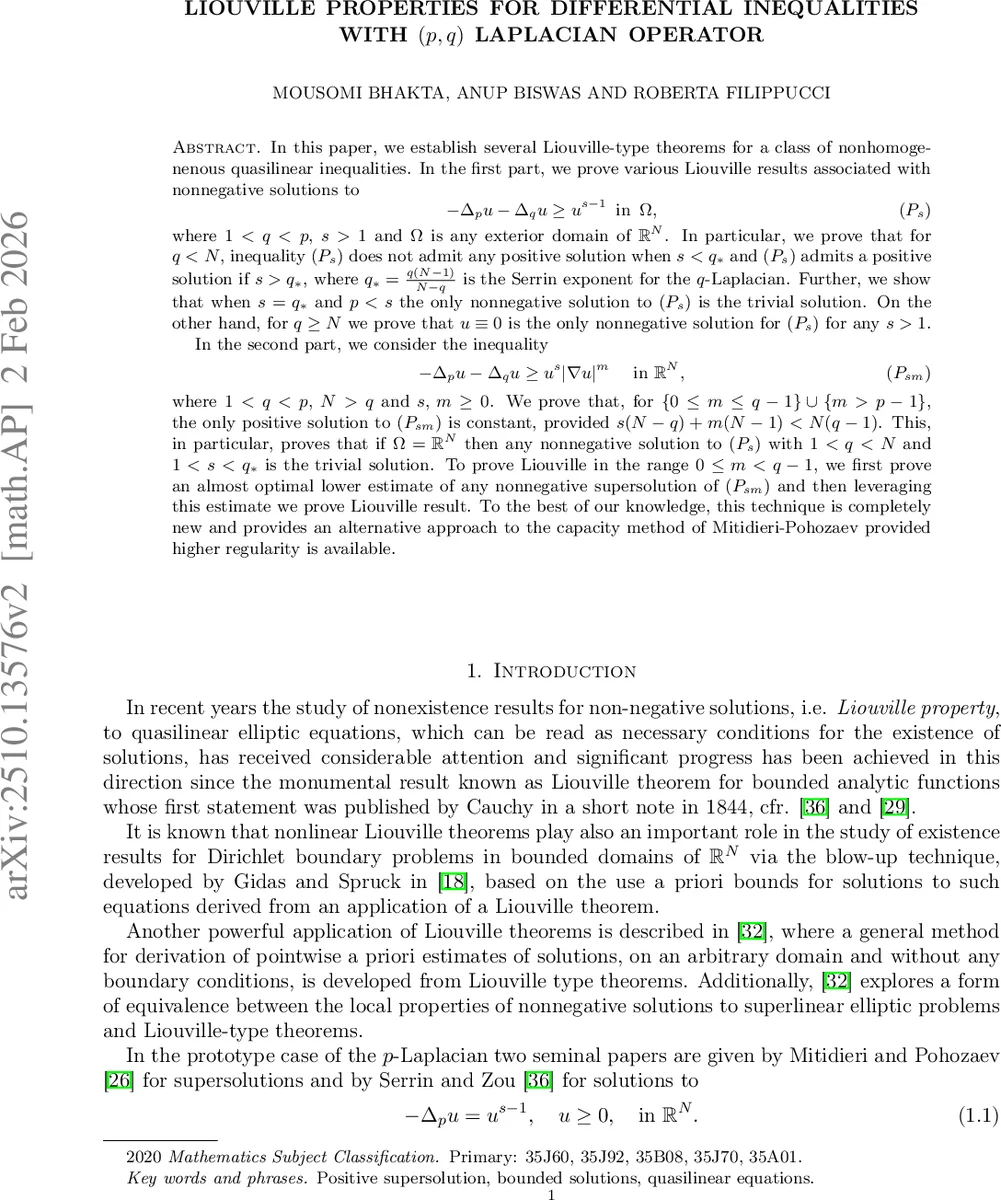
In this paper, we establish several Liouville-type theorems for a class of nonhomogenenous quasilinear inequalities. In the first part, we prove various Liouville results associated with nonnegative solutions to \begin{equation*}\tag{$P_s$} -Δ_p u-Δ_q u\geq u^{s-1} , \text{ in }, Ω, \end{equation*} where $1<q<p$, $s>1$ and $Ω$ is any exterior domain of $\mathbb{R}^N$. In particular, we prove that for $q<N$, inequality $(P_s)$ does not admit any positive solution when $s<q_$ and $(P_s)$ admits a positive solution if $s>q_$, where $q_=\frac{q(N-1)}{N-q}$ is the Serrin exponent for the $q$-Laplacian. Further, we show that when $s=q_$ and $p<s$ the only nonnegative solution to $(P_s)$ is the trivial solution. On the other hand, for $q\geq N$ we prove that $u\equiv 0$ is the only nonnegative solution for $(P_s)$ for any $s>1$. In the second part, we consider the inequality \begin{equation*}\tag{$P_{sm}$} -Δ_p u-Δ_q u \geq u^s |\nabla u|^m \quad \text{ in }\mathbb{R}^N, \end{equation*} where $1<q<p$, $N>q$ and $s, , m\geq 0$. We prove that, for ${0\leq m\leq q-1}\cup{m>p-1}$, the only positive solution to $(P_{sm})$ is constant, provided $s(N-q)+m(N-1)<N(q-1)$. This, in particular, proves that if $Ω=\mathbb{R}^N$ then any nonnegative solution to $(P_s)$ with $1<q<N$ and $1<s<q_*$ is the trivial solution. To prove Liouville in the range $0\leq m<q-1$, we first prove an almost optimal lower estimate of any nonnegative supersolution of $(P_{sm})$ and then leveraging this estimate we prove Liouville result. To the best of our knowledge, this technique is completely new and provides an alternative approach to the capacity method of Mitidieri-Pohozaev provided higher regularity is available.
💡 Research Summary
The paper establishes Liouville‑type non‑existence (or rigidity) results for two families of quasilinear elliptic inequalities driven by the non‑homogeneous (p,q)‑Laplacian operator, i.e. the sum of a p‑Laplacian and a q‑Laplacian with 1 < q < p.
The first inequality, denoted (Pₛ), is
‑Δₚu ‑ Δ_q u ≥ u^{s‑1} in an exterior domain Ω⊂ℝⁿ,
with s > 1. When q < N the Serrin critical exponent for the q‑Laplacian is q* = q(N‑1)/(N‑q). The authors prove:
- If q < N and s < q* then (Pₛ) admits no positive solution; any non‑negative supersolution must be identically zero.
- If s > q* a positive solution exists (explicit barrier functions are constructed).
- In the borderline case s = q* with p < s, the only non‑negative solution is the trivial one.
- When q ≥ N, the inequality has only the zero solution for every s > 1.
The proof rests on two lemmas. Lemma 1.2 provides a lower bound for any non‑negative (p,q)‑superharmonic function: u(x) ≥ κ|x|^{‑θ} with θ ≥ (N‑q)/(q‑1) when q < N, and a positive limit inferior when q ≥ N. Lemma 1.3 treats the more delicate case where a gradient term is present; under the sub‑critical condition
s(N‑q) + m(N‑1) < N(q‑1)
it yields an “almost optimal” lower estimate for supersolutions of
‑Δₚu ‑ Δ_q u ≥ u^{s}|∇u|^{m}.
An iterative scheme improves the lower bound at each step, ultimately forcing a contradiction when s < q*.
The second inequality, (P_{sm}), is considered on the whole space ℝⁿ:
‑Δₚu ‑ Δ_q u ≥ u^{s}|∇u|^{m}, with s,m ≥ 0, 1 < q < p, N > q.
The authors prove that if either 0 ≤ m ≤ q‑1 or m > p‑1 and the same sub‑critical relation s(N‑q)+m(N‑1) < N(q‑1) holds, then any positive solution must be constant; in particular, for the original (Pₛ) with 1 < s < q* the only global solution is u ≡ 0.
When m > p‑1 the result follows directly from the classical nonlinear capacity method of Mitidieri‑Pohozaev. The novelty lies in the range 0 ≤ m ≤ q‑1, where the authors cannot rely on homogeneity. Instead, they exploit the lower bound from Lemma 1.3, which compensates for the lack of scaling invariance and yields the Liouville property without invoking eigenfunctions or capacity arguments that require homogeneity.
Overall, the paper extends known Liouville theorems for the p‑Laplacian and q‑Laplacian to the mixed (p,q)‑Laplacian, identifies the same critical exponent q* as the threshold for existence, and introduces a new lower‑estimate technique that serves as an alternative to the traditional capacity method when higher regularity is available. The results have potential applications to models with anisotropic or multi‑phase diffusion, such as non‑Newtonian fluids, composite materials, and Born‑Infeld type electromagnetic equations.
Comments & Academic Discussion
Loading comments...
Leave a Comment