A functional Loomis-Whitney type inequality in the Heisenberg group and projection theorems over finite fields
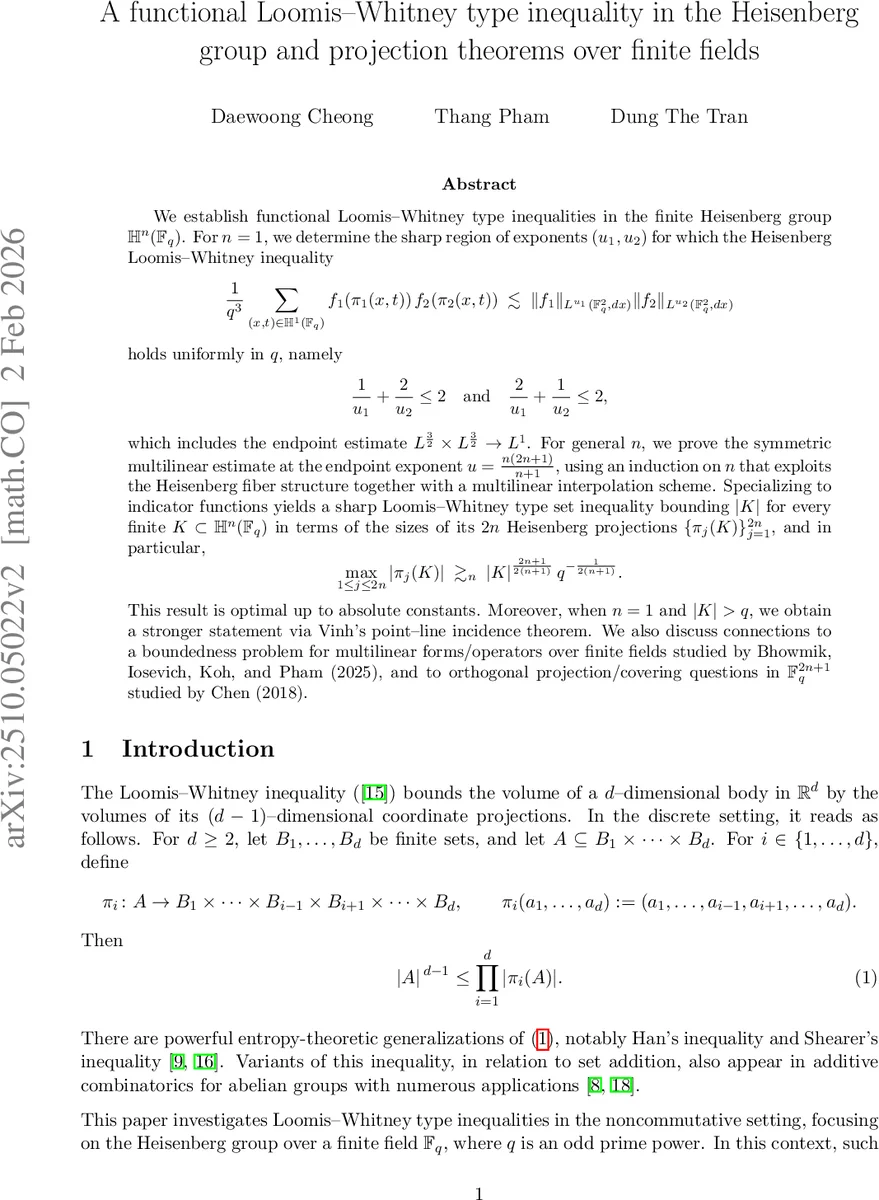
We establish functional Loomis–Whitney type inequalities in the finite Heisenberg group $\mathbb{H}^n(\mathbb{F}q)$. For $n=1$, we determine the sharp region of exponents $(u_1,u_2)$ for which the Heisenberg Loomis–Whitney inequality [ \frac{1}{q^3}\sum{(x,t)\in \mathbb{H}^1(\mathbb{F}q)} f_1(π_1(x,t)),f_2(π_2(x,t)) ;\lesssim; |f_1|{L^{u_1}(\mathbb{F}q^2,dx)}|f_2|{L^{u_2}(\mathbb{F}q^2,dx)} ] holds uniformly in $q$, namely [ \frac{1}{u_1}+\frac{2}{u_2}\le 2 \quad\text{and}\quad \frac{2}{u_1}+\frac{1}{u_2}\le 2, ] which includes the endpoint estimate $L^{\frac{3}{2}}\times L^{\frac{3}{2}}\to L^1$. For general $n$, we prove the symmetric multilinear estimate at the endpoint exponent $ u=\frac{n(2n+1)}{n+1}, $ using an induction on $n$ that exploits the Heisenberg fiber structure together with a multilinear interpolation scheme. Specializing to indicator functions yields a sharp Loomis–Whitney type set inequality bounding $|K|$ for every finite $K\subset \mathbb{H}^n(\mathbb{F}q)$ in terms of the sizes of its $2n$ Heisenberg projections ${π_j(K)}{j=1}^{2n}$, and in particular, [ \max{1\le j\le 2n} |π_j(K)| ;\gtrsim_n; |K|^{\frac{2n+1}{2(n+1)}},q^{-\frac{1}{2(n+1)}}. ] This result is optimal up to absolute constants. Moreover, when $n=1$ and $|K|>q$, we obtain a stronger statement via Vinh’s point–line incidence theorem. We also discuss connections to a boundedness problem for multilinear forms/operators over finite fields studied by Bhowmik, Iosevich, Koh, and Pham (2025), and to orthogonal projection/covering questions in $\mathbb{F}_q^{2n+1}$ studied by Chen (2018).
💡 Research Summary
This paper establishes functional Loomis‑Whitney type inequalities in the finite Heisenberg groups (\mathbb H^n(\mathbb F_q)). The authors treat both the planar case (n=1) and the higher‑dimensional case (n\ge 2), providing sharp exponent ranges, endpoint estimates, and applications to set‑theoretic projection bounds.
Main objects and notation.
For a positive integer (n) the Heisenberg group (\mathbb H^n(\mathbb F_q)) is the set (\mathbb F_q^{2n+1}) equipped with the non‑commutative product
\
Comments & Academic Discussion
Loading comments...
Leave a Comment