Initial value space of the four dimensional Painlevé system with $(A_5+A_1)^{(1)}$ symmetry
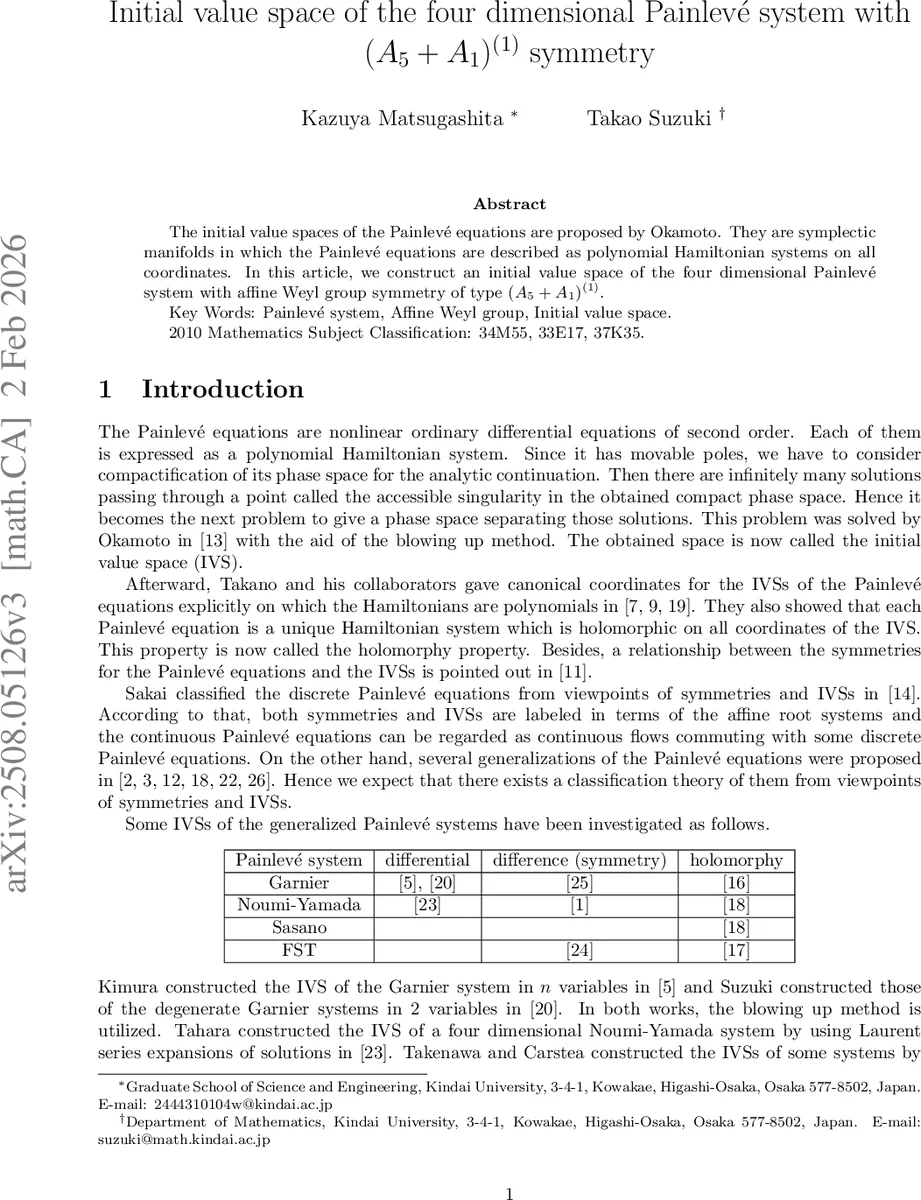
The initial value spaces of the Painlevé equations are proposed by Okamoto. They are symplectic manifolds in which the Painlevé equations are described as polynomial Hamiltonian systems on all coordinates. In this article, we construct an initial value space of the four dimensional Painlevé system with affine Weyl group symmetry of type $(A_5+A_1)^{(1)}$.
💡 Research Summary
The paper addresses the construction of an initial value space (IVS) for a four‑dimensional Painlevé system possessing the affine Weyl group symmetry of type ((A_{5}+A_{1})^{(1)}). The motivation follows Okamoto’s seminal work on the IVS for the classical Painlevé equations, where compactification of the phase space is required to handle movable poles and to obtain a uniform foliation of solutions. While Okamoto’s theory was originally confined to the six second‑order Painlevé equations, recent developments have extended the concept to higher‑dimensional integrable systems, yet a systematic IVS for the four‑dimensional FST (Fukuda‑Sakai‑Takano) system had been lacking.
The authors begin by recalling the four‑dimensional FST system, which can be written as a polynomial Hamiltonian system in two canonical pairs ((q_{1},p_{1})) and ((q_{2},p_{2})). The Hamiltonian is a sum of two Painlevé‑VI type Hamiltonians (H_{VI}) with shifted parameters, plus a coupling term that is rational in the independent variable (t). The parameters (\alpha_{0},\dots,\alpha_{5},\eta) satisfy the linear constraint (\sum_{i=0}^{5}\alpha_{i}=1). The system is invariant under a set of birational transformations ({r_{0},\dots,r_{5},r’{0},\pi{1},\pi_{2},\rho}) which generate an extended affine Weyl group isomorphic to ((A_{5}+A_{1})^{(1)}). The actions on both the parameters and the phase‑space variables are given explicitly; the (r_{i}) generate the (A_{5}) part, while (r’{0},\pi{1},\pi_{2},\rho) generate the (A_{1}) part. This rich symmetry is a cornerstone for the later construction of the IVS.
To compactify the phase space, the authors introduce a (\mathbb{P}^{2})-bundle (\Sigma_{\eta}) over (\mathbb{P}^{2}). Starting from homogeneous coordinates (\xi=
Comments & Academic Discussion
Loading comments...
Leave a Comment