Classification and Nomenclature of Planets in the Mass-Radius Plane
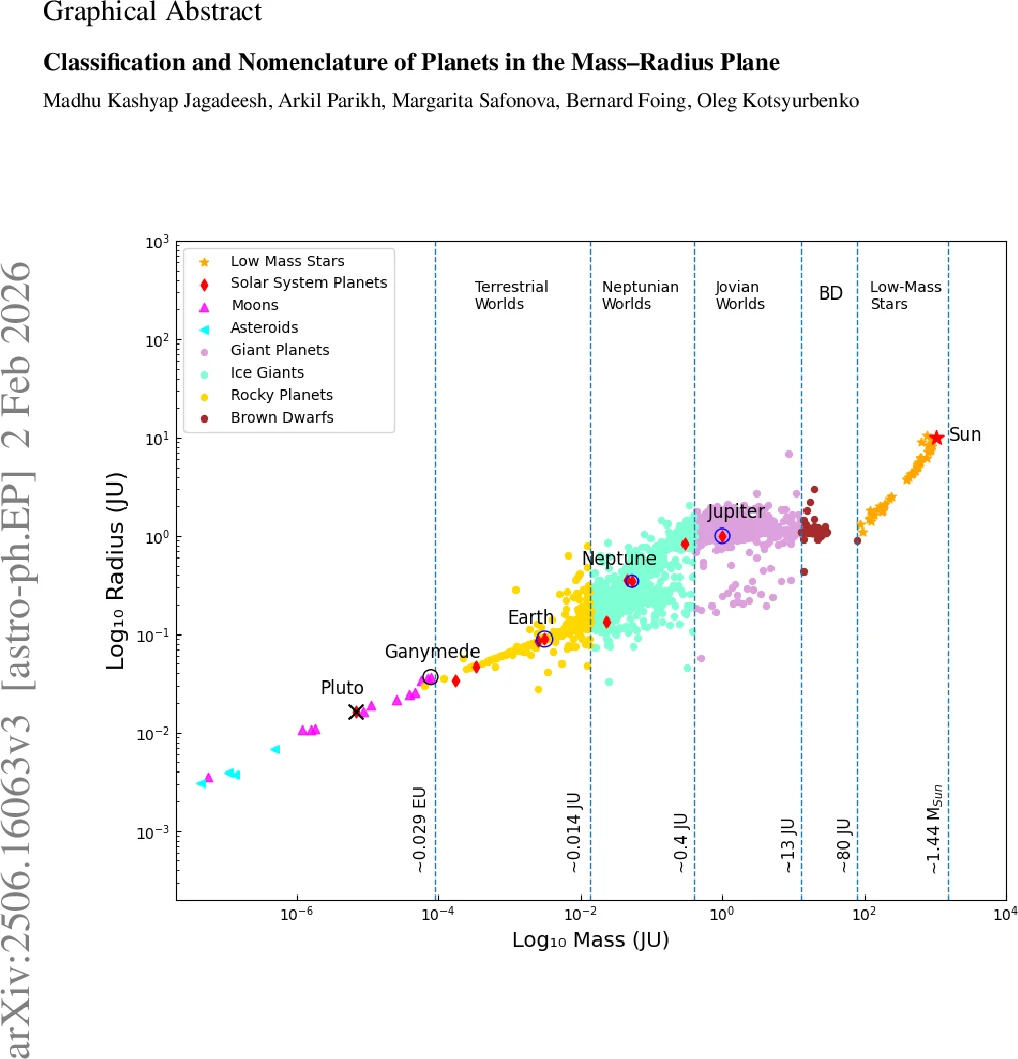
6500+ exoplanets have been detected using various techniques. This prompted the emergence of many recent works on the taxonomy, or classification, of exoplanets. However, there is still no basic, fundamental definition of ‘What is a planet?’. IAU has forwarded a definition in 2006, which however, raised more questions than it solved. The first task here is to establish if there are limits on the size/mass of planets. The lower mass limit may be assumed as of Mimas (0.03 EU) - approximately minimum mass required to attain a nearly spherical hydrostatic equilibrium shape. The upper mass limit may be easier - there is a natural lower limit to what constitutes a star: 0.08 SU. But then there are brown dwarfs: IAU has defined brown dwarfs as objects exceeding the deuterium burning limit (~13 JU), and giant exoplanets generally have masses of 0.3 to 60 JU. The resolution requires assembling the basic physical parameters that define planets quantitatively. Mass and radius are the two fundamental properties, and we propose to use a third correlated parameter: the moment of inertia. Based on this, we create the parametric Fundamental Planetary Plane where the two parameters are correlated with the third. The fundamental planetary plane (FPP) with turn-off point diagrams is constructed for visual representation. We propose an alternate potential description of a planet definition as ‘A celestial spherical object, bound to a star or unbound, that lies on the fundamental planetary plane, within a mass range between 0.02 EU to 13 JU’. This definition is intended to complement existing taxonomies by providing a quantitative, structure-based criterion applicable to both Solar System planets, exoplanets and free-floating planets. These turn-off point diagrams serve as an alternative to the Hertzsprung-Russell (HR) diagram, but for planets.
💡 Research Summary
**
The paper addresses the long‑standing problem of defining what constitutes a planet in the era of thousands of known exoplanets and free‑floating planetary‑mass objects. The authors argue that the 2006 IAU definition—requiring orbit around the Sun, hydrostatic equilibrium, and orbital clearing—is inadequate for extrasolar systems and ambiguous even within the Solar System. To overcome these limitations, they propose a physically grounded classification based on three fundamental bulk properties: mass (M), radius (R), and moment of inertia (I).
Using a self‑gravitating polytropic model, the moment of inertia is expressed as I = kₙ M R², where kₙ depends on the polytropic index n and therefore on the degree of central condensation. Because I cannot be measured directly for most exoplanets, the authors adopt a uniform‑solid‑sphere approximation for all bodies, providing a consistent baseline across planets, moons, asteroids, brown dwarfs, and low‑mass stars.
The authors compile a comprehensive dataset from the PHL‑HWC exoplanet catalog (≈5 600 planets), NASA planetary fact sheets, and the Chen & Kipping (2017) mass–radius relations for low‑mass stars. They plot the entire mass–radius space, colour‑coding each point by its inferred I, thereby constructing a three‑dimensional “Fundamental Planetary Plane” (FPP) analogous to the Hertzsprung–Russell diagram for stars. Within this plane, distinct clusters emerge that correspond to (i) small rocky bodies (asteroids, moons, rocky exoplanets), (ii) classical planets, (iii) dwarf‑planet‑like objects, (iv) brown dwarfs, and (v) low‑mass stars.
Two empirical “turn‑off” points are identified. The lower turn‑off occurs near M ≈ 0.02 Earth masses (≈0.03 M⊕), comparable to the mass of Mimas and representing the minimum mass required for hydrostatic rounding. The upper turn‑off lies at M ≈ 13 Jupiter masses, coinciding with the deuterium‑burning limit that separates brown dwarfs from giant planets. Objects that fall between these two limits and occupy the central cluster of the FPP are classified as planets, regardless of whether they orbit a star or drift freely through interstellar space.
The authors further illustrate the utility of the FPP by placing Pluto on the diagram; it resides on the boundary between the dwarf‑planet and asteroid clusters, confirming that it does not satisfy the planetary region of the plane. Similarly, the “turn‑off” diagrams for moons, asteroids, and dwarf planets are shown, each defining its own sub‑plane within the broader FPP framework.
Based on these findings, the paper proposes a new, quantitative planet definition: “A celestial spherical object, bound to a star or unbound, that lies on the Fundamental Planetary Plane within a mass range of 0.02 Earth masses to 13 Jupiter masses.” This definition eliminates the need for the ambiguous orbital‑clearing criterion and extends naturally to free‑floating planets.
The authors acknowledge limitations: the uniform‑sphere assumption neglects internal stratification, and the value of kₙ is sensitive to the chosen polytropic index, potentially shifting the exact boundaries of the plane. They suggest that future work incorporating detailed interior models, asteroseismic constraints, and direct measurements of moments of inertia (e.g., via gravitational microlensing or transit timing variations) will refine the FPP.
In summary, the study introduces the Fundamental Planetary Plane as a robust, physics‑based tool for planetary classification, identifies natural mass thresholds that separate planets from other celestial bodies, and offers a clear, quantitative definition that is applicable across the full diversity of planetary systems discovered to date. This framework promises to bring greater consistency to planetary taxonomy and to guide future observational and theoretical investigations of planetary formation and evolution.
Comments & Academic Discussion
Loading comments...
Leave a Comment