Stability analysis of time-periodic shear flow generated by an oscillating density interface
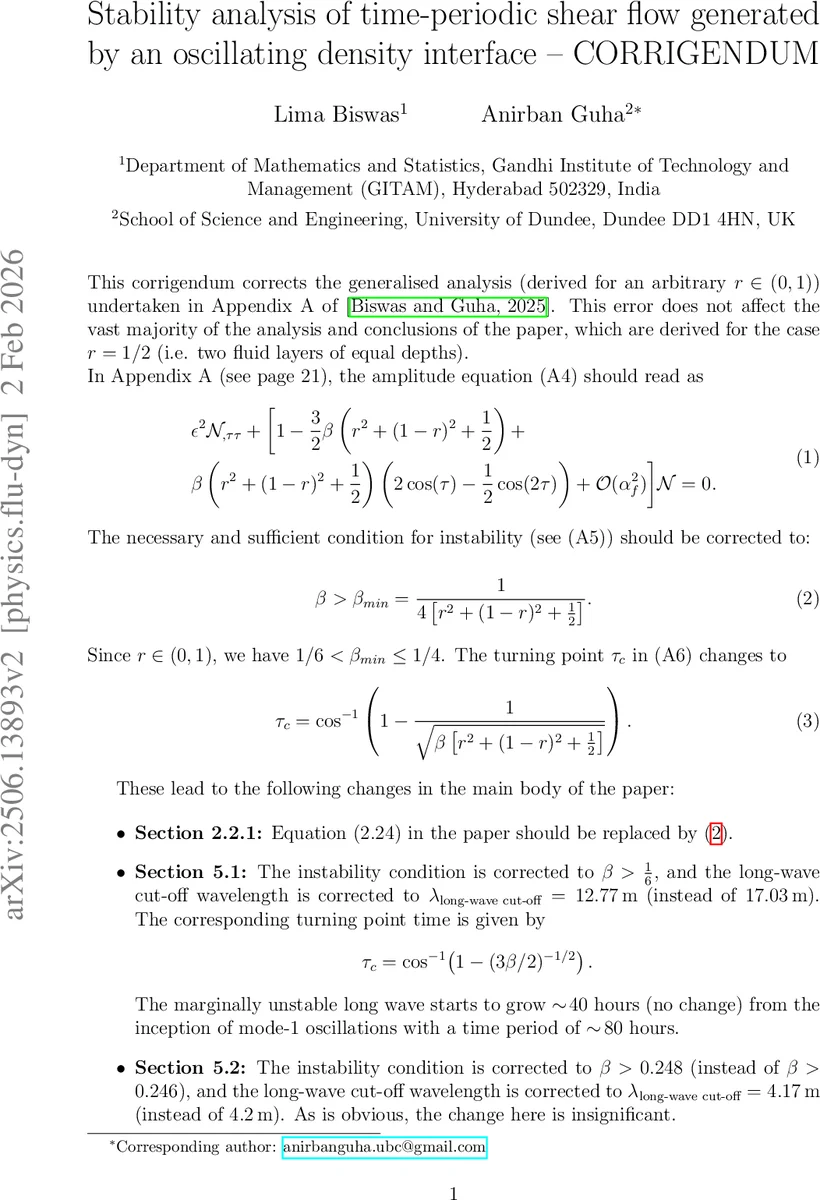
We consider the conceptual two-layered oscillating tank of Inoue & Smyth (2009), which mimics the time-periodic parallel shear flow generated by low-frequency (e.g. semi-diurnal tides) and small-angle oscillations of the density interface. Such self-induced shear of an oscillating pycnocline may provide an alternate pathway to pycnocline turbulence and diapycnal mixing in addition to the turbulence and mixing driven by wind-induced shear of the surface mixed layer. We theoretically investigate shear instabilities arising in the inviscid two-layered oscillating tank configuration and show that the equation governing the evolution of linear perturbations on the density interface is a Schrödinger-type ordinary differential equation with a periodic potential. The necessary and sufficient stability condition is governed by a nondimensional parameter $β$ resembling the inverse Richardson number; for two layers of equal thickness, instability arises when $β!>!1/4$. When this condition is satisfied, the flow is initially stable but finally tunnels into the unstable region after reaching the time marking the turning point. Once unstable, perturbations grow exponentially and reveal characteristics of Kelvin-Helmholtz (KH) instability. The Modified Airy Function method, which is an improved variant of the Wentzel-Kramers-Brillouin (WKB) theory, is implemented to obtain a uniformly valid, composite approximate solution to the interface evolution. Next, we analyse the fully nonlinear stages of interface evolution by modifying the circulation evolution equation in the standard vortex blob method, which reveals that the interface rolls up into KH billows. Finally, we undertake real case studies of Lake Geneva and Chesapeake Bay to provide a physical perspective.
💡 Research Summary
The paper investigates the stability of a time‑periodic shear flow that is generated by the oscillation of a density interface in a two‑layer fluid system, a configuration originally introduced by Inoue & Smyth (2009). The authors consider an idealised rectangular tank whose whole body is tilted back and forth with a small angle α(t)=α_f sin(ω_f t). The tilt creates a buoyancy‑driven horizontal shear: the upper and lower layers acquire opposite, depth‑independent velocities U₁(t)=+U₀(t) and U₂(t)=−U₀(t), where U₀(t)= (g′ α_f/2ω_f)(1−cos ω_f t) and g′=g(ρ₂−ρ₁)/ρ₀.
Linearising about this background flow, the authors introduce an infinitesimal interfacial displacement ξ(x,t)=η(t) e^{ikx} and solve the Laplace equation for the velocity potentials in each layer together with kinematic and dynamic boundary conditions. The result is a single ordinary differential equation for η(t):
η̈ +
Comments & Academic Discussion
Loading comments...
Leave a Comment