The theory of planar ballistic SNS junctions at $T=0$
The Letter presents the theory of planar ballistic SNS junctions at $T=0$ for any normal layer thickness $L$ taking into account phase gradients in superconducting leads. The current-phase relation was derived in the model of the steplike pairing potential analytically and is exact in the limit of large ratio of the Fermi energy to the superconducting gap. At small $L$ (short junction) the obtained current-phase relation is essentially different from that in the previous theory neglecting phase gradients. It was confirmed by recent numerical calculations and was observed in the experiment on short InAs nanowire Josephson junctions. The analysis resolves the problem with the charge conservation law in the steplike pairing potential model.
💡 Research Summary
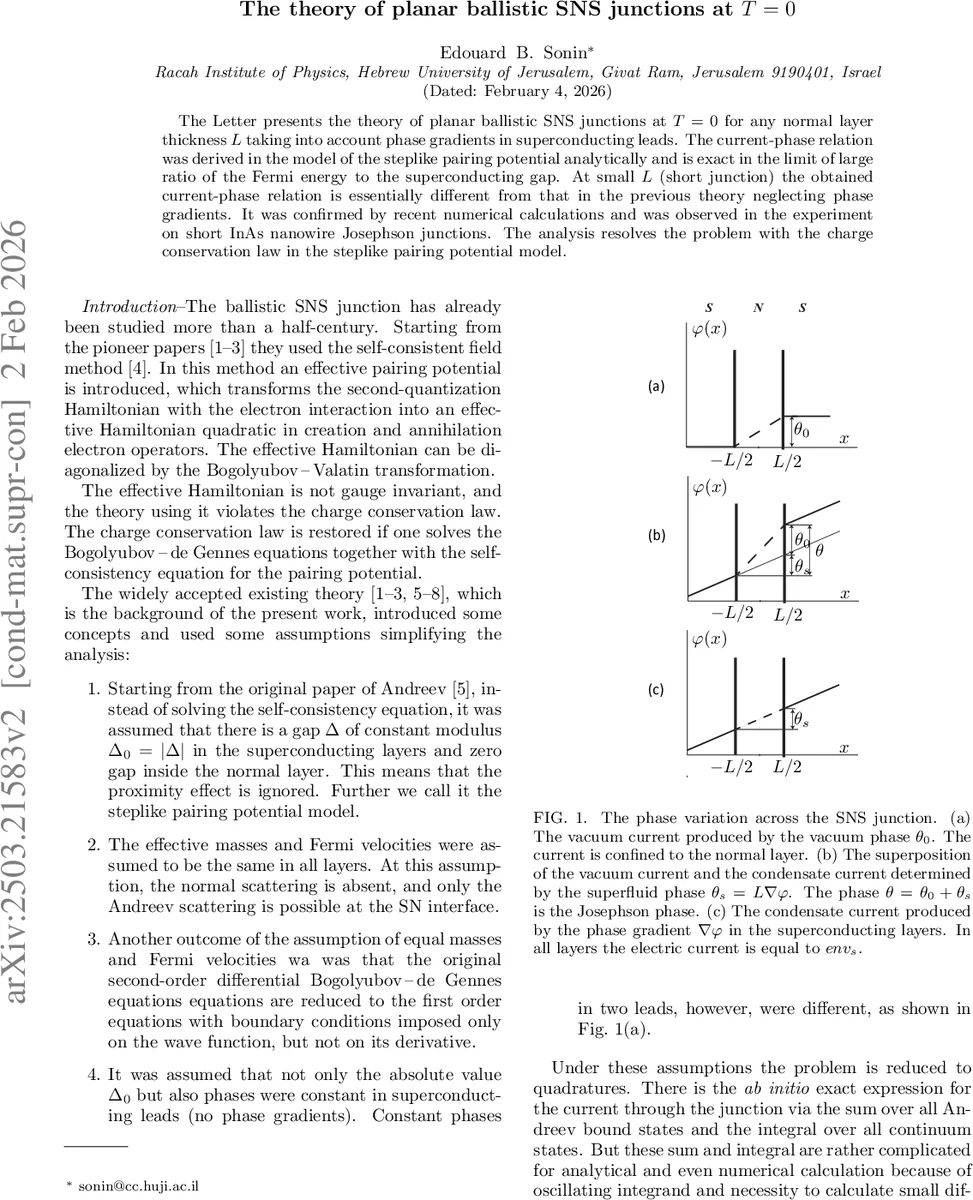
The paper presents a comprehensive analytical theory of planar ballistic superconductor–normal–superconductor (SNS) junctions at zero temperature for arbitrary normal‑layer thickness L, explicitly incorporating phase gradients in the superconducting leads. Historically, the standard approach to SNS junctions has relied on a “step‑like” pairing potential: a constant magnitude Δ₀ with a fixed phase in the superconductors and zero gap in the normal metal. While this simplification makes the Bogoliubov‑de Gennes (BdG) equations tractable, it violates charge conservation because the resulting current flows only in the normal region. The authors resolve this long‑standing issue by allowing the superconducting order parameter to acquire a linear phase profile, Δ(x)=Δ₀ e^{iθ₀+i∇φ·x} for |x|>L/2 and zero otherwise, where θ₀ is the “vacuum phase” and θ_s=L∇φ is the “superfluid phase” accumulated across the normal slab.
Solving the BdG equations exactly for any choice of θ₀ and θ_s, the authors find that the total current can be expressed as a sum of a vacuum current J_v (carried solely by the normal layer and dependent on θ₀) and an excitation current J_q (arising from the occupation of Andreev bound states). At T=0, J_q appears only when the lowest Andreev level reaches zero energy, i.e., at the Landau critical current. Charge conservation demands J_v+J_q=0, which yields a new current‑phase relation (CPR).
A key insight is that the ground state with zero phase gradients can be transformed into the state with finite ∇φ by a Galilean boost. This transformation leaves the spectrum invariant but adds a uniform superfluid velocity v_s=ħ∇φ/2m to all quasiparticles. Consequently, the total current in all layers becomes J=J_s=env_s=J₀θ/π, where J₀=πeħk_F/(2mL) and θ=θ₀+θ_s. This linear CPR holds for any L in the limit of a large Fermi‑energy‑to‑gap ratio, confirming that the linear relation is robust beyond the step‑like model.
The authors then examine the short‑junction limit (L→0). In this regime the normal metal disappears and the junction reduces to a uniform superconductor. The CPR deviates markedly from the linear form; the exact analytical expression becomes J=J₀ sinθ/(1+|cosθ|), a non‑sinusoidal, saw‑tooth‑like curve that differs from the traditional saw‑tooth J=J₀θ/π predicted by earlier theories. The deviation is maximal near θ≈π/2 and vanishes only for long junctions (L≫ξ₀, where ξ₀=ħv_F/Δ₀). This result reconciles recent numerical studies (Riedel et al., Krekels et al.) that observed a constant phase gradient across the whole structure, and it matches experimental measurements on short InAs nanowire Josephson junctions, which display a distinctly non‑linear CPR.
The paper also discusses the physical picture: the “vacuum current” flows only in the normal region, while the “condensate current” associated with the phase gradient flows throughout the superconducting leads, ensuring global charge conservation. The previous theory, which ignored the condensate contribution, incorrectly identified the total current with the vacuum component alone. By restoring the condensate current, the authors provide a self‑consistent description of charge transport that satisfies the continuity equation without invoking the full self‑consistency equation for Δ(x).
In summary, the work (i) resolves the charge‑conservation paradox in the step‑like pairing potential model, (ii) derives an exact analytical CPR for arbitrary L at T=0, (iii) demonstrates that short‑junction behavior is fundamentally different from the long‑junction limit, and (iv) validates the theory against state‑of‑the‑art numerical simulations and recent experimental data. The findings have immediate implications for the design of superconducting quantum circuits, especially those employing short ballistic SNS weak links, where the phase gradient in the leads must be accounted for to predict the correct Josephson dynamics.
Comments & Academic Discussion
Loading comments...
Leave a Comment