Code Digital Twin: A Knowledge Infrastructure for AI-Assisted Complex Software Development
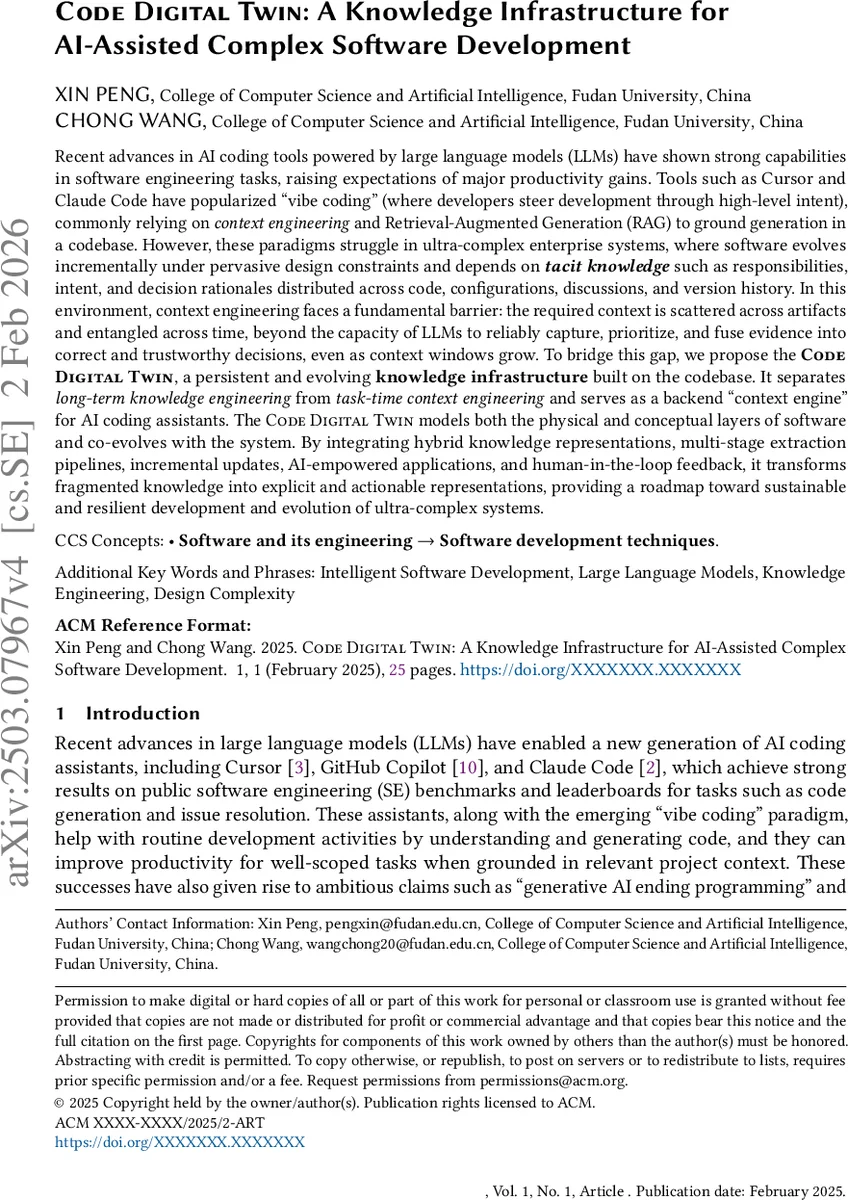
Recent advances in AI coding tools powered by large language models (LLMs) have shown strong capabilities in software engineering tasks, raising expectations of major productivity gains. Tools such as Cursor and Claude Code have popularized “vibe coding” (where developers steer development through high-level intent), commonly relying on context engineering and Retrieval-Augmented Generation (RAG) to ground generation in a codebase. However, these paradigms struggle in ultra-complex enterprise systems, where software evolves incrementally under pervasive design constraints and depends on tacit knowledge such as responsibilities, intent, and decision rationales distributed across code, configurations, discussions, and version history. In this environment, context engineering faces a fundamental barrier: the required context is scattered across artifacts and entangled across time, beyond the capacity of LLMs to reliably capture, prioritize, and fuse evidence into correct and trustworthy decisions, even as context windows grow. To bridge this gap, we propose the Code Digital Twin, a persistent and evolving knowledge infrastructure built on the codebase. It separates long-term knowledge engineering from task-time context engineering and serves as a backend “context engine” for AI coding assistants. The Code Digital Twin models both the physical and conceptual layers of software and co-evolves with the system. By integrating hybrid knowledge representations, multi-stage extraction pipelines, incremental updates, AI-empowered applications, and human-in-the-loop feedback, it transforms fragmented knowledge into explicit and actionable representations, providing a roadmap toward sustainable and resilient development and evolution of ultra-complex systems.
💡 Research Summary
The paper opens by observing that recent large‑language‑model (LLM) powered coding assistants (e.g., Cursor, GitHub Copilot, Claude Code) have enabled a “vibe‑coding” workflow in which developers steer development through high‑level intent rather than low‑level syntax. This workflow relies heavily on context engineering and Retrieval‑Augmented Generation (RAG) to ground model output in the current codebase. While effective for well‑scoped, short‑term tasks, the authors argue that this paradigm collapses when applied to ultra‑complex, long‑lived enterprise systems. In such environments, essential knowledge—responsibilities, design rationales, historical decisions, non‑functional constraints—is scattered across source files, configuration artifacts, issue trackers, commit messages, design documents, and informal discussions. The authors label the resulting inability of LLMs to capture, prioritize, and fuse this distributed evidence as “uncontrollable knowledge entropy” and enumerate eleven concrete challenges spanning software‑system complexity, tacit knowledge loss, and AI‑assistant limitations (e.g., precise task formalization, context‑aware reasoning, trustworthy output under human oversight).
To address this gap, the authors propose the Code Digital Twin (CDT), a persistent, evolving knowledge infrastructure that sits on top of the codebase. Inspired by the digital‑twin concept in manufacturing, CDT consists of two tightly coupled layers:
- Physical Layer – the concrete software artifacts: source files, functions, modules, build scripts, CI/CD pipelines, deployment descriptors, and version‑control metadata.
- Conceptual Layer – a structured representation of the system’s intent: domain concepts, functional responsibilities, architectural constraints, design rationales, trade‑offs, and historical decision provenance.
Bidirectional, traceable links connect the two layers to concrete artifacts (commits, pull‑requests, Jira tickets, mailing‑list threads, etc.), ensuring that any change in the physical layer propagates to the conceptual layer and vice‑versa. The CDT therefore acts as a “knowledge engine” that continuously curates and updates tacit knowledge alongside code evolution.
The construction methodology is a multi‑stage pipeline:
- Artifact Extraction – static analysis and AST parsing generate a backbone graph of code entities.
- Rationale Mining – NLP techniques (named‑entity recognition, relation extraction, summarization) process unstructured sources (commit messages, issue discussions, design docs) to capture decision rationales and constraints.
- Hybrid Knowledge Stack – combines structured knowledge graphs, frames, and “cards” with preserved unstructured text to retain nuance.
- Linkage & Traceability – establishes bidirectional edges between code entities and rationale nodes, enabling version‑aware queries.
- Incremental Synchronization – monitors repository events (commits, merges) and incrementally updates the twin, while a human‑in‑the‑loop validation step corrects extraction errors and refines the model.
On top of this infrastructure, the authors envision an AI capability layer that leverages CDT as a context engine for RAG, impact analysis, constraint checking, and design‑aware code generation. The paper illustrates a “vibe‑coding trap” where an assistant naïvely rewrites a synchronous payment validator to an asynchronous version, ignoring a legacy mainframe constraint that requires ordered requests. Using CDT, the assistant automatically surfaces the hidden rationale (a Jira ticket explaining the constraint), flags a potential violation, and suggests a safe alternative, thereby preventing a regression.
The authors also discuss broader implications: CDT can be extended to a System Digital Twin for cloud‑native services, incorporating deployment state, configuration, and operational telemetry. They outline a research roadmap covering scalable graph storage, higher‑fidelity extraction models, near‑real‑time synchronization, richer human‑AI collaboration interfaces, and evaluation metrics for trustworthiness and productivity gains.
In summary, the paper contributes three main points:
- Diagnosis of the Context Engineering Bottleneck – articulating why code‑centric retrieval fails for long‑lived, complex systems and defining the notion of knowledge entropy.
- Introduction of Code Digital Twin – a living, bidirectional knowledge infrastructure that captures both physical artifacts and conceptual intent, enabling reliable, version‑aware context for AI assistants.
- Construction Methodology & Roadmap – a concrete pipeline for building hybrid knowledge representations, continuous co‑evolution with code, and a set of open research challenges.
By positioning CDT as a foundational knowledge layer, the authors argue that AI coding assistants can move beyond syntactic code completion toward truly context‑aware, design‑conscious collaboration, thereby delivering sustainable productivity gains in the most demanding enterprise software domains.
Comments & Academic Discussion
Loading comments...
Leave a Comment