LIFT: A Novel Framework for Enhancing Long-Context Understanding of LLMs via Long Input Fine-Tuning
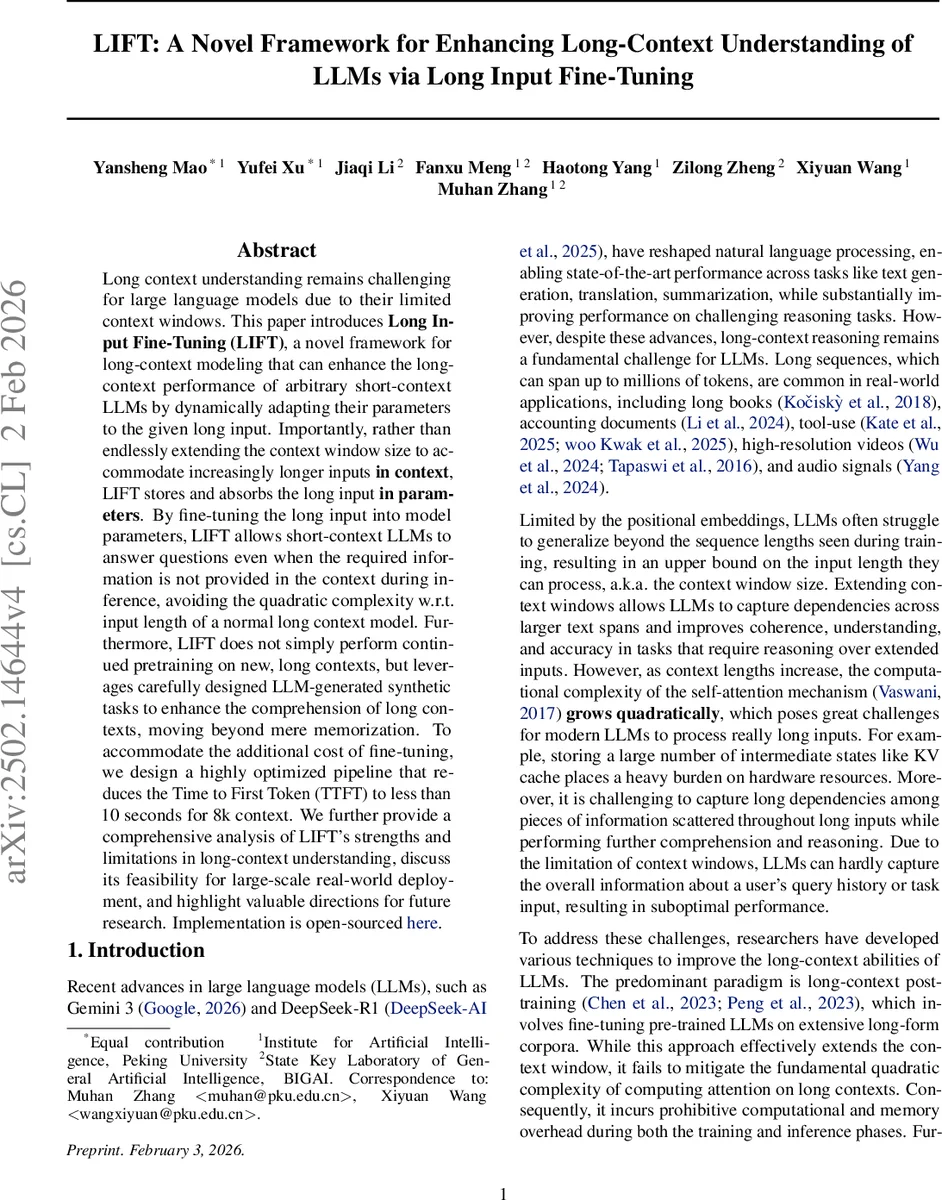
Long context understanding remains challenging for large language models due to their limited context windows. This paper introduces Long Input Fine-Tuning (LIFT), a novel framework for long-context modeling that can enhance the long-context performance of arbitrary short-context LLMs by dynamically adapting their parameters to the given long input. Importantly, rather than endlessly extending the context window size to accommodate increasingly longer inputs in context, LIFT stores and absorbs the long input in parameters. By fine-tuning the long input into model parameters, LIFT allows short-context LLMs to answer questions even when the required information is not provided in the context during inference, avoiding the quadratic complexity w.r.t. input length of a normal long context model. Furthermore, LIFT does not simply perform continued pretraining on new, long contexts, but leverages carefully designed LLM-generated synthetic tasks to enhance the comprehension of long contexts, moving beyond mere memorization. To accommodate the additional cost of fine-tuning, we design a highly optimized pipeline that reduces the Time to First Token (TTFT) to less than 10 seconds for 8k context. We further provide a comprehensive analysis of LIFT’s strengths and limitations in long-context understanding, discuss its feasibility for large-scale real-world deployment, and highlight valuable directions for future research.
💡 Research Summary
Paper Overview
The authors introduce Long Input Fine‑Tuning (LIFT), a test‑time fine‑tuning framework that enables any short‑context large language model (LLM) to handle arbitrarily long inputs without expanding its attention window. Instead of increasing the context window or redesigning the transformer architecture, LIFT “absorbs” the long document into the model’s parameters. At inference time the model no longer needs to keep the original text in memory; it simply relies on the knowledge encoded during fine‑tuning.
Key Components
-
Document Segmentation & Synthetic QA Generation – A long document is split into individual sentences. For each sentence, a powerful generator LLM (Qwen‑2.5‑72B‑Instruct in the experiments) is prompted to produce a set of question‑answer (QA) pairs that cover factual details as well as reading‑comprehension style queries. This transforms raw text, which is often implicit and compact, into explicit mappings that are easier for a model to internalize.
-
Asynchronous Producer‑Consumer Pipeline – Sentence‑to‑QA generation (producer) and batch supervised fine‑tuning (consumer) run in parallel using a queue. This design avoids loading the entire document into GPU memory and reduces the “time to first token” (TTFT) for an 8 k‑token document to under 10 seconds, making the approach viable for real‑time services.
-
Efficient Fine‑Tuning – Only a small set of adapter/LoRA parameters are updated, not the full model. Training leverages data parallelism and mixed‑precision arithmetic, keeping GPU memory usage 5–10× lower than full long‑context pre‑training. The fine‑tuning process typically converges within a few epochs.
-
Inference Without the Original Text – After fine‑tuning, the “LIFT‑ed” model can answer questions about the document directly. Because the long input is no longer present in the context window, the model’s self‑attention cost remains O(1) with respect to the original document length, preserving the speed of the underlying short‑context LLM.
Experimental Findings
- Benchmarks: LIFT was evaluated on several long‑context tasks, including LooGLE (long‑dependency QA), other long‑QA datasets, and summarization benchmarks.
- Performance Gains: On LooGLE, a Llama‑3‑8B‑Instruct model fine‑tuned with LIFT achieved 27.25 % accuracy, compared to 15.44 % for in‑context learning (ICL) with the same base model—a relative improvement of over 75 %. Summarization metrics (ROUGE) also improved by 3–5 % points.
- Efficiency: Compared to conventional long‑context post‑training, LIFT reduces GPU memory consumption and training time dramatically, while inference latency remains comparable to the original short‑context model.
Ablation & Insight
- Synthetic QA vs. Raw Text Fine‑Tuning: A pilot on SQuAD showed that fine‑tuning on synthetic QA pairs (Finetune‑QA) succeeds where fine‑tuning on raw text (Finetune‑Raw) fails, because the former forces the model to learn explicit question‑answer mappings rather than superficial token patterns.
- Failure Modes: Finetune‑Raw exhibits “superficial pattern matching,” pretrained‑knowledge interference, and outright refusal, indicating poor comprehension. Finetune‑QA’s errors are mainly due to insufficient coverage of the source material, suggesting that more diverse synthetic tasks could further boost performance.
Limitations
- Fine‑Tuning Cost – Although optimized, each document still requires several minutes of GPU time, which may be prohibitive for high‑throughput or latency‑critical applications.
- Knowledge Staleness – Encoded knowledge is static; any document update necessitates re‑fine‑tuning, unlike retrieval‑augmented systems that can fetch fresh content instantly.
- Security & Privacy – Storing sensitive documents inside model parameters raises data‑leakage concerns; mechanisms for encryption or secure disposal of fine‑tuned weights are needed.
- Scope of Evaluation – Experiments focus on QA and summarization; applicability to code generation, multimodal inputs, or tasks requiring complex reasoning across multiple document sections remains untested.
Future Directions Proposed by the Authors
- Parameter‑Efficient Adaptation: Investigate meta‑learning or hyper‑network approaches to further reduce the number of updated parameters and speed up adaptation.
- Incremental Fine‑Tuning: Develop algorithms that only adjust the model for changed portions of a document, avoiding full re‑training.
- Multimodal Extension: Apply the sentence‑to‑QA pipeline to video subtitles, audio transcripts, or image captions, turning LIFT into a general long‑input learner.
- Robust Security: Explore encrypted adapters, secure enclaves, or on‑the‑fly weight disposal to mitigate privacy risks.
- Broader Task Coverage: Test LIFT on programming assistance, chain‑of‑thought reasoning, and other downstream tasks to assess generalization.
Conclusion
LIFT presents a pragmatic solution to the long‑context bottleneck: by converting a long document into a set of synthetic QA pairs and fine‑tuning a short‑context LLM on those pairs, the model internalizes the document’s knowledge without ever needing to attend to the full text during inference. This sidesteps the quadratic attention cost, reduces hardware demands, and delivers measurable accuracy improvements on challenging long‑dependency benchmarks. The primary challenges lie in the computational overhead of per‑document fine‑tuning, handling updates, and ensuring data privacy. If these hurdles are addressed, LIFT could become a cornerstone technique for deploying LLMs in domains where massive documents—legal contracts, scientific reports, or multimodal media—must be understood quickly and securely.
Comments & Academic Discussion
Loading comments...
Leave a Comment