Revealing the fuel of a quantum continuous measurement-based refrigerator
While quantum measurements have been shown to constitute a resource for operating quantum thermal machines, the nature of the energy exchanges involved in the interaction between system and measurement apparatus is still under debate. In this work, we show that a microscopic model of the apparatus is necessary to unambiguously determine whether quantum measurements provide energy in the form of heat or work. We illustrate this result by considering a measurement-based refrigerator, made of a double quantum dot embedded in a two-terminal device, with the charge of one of the dots being continuously monitored. Tuning the parameters of the measurement device interpolates between a heat- and a work-fueled regimes with very different thermodynamic efficiency. Notably, we demonstrate a trade-off between a maximal thermodynamic efficiency when the measurement-based refrigerator is fueled by heat and a maximal measurement efficiency quantified by the signal-to-noise ratio in the work-fueled regime. Our analysis offers a new perspective on the nature of the energy exchanges occurring during a quantum measurement, paving the way for energy optimization in quantum protocols and quantum machines.
💡 Research Summary
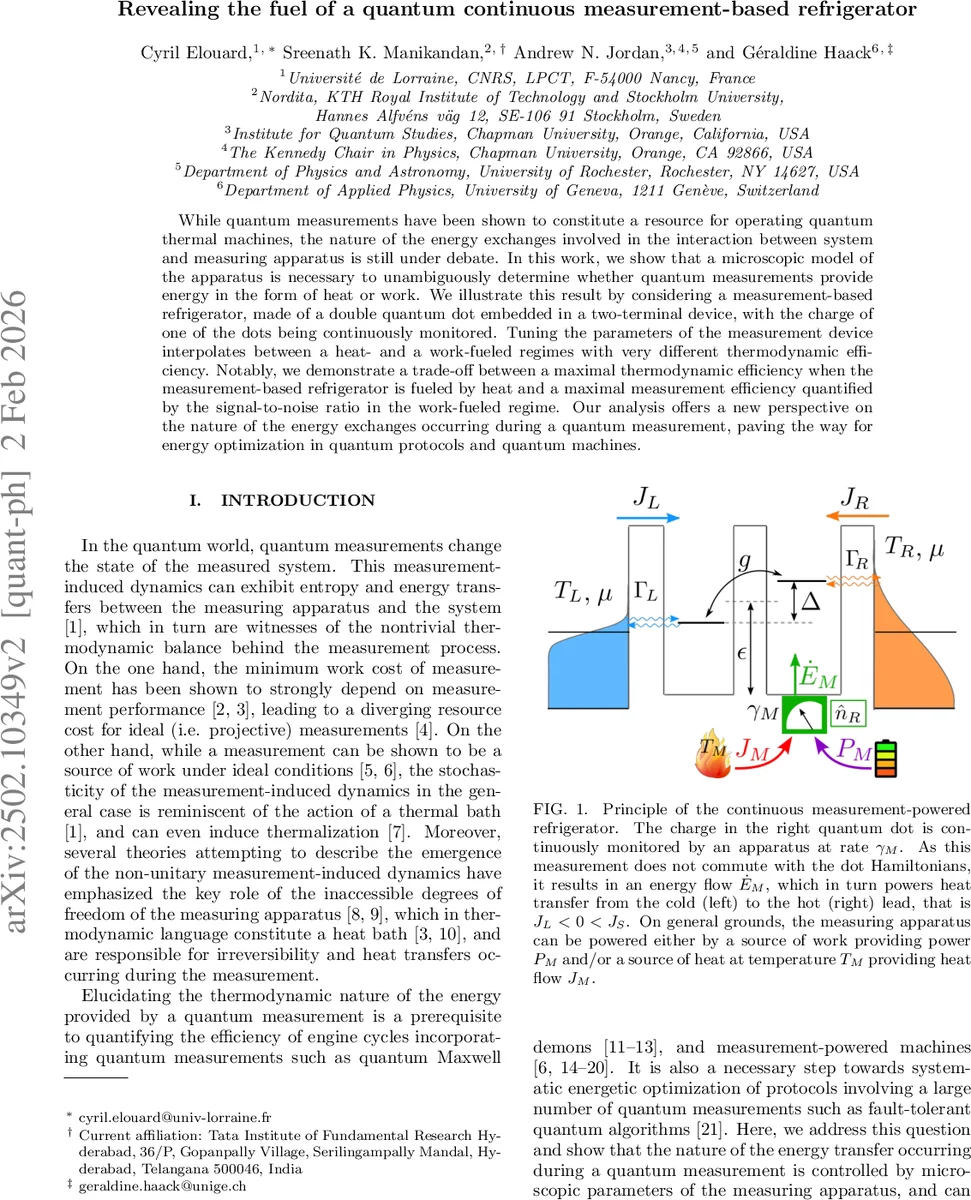
The paper addresses a fundamental question in quantum thermodynamics: what type of energy—heat or work—is supplied by a quantum measurement when it is used as a resource for a thermal machine? While previous studies have treated the measurement apparatus as a black box, the authors argue that a microscopic description of the apparatus is essential to resolve this ambiguity. They illustrate the issue with a concrete model of a measurement‑driven refrigerator consisting of two tunnel‑coupled single‑level quantum dots (QDs) each connected to electronic reservoirs at different temperatures. The charge of the right‑hand dot is continuously monitored, which induces a non‑commuting back‑action that can pump energy into the dot system.
The dynamics of the dots and reservoirs are captured by a weak‑coupling master equation. The continuous measurement is represented by a Lindblad term with rate γ_M, which quantifies how strongly the detector perturbs the system. Solving the steady‑state master equation yields three energy flows: the heat currents J_L and J_R from the left (cold) and right (hot) reservoirs, and the energy flow ˙E_M from the measurement apparatus to the dots. When γ_M=0 the device behaves as a simple double‑dot conductor with no net cooling. For sufficiently large γ_M (relative to the inter‑dot tunnelling g) and a modest temperature bias ΔT, the measurement supplies positive energy (˙E_M>0) that drives heat extraction from the cold reservoir (J_L>0) and its deposition into the hot reservoir (J_R<0), thus operating as a refrigerator.
To determine whether ˙E_M is heat or work, the authors introduce a generic thermodynamic model of the detector. The detector is assumed to exchange heat J_M with an internal environment at temperature T_M and to receive work P_M from an external power source (e.g., a voltage bias). Energy conservation then reads ˙E_M = J_M + P_M. Applying the second law to the extended system (dots + detector + reservoirs) leads to an inequality that bounds the cooling power J_L in terms of the supplied work and heat. Two limiting regimes emerge:
-
Work‑fueled regime (T_M = T_R): The detector operates at the temperature of the hot reservoir, so refrigeration (J_L>0) is possible only if P_M>0. The performance is limited by the Carnot bound η_C = T_L/(T_R−T_L).
-
Heat‑fueled regime (P_M = 0, T_M > T_R): The detector acts as an autonomous heat source (an absorption refrigerator). The efficiency is bounded by the three‑temperature Carnot‑like expression η_abs = (T_R⁻¹−T_M⁻¹)/(T_L⁻¹−T_R⁻¹).
In realistic situations the detector can receive a mixture of heat and work, characterized by the ratio ξ = J_M/P_M. The overall coefficient of performance (COP) of the hybrid machine is a continuous function of ξ, interpolating between the two limits.
To make the discussion concrete, the authors model the detector as a quantum point contact (QPC) capacitively coupled to the right dot. The QPC is a single‑channel conductor whose transmission depends on the dot’s charge. A voltage bias ΔV = μ_M/e drives a current I_QPC, providing the measurement signal. Maintaining the bias consumes electrical power P_M = ΔV·I_QPC, while the electron flow between source and drain also carries heat J_M. Using a microscopic scattering‑theory description of the QPC, they derive the measurement‑induced Lindblad rates γ_QPC(ω) and relate the effective measurement rate γ_M to the QPC parameters (temperature T_M, bias μ_M). This allows independent tuning of the heat‑to‑work ratio ξ while keeping γ_M (and thus the measurement back‑action) fixed.
Numerical results (Figures 2 and 3) show that increasing γ_M turns on refrigeration, and that the apparent efficiency η_app = J_L/˙E_M can reach values close to a simple analytical bound. More importantly, by varying T_M and μ_M the detector can be switched from a heat‑dominated fuel (large ξ) to a work‑dominated fuel (small ξ). In the heat‑dominated regime the COP approaches the absorption‑refrigerator limit, but the signal‑to‑noise ratio (SNR) of the measurement is low because the QPC operates near equilibrium. In the work‑dominated regime the COP is reduced, yet the SNR is maximized, reflecting a high‑quality measurement. The authors thus reveal a trade‑off: maximal thermodynamic efficiency occurs when the measurement is powered by heat, whereas maximal measurement efficiency (high SNR) occurs when the detector is powered by work.
The paper concludes that the nature of the energy supplied by a quantum measurement cannot be inferred without a microscopic model of the detector. Depending on the detector’s internal temperature and bias, the same measurement back‑action can be interpreted either as heat or work, leading to dramatically different performance metrics for quantum thermal machines. This insight opens a pathway for designing quantum engines and refrigerators with optimized trade‑offs between thermodynamic efficiency and measurement fidelity, and suggests that future quantum technologies should incorporate detailed detector modeling when assessing energetic costs.
Comments & Academic Discussion
Loading comments...
Leave a Comment