Second-order derivations of function spaces -- a characterization of second-order differential operators
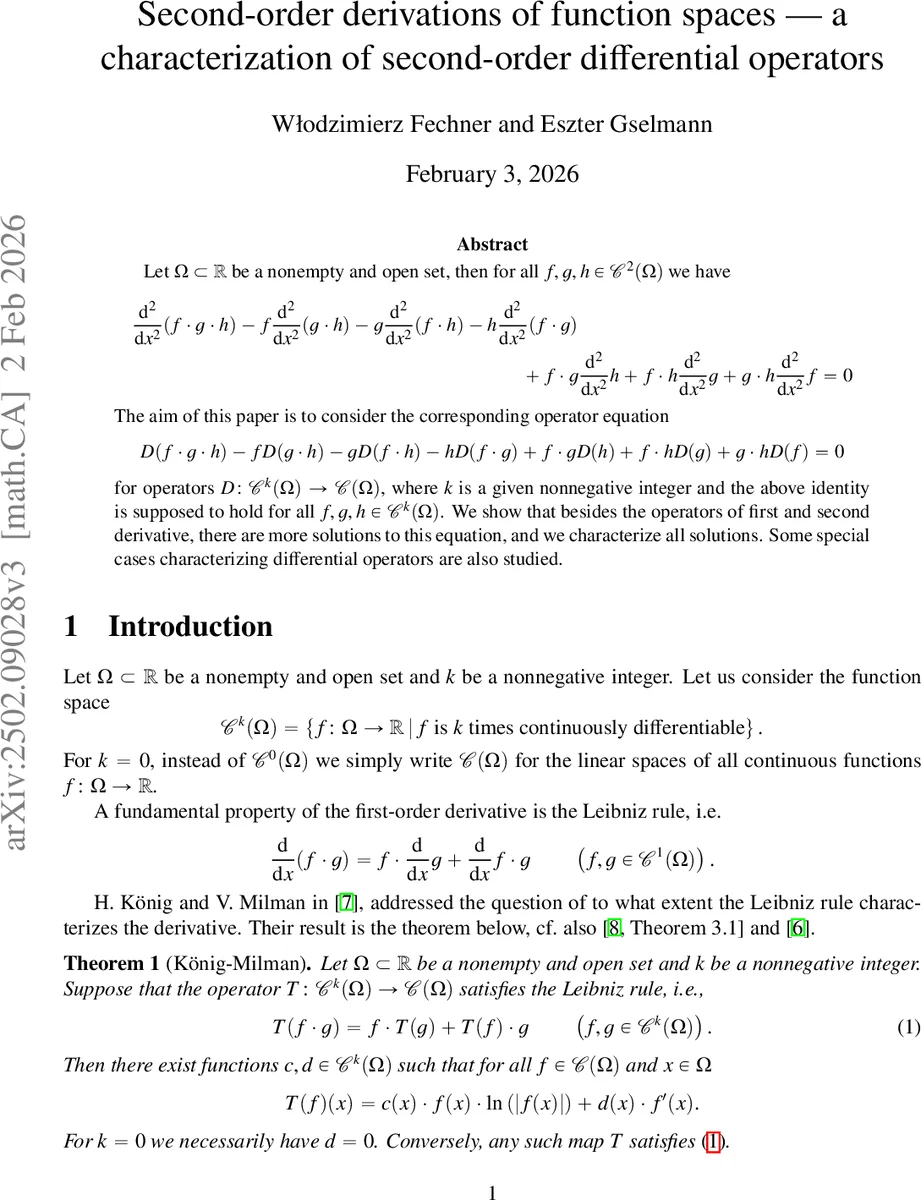
Let $Ω\subset \mathbb{R}$ be a nonempty and open set, then for all $f, g, h\in \mathscr{C}^{2}(Ω)$ we have \begin{multline*} \diff{2}{x}(f\cdot g\cdot h) -f\diff{2}{x}(g\cdot h)-g\diff{2}{x}(f\cdot h)-h\diff{2}{x}(f\cdot g) + f\cdot g\diff{2}{x}h+f\cdot h\diff{2}{x}g+g\cdot h\diff{2}{x}f=0 \end{multline*} The aim of this paper is to consider the corresponding operator equation [ D(f\cdot g \cdot h) - fD(g\cdot h) - gD(f\cdot h) - hD(f \cdot g) + f\cdot g D(h) + f\cdot h D(g) +g\cdot h D(f) =0 ] for operators $D\colon \mathscr{C}^{k}(Ω)\to \mathscr{C}(Ω)$, where $k$ is a given nonnegative integer and the above identity is supposed to hold for all $f, g, h \in \mathscr{C}^{k}(Ω)$. We show that besides the operators of first and second derivative, there are more solutions to this equation, and we characterize all solutions. Some special cases characterizing differential operators are also studied.
💡 Research Summary
The paper studies operators (D) acting on the function space (C^{k}(\Omega)), where (\Omega\subset\mathbb{R}) is a non‑empty open set and (k\ge0) is an integer. The central object is the ternary identity
\
Comments & Academic Discussion
Loading comments...
Leave a Comment