A Contact Topological Glossary for Non-Equilibrium Thermodynamics
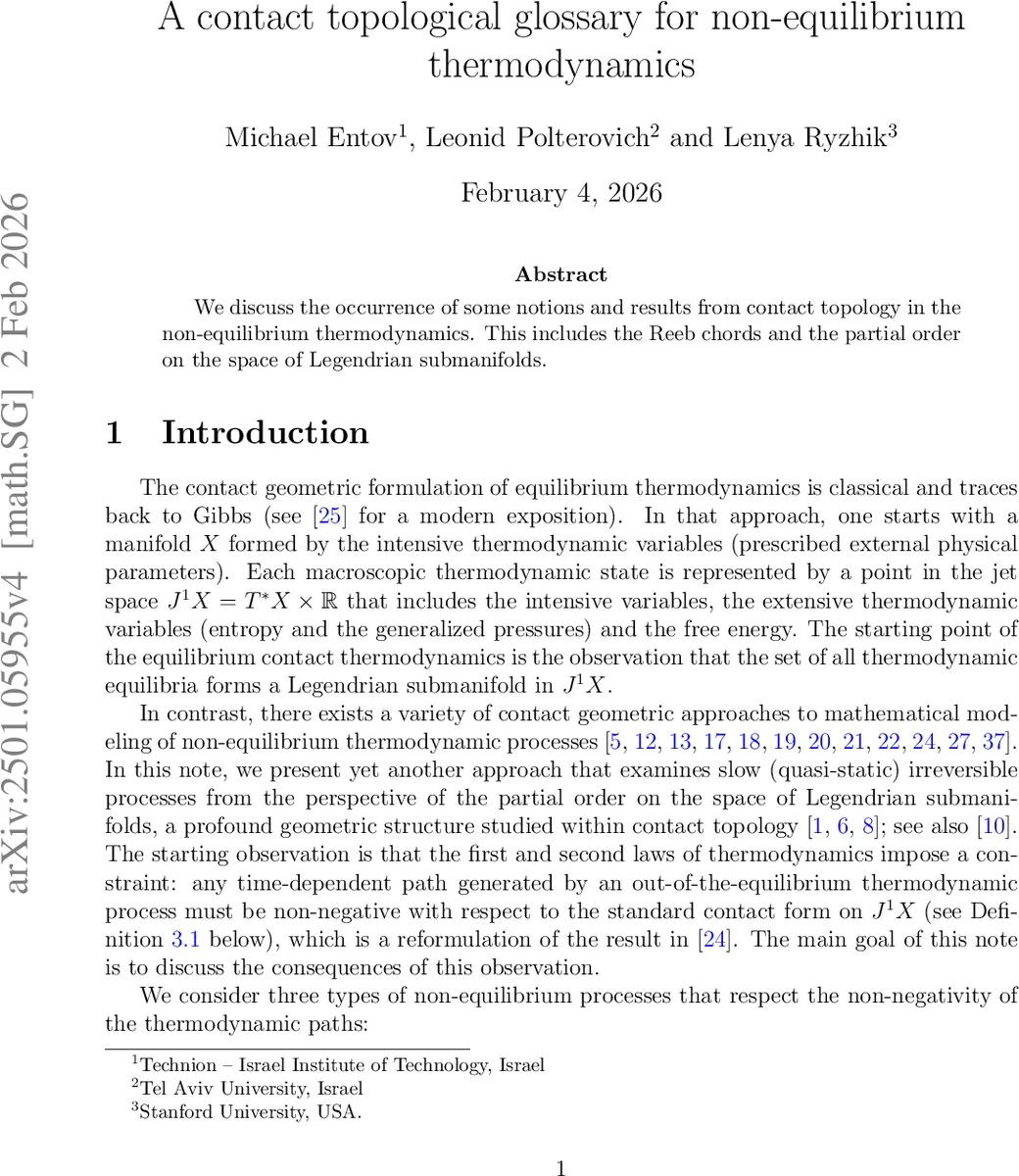
We discuss the occurrence of some notions and results from contact topology in the non-equilibrium thermodynamics. This includes the Reeb chords and the partial order on the space of Legendrian submanifolds.
💡 Research Summary
The paper “A Contact Topological Glossary for Non‑Equilibrium Thermodynamics” presents a unified geometric framework that brings together concepts from contact topology—Legendrian submanifolds, Reeb chords, and the partial order on Legendrians—with the phenomenology of non‑equilibrium thermodynamic processes. Starting from the classical contact‑geometric formulation of equilibrium thermodynamics, the authors recall that the thermodynamic phase space can be modeled as a (2n+3)‑dimensional contact manifold 𝔅𝑇 = J¹ℝⁿ⁺¹ equipped with the Gibbs 1‑form λ = dz – S dT – Σ pⱼ dqⱼ. In this setting each equilibrium state corresponds to a point on a Legendrian submanifold Λ, i.e., a maximal integral submanifold on which λ vanishes. The generating function of Λ is the (negative) free energy, and microscopic probability densities appear as auxiliary “ghost” variables in the generating function formalism.
To make the theory physically tractable, the authors introduce a reduction procedure: by fixing a subset of intensive variables (temperature and selected external parameters) and setting the corresponding extensive variables to zero, they define an affine subspace h ⊂ J¹ℝⁿ⁺¹. Projecting h yields a reduced contact manifold 𝕋 = J¹ℝᵏ of dimension 2k+1, still carrying the standard contact form λ = dz – Σ pⱼ dqⱼ. The reduced Legendrian Λ̃ is the image of the original equilibrium Legendrian under this projection and encodes the equilibria relevant to the chosen experimental observables.
A central physical insight is that the first and second laws of thermodynamics impose a positivity condition on admissible trajectories in the contact phase space. A smooth path γ(t) = (−G(T(t),q(t),ρ(t)), S(ρ(t)), T(t), p(q(t),ρ(t)), q(t)) is called non‑negative if λ(γ̇) ≥ 0 for all t. This condition is equivalent to the statement that the infinitesimal heat supplied minus the work done is non‑negative and that irreversible entropy production is never negative. Consequently, any two Legendrians L₁ and L₂ for which there exists a non‑negative path from a point on L₁ to a point on L₂ acquire a partial order L₁ ≼ L₂. This order captures the notion of a slow (quasi‑static) global process: the external parameters change so slowly that the system remains in equilibrium at every instant, and the thermodynamic trajectory stays on a family of Legendrians ordered by non‑negativity.
The authors distinguish three classes of non‑equilibrium processes:
-
Slow (quasi‑static) global processes – described by non‑negative Legendrian families; they respect the partial order and correspond to temperature‑non‑decreasing, free‑energy‑non‑increasing evolutions.
-
Fast processes – after an abrupt change in extensive variables, the system evolves according to a Fokker‑Planck (or more generally a stochastic) equation for the probability density ρ(t). The trajectory remains non‑negative but does not stay on the equilibrium Legendrian during the transient.
-
Ultrafast (instantaneous) processes – the system jumps instantly from one equilibrium Legendrian to another. In contact topology such jumps are modeled by Reeb chords, i.e., flow lines of the Reeb vector field associated with λ that connect two Legendrian submanifolds.
The paper’s most significant topological result (Theorem 5.2) states that if two thermodynamic systems are related by a slow, temperature‑non‑decreasing global process, then there exists a free‑energy‑non‑increasing Reeb chord linking an equilibrium of the first system to an equilibrium of the second. Physically this means that an ultrafast transition respecting the second law can be found whenever a quasi‑static path exists, providing a rigorous bridge between reversible and irreversible dynamics.
To illustrate the abstract theory, the authors discuss three concrete examples:
-
Ideal gas – the standard (T, V) variables generate a Legendrian; an ultrafast isothermal compression/expansion is identified as a Reeb chord.
-
Stirling engine – experimental observations of rapid compression and expansion phases match the predicted Reeb chords, confirming the relevance of the contact‑topological description.
-
Curie‑Weiss magnet – the magnetization and external magnetic field form a Legendrian; the sudden spin‑flip at the critical point is interpreted as a Reeb chord connecting two equilibrium branches.
The paper also addresses technical subtleties such as the need for compactly supported Hamiltonian isotopies to generate Legendrian perturbations, the role of generating functions with auxiliary variables, and the distinction between mathematical compactness requirements and physical non‑compact Hamiltonians.
In conclusion, the authors provide a comprehensive glossary that translates contact‑topological language into thermodynamic terminology, showing that Legendrian submanifolds encode equilibrium states, the partial order induced by non‑negative contact paths encodes slow quasi‑static processes, and Reeb chords encode ultrafast transitions. This framework not only unifies disparate descriptions of non‑equilibrium phenomena but also opens new avenues for applying symplectic and contact invariants (e.g., generating function homology, Floer‑type theories) to the analysis of thermodynamic cycles, efficiency bounds, and irreversible entropy production. The work thus establishes a promising interdisciplinary bridge between modern geometric topology and classical/quantum thermodynamics.
Comments & Academic Discussion
Loading comments...
Leave a Comment