Topological advantage for adsorbate chemisorption on conjugated chains
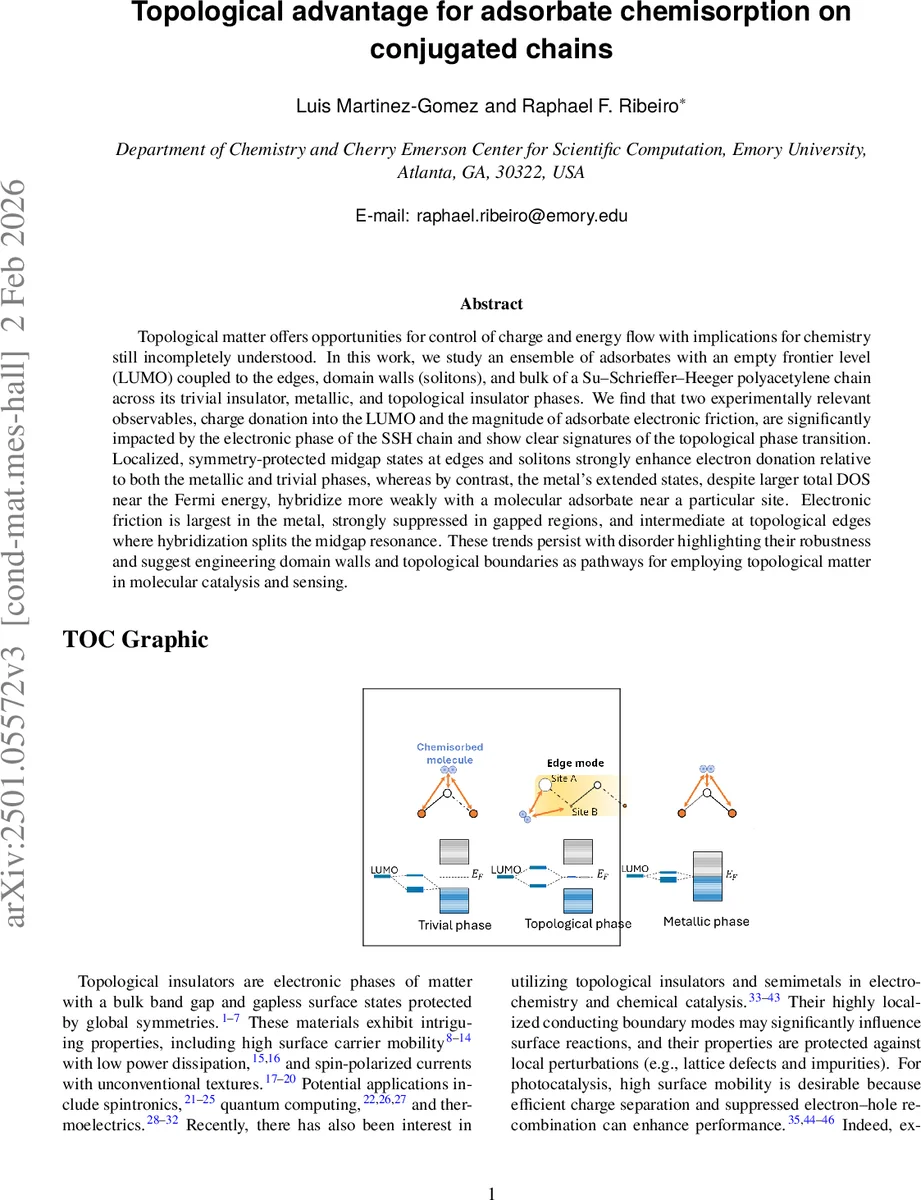
Topological matter offers opportunities for control of charge and energy flow with implications for chemistry still incompletely understood. In this work, we study an ensemble of adsorbates with an empty frontier level (LUMO) coupled to the edges, domain walls (solitons), and bulk of a Su-Schrieffer-Heeger polyacetylene chain across its trivial insulator, metallic, and topological insulator phases. We find that two experimentally relevant observables, charge donation into the LUMO and the magnitude of adsorbate electronic friction, are significantly impacted by the electronic phase of the SSH chain and show clear signatures of the topological phase transition. Localized, symmetry-protected midgap states at edges and solitons strongly enhance electron donation relative to both the metallic and trivial phases, whereas by contrast, the metal’s extended states, despite larger total DOS near the Fermi energy, hybridize more weakly with a molecular adsorbate near a particular site. Electronic friction is largest in the metal, strongly suppressed in gapped regions, and intermediate at topological edges where hybridization splits the midgap resonance. These trends persist with disorder highlighting their robustness and suggest engineering domain walls and topological boundaries as pathways for employing topological matter in molecular catalysis and sensing.
💡 Research Summary
**
In this work the authors investigate how the electronic topology of a one‑dimensional Su‑Schrieffer‑Heeger (SSH) polyacetylene chain influences two key processes that govern heterogeneous catalysis: (i) charge transfer (hybridization) between a molecular adsorbate and the substrate, and (ii) non‑adiabatic vibrational energy dissipation (electronic friction) mediated by electron‑hole pair excitations. The SSH model is tuned by varying the intra‑cell hopping (v) and inter‑cell hopping (w); the ratio (r=w/v) drives the chain through three distinct electronic phases: a trivial insulator ((r<1)), a metallic point ((r\approx1)), and a topological insulator ((r>1)).
The adsorbate is modeled as a single empty frontier orbital (LUMO) with energy (\varepsilon_0) that can be displaced linearly by a vibrational coordinate (R) (Condon coupling (g)). The molecule is coupled weakly (hopping (T)) to either a site at the chain edge ((x_E)) or a bulk site at the chain centre ((x_B)). The full Hamiltonian is of Fano‑Anderson type, allowing exact diagonalization for finite chains and perturbative analysis where appropriate.
Two observables are computed: (1) the LUMO occupation (n_0(R,x_M)), which quantifies charge donation from the substrate to the molecule, and (2) the electronic friction coefficient (\gamma(R)), obtained from the Head‑Gordon‑Tully (HGT) linear‑response formula. To obtain a smooth spectrum for (\gamma), the discrete eigenvalues of the finite chain are broadened with a Gaussian of width comparable to thermal energy.
Key findings:
-
Charge Transfer: In the topological phase, the chain hosts symmetry‑protected mid‑gap states localized at edges and at domain walls (solitons). When the adsorbate is placed at such a location, the local density of states at the LUMO energy is dramatically enhanced, leading to a pronounced increase in (n_0). The enhancement is maximal when (\varepsilon_0) is resonant with the mid‑gap state, reaching near‑unit occupation even though the overall density of states of the metal is larger. By contrast, in the metallic regime the electronic states are delocalized; despite a larger total DOS near the Fermi level, the hybridization with a specific site is weaker, and (n_0) is sizable only in a narrow window around the metal‑insulator transition point. The trivial insulator shows negligible edge hybridization because no localized states exist.
-
Electronic Friction: The friction follows the expected trend of being largest in the metallic phase (abundant electron‑hole excitations), strongly suppressed in both insulating phases, and intermediate in the topological phase. The presence of a single mid‑gap state that hybridizes with the LUMO creates a sharp resonance in the electron‑hole pair spectrum, raising (\gamma) above the insulating background but keeping it below the metallic value. When multiple domain walls are introduced, a set of mid‑gap states appears, providing a more uniform and sizable friction across the surface.
-
Robustness to Disorder: Random on‑site potentials and variations in the molecule‑substrate coupling were added to mimic realistic imperfections. The topological enhancement of both charge transfer and friction persists, reflecting the protection offered by chiral symmetry.
-
Multiple Adsorbates and Domain Walls: Extending the model to many non‑interacting adsorbates coupled to several solitons shows that the average LUMO occupancy scales linearly with the number of domain walls, overcoming the “measure‑zero” limitation of a single edge state. This suggests that engineering a high density of topological defects could be a practical route to boost catalytic activity.
Overall, the paper demonstrates that (i) symmetry‑protected mid‑gap states can dramatically increase molecule‑substrate charge exchange, (ii) the simple intuition that a larger bulk DOS guarantees stronger coupling is insufficient in low‑dimensional topological systems, (iii) electronic friction can be tuned by moving across a topological phase transition, and (iv) these effects survive realistic disorder. The authors argue that deliberately creating domain walls or exploiting existing topological boundaries offers a novel design principle for molecular catalysis and sensing platforms based on topological matter.
Comments & Academic Discussion
Loading comments...
Leave a Comment