CaST: Causal Discovery via Spatio-Temporal Graphs in Disaster Tweets
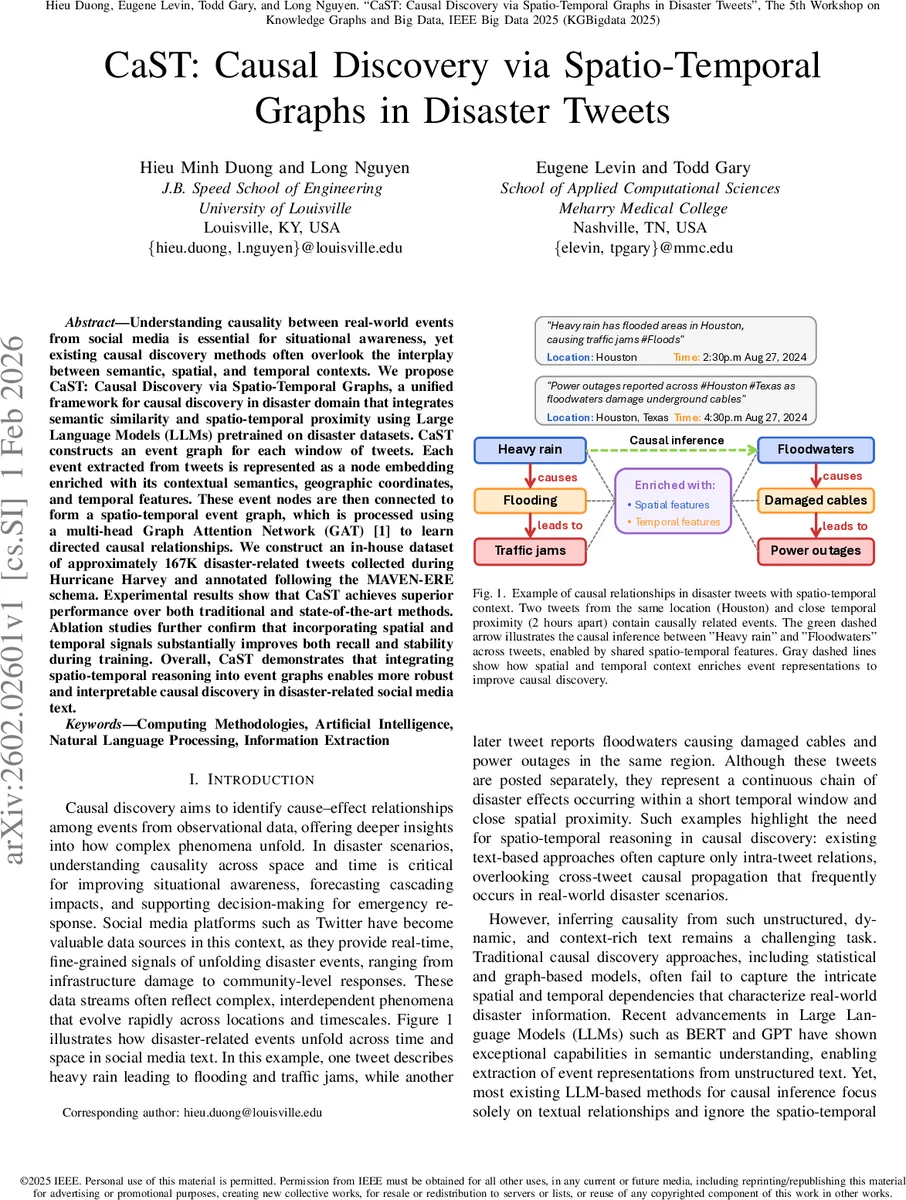
Understanding causality between real-world events from social media is essential for situational awareness, yet existing causal discovery methods often overlook the interplay between semantic, spatial, and temporal contexts. We propose CaST: Causal Discovery via Spatio-Temporal Graphs, a unified framework for causal discovery in disaster domain that integrates semantic similarity and spatio-temporal proximity using Large Language Models (LLMs) pretrained on disaster datasets. CaST constructs an event graph for each window of tweets. Each event extracted from tweets is represented as a node embedding enriched with its contextual semantics, geographic coordinates, and temporal features. These event nodes are then connected to form a spatio-temporal event graph, which is processed using a multi-head Graph Attention Network (GAT) \cite{gat} to learn directed causal relationships. We construct an in-house dataset of approximately 167K disaster-related tweets collected during Hurricane Harvey and annotated following the MAVEN-ERE schema. Experimental results show that CaST achieves superior performance over both traditional and state-of-the-art methods. Ablation studies further confirm that incorporating spatial and temporal signals substantially improves both recall and stability during training. Overall, CaST demonstrates that integrating spatio-temporal reasoning into event graphs enables more robust and interpretable causal discovery in disaster-related social media text.
💡 Research Summary
The paper introduces CaST (Causal Discovery via Spatio‑Temporal Graphs), a unified framework designed to uncover cause‑effect relationships from disaster‑related Twitter streams by explicitly modeling semantic, spatial, and temporal information. The authors first fine‑tune large language models (LLMs) on a disaster‑specific corpus to obtain rich textual embeddings for each extracted event. In addition to these embeddings, each event node is enriched with normalized GPS coordinates and timestamps, producing a multi‑modal node representation that captures where and when the event occurred.
A spatio‑temporal event graph is then constructed for each sliding time window. Edges are created based on two proximity criteria: (i) spatial neighbors, identified via k‑nearest‑neighbor or radius searches on latitude‑longitude data, and (ii) temporal neighbors, defined by a configurable time window (e.g., two hours). This graph encodes potential causal links as directed candidate edges between events that are close in both space and time.
To learn causal directionality, the authors employ a multi‑head Graph Attention Network (GAT). Each attention head can specialize in either spatial or temporal relations, allowing the model to dynamically weight information from different modalities. The GAT aggregates messages from neighboring nodes, updates event representations, and finally predicts a binary label for each candidate edge indicating the presence and direction of a causal relationship. The loss combines a weighted binary cross‑entropy (to address class imbalance) with a label‑smoothing term that encourages structural consistency across the graph.
The experimental evaluation uses a newly compiled dataset of approximately 167 K tweets collected during Hurricane Harvey. Tweets were annotated according to the MAVEN‑ERE schema with extensions for spatial, temporal, and causal attributes, providing a high‑quality benchmark for disaster‑domain causal inference. CaST is compared against eight strong baselines, including traditional statistical methods (PC, GES), recent graph‑neural approaches (IE‑GNN, iLIF), and LLM‑based zero‑shot prompting (GPT‑3.5). Across precision, recall, and F1‑score, CaST consistently outperforms the baselines, achieving a 5‑8 % absolute gain in F1 and a notable 12 % increase in recall. Ablation studies demonstrate that removing spatial or temporal features degrades performance dramatically (recall drops >10 %) and destabilizes training loss, confirming the critical role of spatio‑temporal signals.
The authors acknowledge limitations: (1) events lacking explicit geotags rely on noisy named‑entity location extraction, (2) the choice of temporal window size is domain‑sensitive, and (3) the current implementation focuses on offline batch processing rather than true streaming inference. Future work is outlined to incorporate multimodal data (satellite imagery, weather sensors), adopt dynamic graph neural networks for real‑time updates, and explore reinforcement‑learning strategies for adaptive windowing.
In summary, CaST demonstrates that integrating semantic embeddings with explicit spatial and temporal context in a graph‑based learning paradigm yields more robust and interpretable causal discovery from noisy social‑media streams. This advancement holds practical value for emergency management, enabling faster situational awareness and more accurate forecasting of cascading disaster impacts.
Comments & Academic Discussion
Loading comments...
Leave a Comment