A Statistical Theory of Gated Attention through the Lens of Hierarchical Mixture of Experts
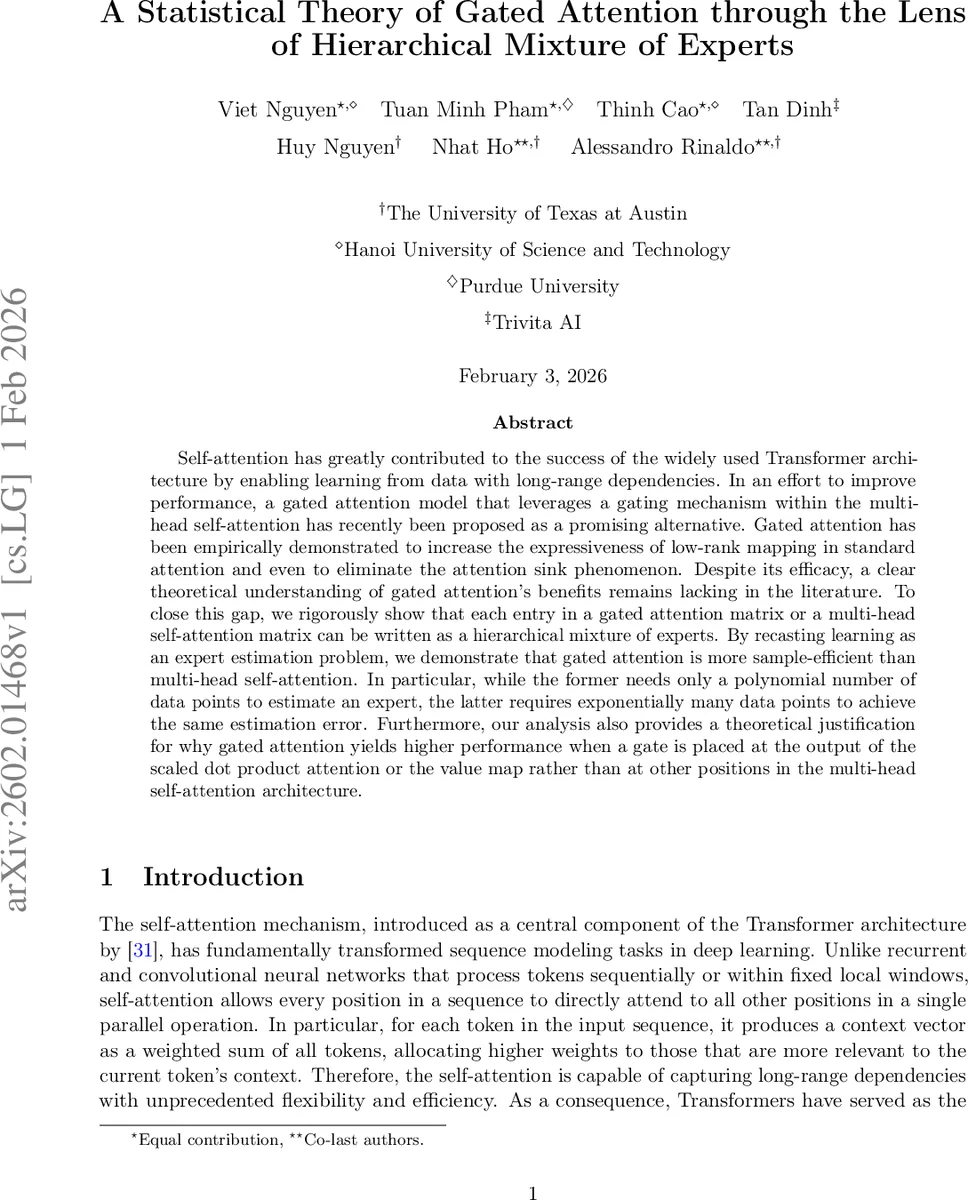
Self-attention has greatly contributed to the success of the widely used Transformer architecture by enabling learning from data with long-range dependencies. In an effort to improve performance, a gated attention model that leverages a gating mechanism within the multi-head self-attention has recently been proposed as a promising alternative. Gated attention has been empirically demonstrated to increase the expressiveness of low-rank mapping in standard attention and even to eliminate the attention sink phenomenon. Despite its efficacy, a clear theoretical understanding of gated attention’s benefits remains lacking in the literature. To close this gap, we rigorously show that each entry in a gated attention matrix or a multi-head self-attention matrix can be written as a hierarchical mixture of experts. By recasting learning as an expert estimation problem, we demonstrate that gated attention is more sample-efficient than multi-head self-attention. In particular, while the former needs only a polynomial number of data points to estimate an expert, the latter requires exponentially many data points to achieve the same estimation error. Furthermore, our analysis also provides a theoretical justification for why gated attention yields higher performance when a gate is placed at the output of the scaled dot product attention or the value map rather than at other positions in the multi-head self-attention architecture.
💡 Research Summary
The paper provides a rigorous statistical foundation for gated attention mechanisms within the Transformer architecture by establishing a formal equivalence between gated multi‑head self‑attention (MHSA) and hierarchical mixtures of experts (HMoE). The authors first decompose each entry of a standard MHSA matrix into a three‑level HMoE consisting of linear experts and softmax routing weights. They then show that inserting a non‑linear gate either after the scaled dot‑product attention (G1) or after the value projection (G2) transforms the experts from linear to non‑linear, while preserving the hierarchical routing structure.
Using this representation, the learning problem is recast as expert specialization: estimating the parameters of the underlying mixture (expert weights, routing matrices, and expert functions) from i.i.d. data generated by a regression model Y = f_G*(X) + ε. Under mild compactness and identifiability assumptions, the authors prove that the least‑squares estimator of the regression function converges at a near‑parametric rate O_p(√(log n / n)). However, the convergence of the mixture parameters themselves is governed by a Voronoi loss that captures the interaction between expert parameters and routing weights.
For standard MHSA, where all experts are linear, the authors establish a minimax lower bound showing that any estimator requires an exponential number of samples in the inverse error tolerance, i.e., sample complexity O(exp(ε⁻¹/τ)). This reflects the difficulty of disentangling the tightly coupled linear components. In contrast, for the gated variants G1 and G2, the presence of a non‑linear activation φ decouples the expert parameters from the routing, leading to a dramatically reduced sample complexity of O(ε⁻⁴). Theorems 2 and 3 formalize this polynomial bound, demonstrating that gated attention is statistically far more sample‑efficient.
The paper also provides a theoretical justification for why gating at positions G1 and G2 outperforms other placements (G3‑G5). By applying the gate after the softmax or after the value projection, the gating function directly influences the routing probabilities, making them more sensitive to the input and mitigating the “attention sink” phenomenon where attention mass concentrates on a few irrelevant tokens. Gating earlier (on queries or keys) or later (after the final dense projection) does not affect routing in the same way, resulting in weaker statistical gains.
Empirical experiments on synthetic data and downstream language modeling tasks corroborate the theory. G1 and G2 achieve comparable or better performance than vanilla MHSA with far fewer training samples, and they exhibit faster convergence of loss and perplexity. Ablation studies confirm that alternative gate placements indeed lead to slower learning and higher error, aligning with the theoretical predictions.
Finally, the authors discuss limitations: the analysis assumes known numbers of heads, experts, and hierarchy depth; the parameter space is assumed compact; and the added gate introduces extra computation that may be non‑trivial for very large models. Future work is suggested on adaptive expert count selection, more efficient gate learning algorithms, and extending the theory to other non‑linear gating functions or deeper hierarchical structures. Overall, the paper bridges a gap between empirical successes of gated attention and a solid statistical understanding, highlighting the profound impact of non‑linearity and hierarchical routing on sample efficiency.
Comments & Academic Discussion
Loading comments...
Leave a Comment