Modeling Topological Impact on Node Attribute Distributions in Attributed Graphs
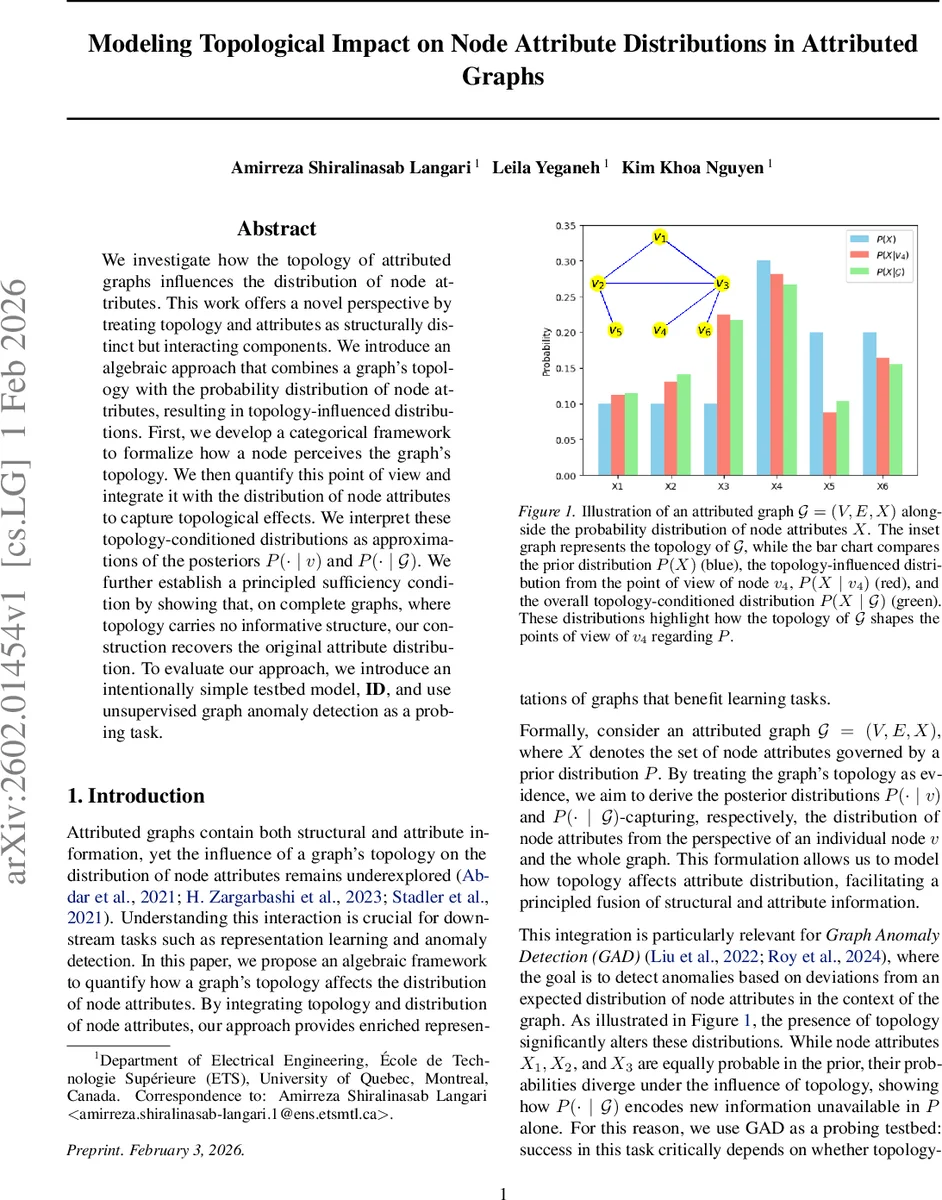
We investigate how the topology of attributed graphs influences the distribution of node attributes. This work offers a novel perspective by treating topology and attributes as structurally distinct but interacting components. We introduce an algebraic approach that combines a graph’s topology with the probability distribution of node attributes, resulting in topology-influenced distributions. First, we develop a categorical framework to formalize how a node perceives the graph’s topology. We then quantify this point of view and integrate it with the distribution of node attributes to capture topological effects. We interpret these topology-conditioned distributions as approximations of the posteriors $P(\cdot \mid v)$ and $P(\cdot \mid \mathcal{G})$. We further establish a principled sufficiency condition by showing that, on complete graphs, where topology carries no informative structure, our construction recovers the original attribute distribution. To evaluate our approach, we introduce an intentionally simple testbed model, $\textbf{ID}$, and use unsupervised graph anomaly detection as a probing task.
💡 Research Summary
The paper tackles the largely unexplored problem of how a graph’s topology influences the probability distribution of node attributes. Rather than treating structure and attributes as loosely coupled, the authors adopt a rigorous categorical perspective that treats the topology as evidence for updating attribute priors. They begin by constructing the free category Cat(G) of a graph, where objects are nodes and morphisms are directed paths built from the monoidal operation · introduced in the Grothendieck Graph Neural Network (GGNN) framework. This category uniquely determines the graph up to isomorphism, and for each node v they define the under‑category v/G, which captures all paths emanating from v. This under‑category is interpreted as the node’s “point of view” on the graph’s topology.
Because under‑categories are infinite, the authors introduce a finite approximation called a cover Cov(m), consisting of all directed paths of a fixed length m. Using the monoidal homomorphism Tr from GGNN, each cover is mapped to a matrix representation. Repeated application of the monoidal matrix operation ∘ (defined as A∘B = A + B + AB) yields the matrix MI(m) = A∘…∘A (m times), which can be computed efficiently as MI(m) = (I + A)^m – I = Σ_{k=1}^m C(m,k) A^k. The i‑th row of MI(m) encodes how node v_i perceives the rest of the graph via counts of length‑m paths and their sub‑paths, providing a quantitative “viewpoint” vector.
To fuse this structural viewpoint with the attribute distribution P, the authors define a weight matrix W whose entries are W_{ij} = P_j (1 – P_j)^θ if an edge (i,j) exists (θ∈
Comments & Academic Discussion
Loading comments...
Leave a Comment