Correlated and anti-correlated density dependent motility
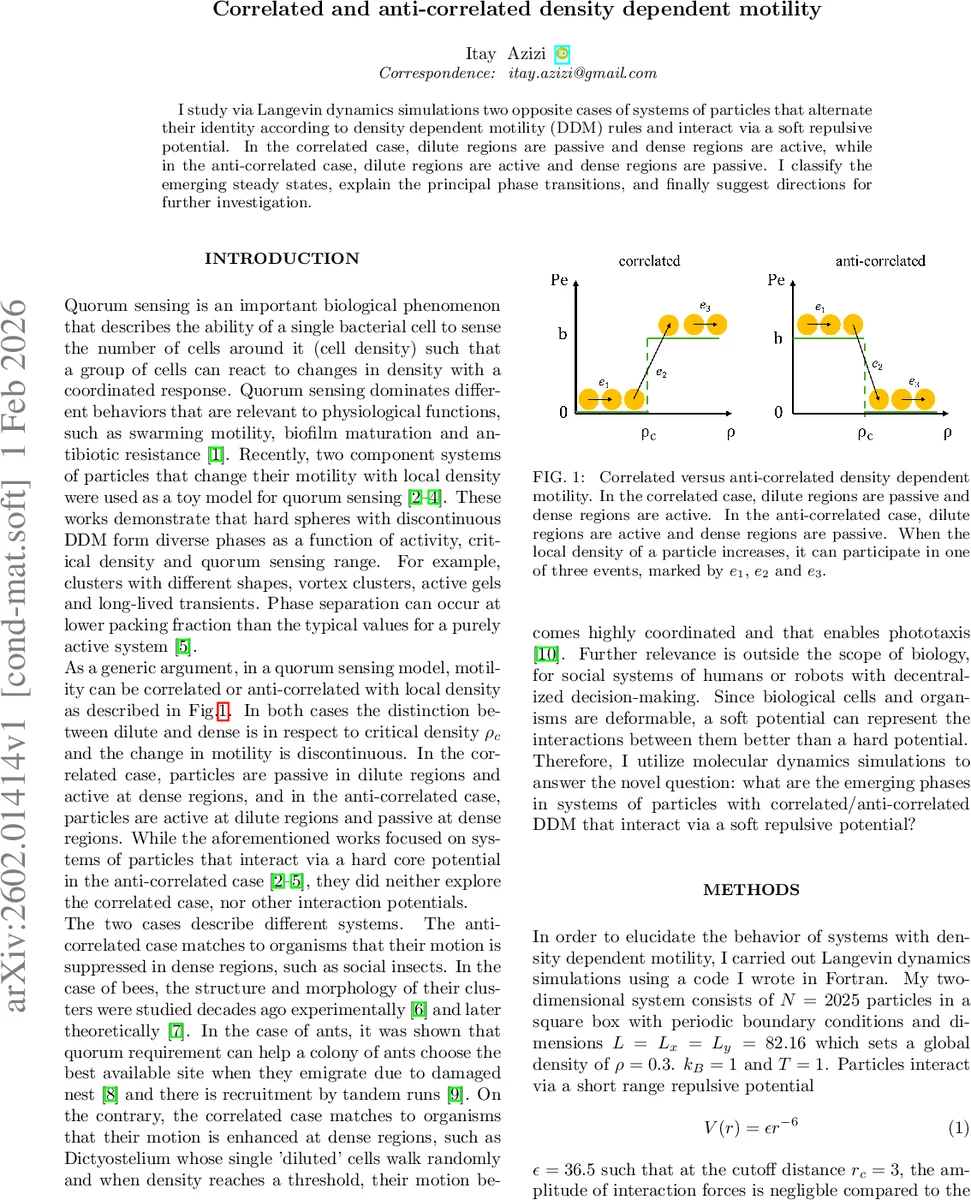
I study via Langevin dynamics simulations two opposite cases of systems of particles that alternate their identity according to density dependent motility (DDM) rules and interact via a soft repulsive potential. In the correlated case, dilute regions are passive and dense regions are active, while in the anti-correlated case, dilute regions are active and dense regions are passive. I classify the emerging steady states, explain the principal phase transitions, and finally suggest directions for further investigation.
💡 Research Summary
In this work the author investigates two opposite implementations of density‑dependent motility (DDM) using Langevin dynamics simulations of soft‑repulsive particles in two dimensions. In the “correlated” case particles are passive in low‑density regions and become active once the local density exceeds a prescribed critical value ρc; in the “anti‑correlated” case the opposite rule applies. The particles interact via a short‑range, purely repulsive potential V(r)=ε r⁻⁶ (ε=36.5, cutoff rc=3) so that any clustering can be attributed solely to the DDM rule rather than attractive forces.
The simulation setup consists of N=2025 particles in a square box of side L=82 (global packing fraction ρ=0.3). For each particle the number of neighbours mi inside a disk of radius 2a (a=ρ⁻¹/² is the mean inter‑particle spacing) is counted, giving a local density ρi=mi/A. If ρi>ρc the particle is assigned a self‑propulsion speed vp such that the Péclet number Pe=v √(D/D_r) equals a prescribed activity parameter b (b∈
Comments & Academic Discussion
Loading comments...
Leave a Comment