Phase Dynamics of Self-Accelerating Bose-Einstein Condensates
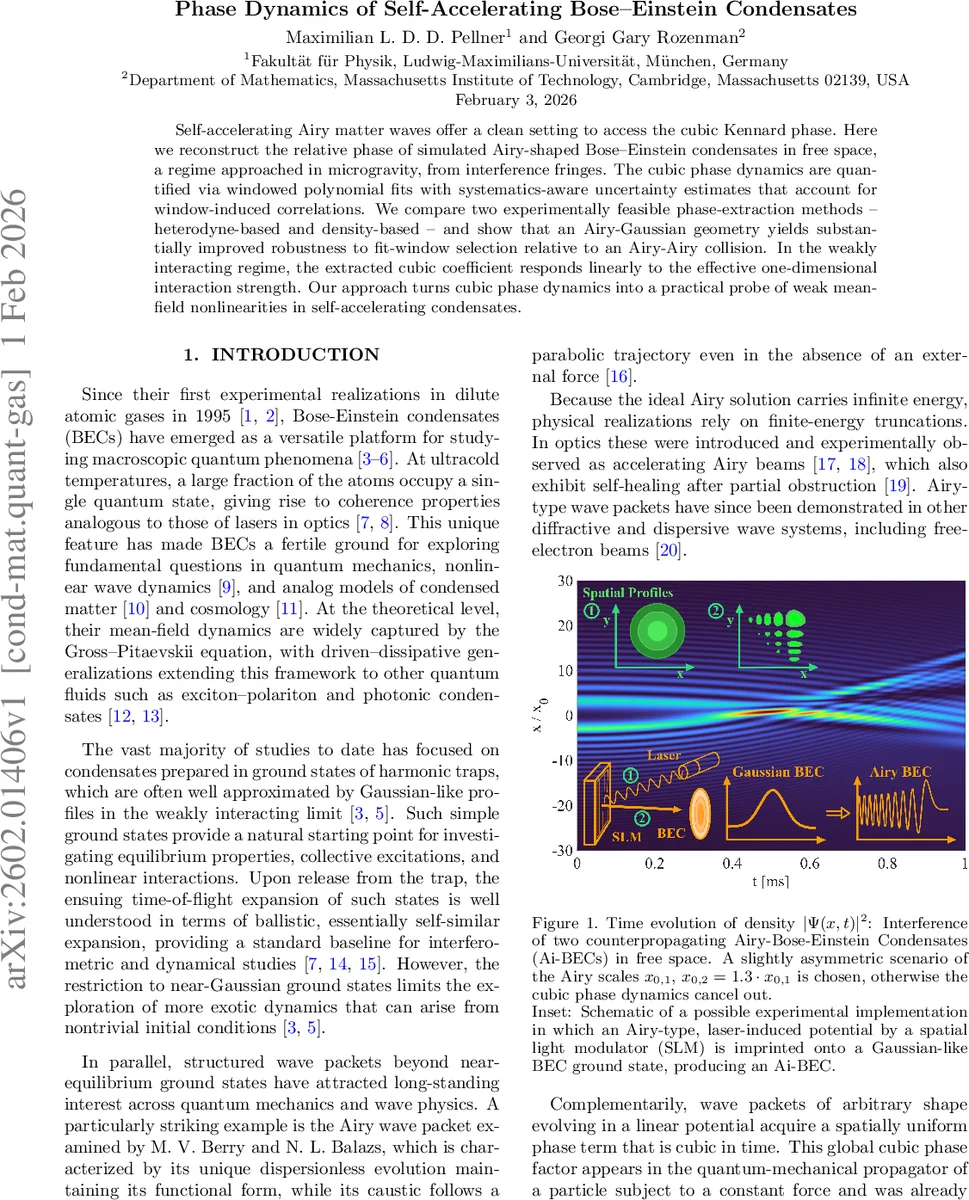
Self-accelerating Airy matter waves offer a clean setting to access the cubic Kennard phase. Here we reconstruct the relative phase of simulated Airy-shaped Bose-Einstein condensates in free space, a regime approached in microgravity, from interference fringes. The cubic phase dynamics are quantified via windowed polynomial fits with systematics-aware uncertainty estimates that account for window-induced correlations. We compare two experimentally feasible phase-extraction methods - heterodyne-based and density-based - and show that an Airy-Gaussian geometry yields substantially improved robustness to fit-window selection relative to an Airy-Airy collision. In the weakly interacting regime, the extracted cubic coefficient responds linearly to the effective one-dimensional interaction strength. Our approach turns cubic phase dynamics into a practical probe of weak mean-field nonlinearities in self-accelerating condensates.
💡 Research Summary
This paper investigates the cubic Kennard phase that naturally accompanies self‑accelerating Airy wave packets when they are realized as Bose‑Einstein condensates (BECs) in free space. By simulating Airy‑shaped condensates that expand without external forces—an experimental regime that can be approached in micro‑gravity—the authors develop two experimentally feasible methods for extracting the relative phase from interference fringes: a heterodyne‑based phase extraction (HPE) and a density‑based phase extraction (DPE).
The theoretical framework starts from the one‑dimensional Gross‑Pitaevskii equation (GPE). In the non‑interacting limit (g = 0) the exact propagator yields an analytic expression for the Airy wavefunction, from which the phase Φ_Ai(ξ,τ)=−τ³/12+τξ²+ a²τ² is identified. The cubic term (−τ³/12) is the Kennard phase, independent of position. For a Gaussian packet the propagator produces the familiar Gouy phase together with a τ‑dependent quadratic term; a short‑time expansion shows higher‑order contributions (τ⁴, τ⁶) that are absent in the Airy case.
Two collision scenarios are examined. In an Airy‑Airy collision the relative phase ΔΦ_Ai‑Ai contains two cubic contributions with opposite signs, leading to a net cubic coefficient c₃∝ℏ³/(12m³)(x₀,2⁻⁶−x₀,1⁻⁶), where x₀,i are the characteristic Airy scales. In an Airy‑Gaussian collision the cubic coefficient becomes c₃∝ℏ³/m³(1/12+1/48s⁶), with s the dimensionless Gaussian width. Thus the Gaussian width provides a convenient knob to tune the magnitude of the cubic phase.
The HPE method constructs a complex overlap signal S_HPE(τ)=∫w(ξ)Ψ₂*Ψ₁ e^{-ik_f(ξ−ξ_c)} dξ, where w(ξ) is a Gaussian window centred on the instantaneous overlap peak ξ_c and k_f is the differential fringe carrier obtained from separate calibrations. The argument of S_HPE, after phase unwrapping, yields the relative phase ϕ_rel(τ). Experimentally this would require two interferometric measurements with controlled relative phase shifts.
The DPE method, more directly implementable, uses only the measured density ρ(ξ,τ). After subtracting the spatial mean, the fluctuating component ρ_fluc(ξ,τ)=w(ξ)
Comments & Academic Discussion
Loading comments...
Leave a Comment