On the squareness of the discriminant of elliptic curves with an isogeny
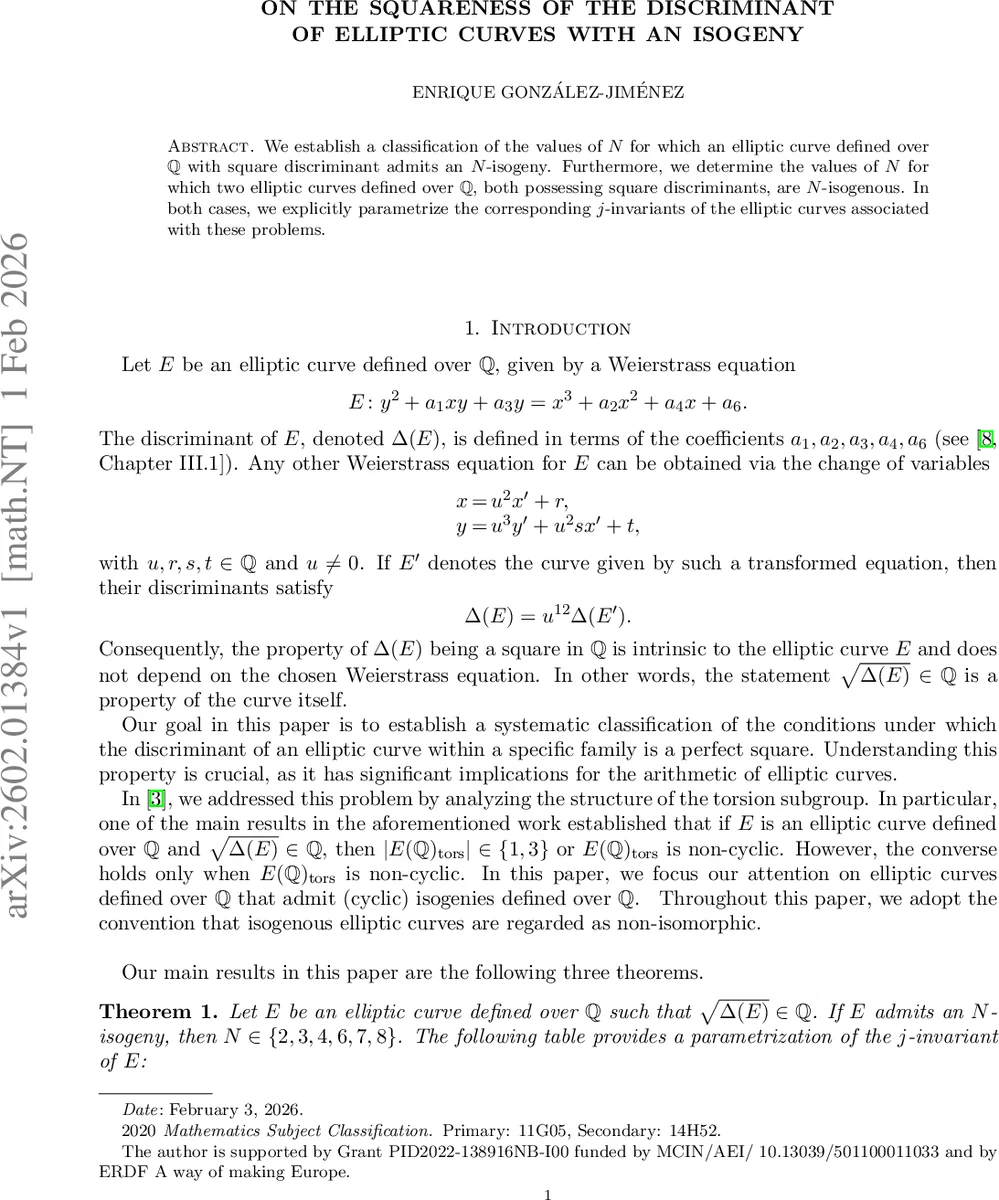
We establish a classification of the values of ( N ) for which an elliptic curve defined over ( \mathbb{Q} ) with square discriminant admits an ( N )-isogeny. Furthermore, we determine the values of ( N ) for which two elliptic curves defined over ( \mathbb{Q} ), both possessing square discriminants, are ( N )-isogenous. In both cases, we explicitly parametrize the corresponding ( j )-invariants of the elliptic curves associated with these problems.
💡 Research Summary
**
The paper investigates elliptic curves defined over the rational field ℚ whose discriminant Δ(E) is a perfect square in ℚ, and asks which rational cyclic isogenies such curves can admit. The authors obtain a complete classification for two related problems: (i) a single elliptic curve with square discriminant admitting an N‑isogeny, and (ii) a pair of elliptic curves, each with square discriminant, that are N‑isogenous. In both cases they give explicit parametrizations of the corresponding j‑invariants.
The starting point is the observation that the property “Δ(E) is a square” is invariant under change of Weierstrass model, because Δ transforms by a factor u¹². Using the classical formulas for the discriminant and the j‑invariant, the authors prove a simple but crucial criterion (Proposition 4): Δ(E) is a square if and only if either
- j(E) = 1728 + t² for some t∈ℚ (with t≠0), or
- j(E) = 1728 and E is ℚ‑isomorphic to the curve y² = x³ – s²x for some s∈ℚ*.
Thus the problem reduces to studying rational points on modular curves that encode the existence of an N‑isogeny together with the square‑discriminant condition.
The known classification of rational N‑isogenies (Mazur, Kenku, Ogg, Kubert, etc.) tells us that a rational elliptic curve can have a cyclic N‑isogeny only for N in the set
{2,3,4,5,6,7,8,9,10,12,13,16,18,25} together with a few larger exceptional values. The authors discard the exceptional CM cases later, so the focus is on the above list.
For each admissible N they define two auxiliary curves:
-
C_N : y² = F_N(h) – a curve whose ℚ‑points parametrize elliptic curves with an N‑isogeny and square discriminant. Here F_N is an explicit polynomial (given in Table 1) and the associated j‑map is j_N(h).
-
X_N : {y² = F_N(h), z² = G_N(h)} – a surface whose ℚ‑points parametrize ordered pairs (E, E′) of N‑isogenous curves, both with square discriminant. The polynomials F_N and G_N are again explicit.
The authors compute the genus of C_N and X_N. When the genus is zero (N = 2,3,4,6,7,8) they obtain rational parametrizations, proving that infinitely many curves satisfy the square‑discriminant condition for these N. For example, for N = 2, \
Comments & Academic Discussion
Loading comments...
Leave a Comment