Calibrated Quantification of the Dark-Exciton Reservoir via a k-Space-Folding Probe
Spin-forbidden dark excitons in monolayer transition metal dichalcogenides constitute a dominant hidden reservoir that governs exciton dynamics and many-body interactions. Yet determining the population distribution within this reservoir remains challenging because detected brightness conflates radiative-rate modification with collection efficiency, obscuring the link between intensity and population. Here we make this inverse problem well posed by calibrating the position- and orientation-resolved detection response. Combining microsphere-enabled k-space folding with Green-tensor quasinormal-mode calibration, we decouple radiative-rate modification from collection efficiency. We extract a room-temperature dark-to-bright population ratio ND/NB = 4.3, consistent with a near-thermalized manifold under continuous-wave excitation. This calibrated population metric provides a quantitative thermodynamic benchmark for the dark reservoir and interaction-driven 2D exciton phases.
💡 Research Summary
The paper presents a calibrated far‑field technique for quantitatively measuring the population of spin‑forbidden dark excitons in monolayer WSe₂, a problem that has long hindered a thermodynamic description of the hidden exciton reservoir. Dark excitons emit predominantly at large in‑plane wavevectors (high‑k), which lie outside the collection cone of conventional high‑NA objectives, making their direct photoluminescence (PL) detection extremely inefficient. Existing approaches—bright‑dark mixing, plasmonic antennas, or engineered out‑coupling structures—can enhance the signal but conflate the exciton population with radiative‑rate modification and collection efficiency, rendering the inverse problem ill‑posed.
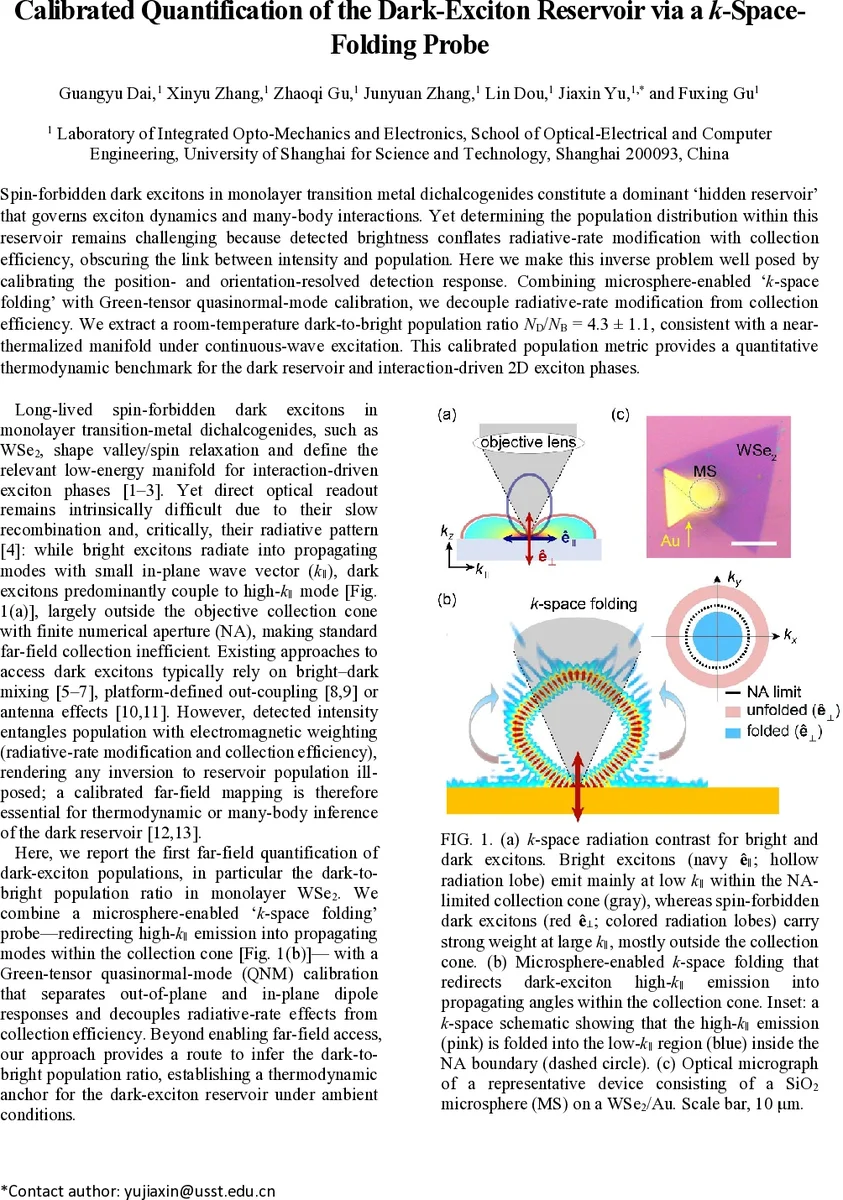
The authors solve this by combining two complementary strategies. First, they place a 6.5 µm SiO₂ microsphere on top of the WSe₂/Au heterostructure. The microsphere acts as a “k‑space folding” element: its curvature and the breaking of translational symmetry redirect the high‑k evanescent emission of dark excitons into propagating modes that fall within the numerical aperture (NA = 0.8) of a standard 100× objective. This dramatically increases the collection efficiency for the out‑of‑plane dipole channel while leaving the in‑plane (bright‑exciton) channel essentially unchanged.
Second, they employ a Green‑tensor quasinormal‑mode (QNM) calibration. Full‑wave simulations reveal two degenerate TM‑like QNMs arising from the hybridization of whispering‑gallery modes with surface‑plasmon polaritons on the Au substrate. By extracting the local density of optical states (LDOS) for both in‑plane and out‑of‑plane dipoles, they compute position‑ and orientation‑dependent detection response functions R_i = η_i Γ_i, where η_i is the collection efficiency and Γ_i is the environment‑modified radiative rate (Purcell factor F_r,i). The microsphere boosts η_⊥ from 8.7 % to 43.4 % (≈5×) and raises F_r,⊥ by a factor of ~37 relative to the in‑plane channel, effectively compensating the intrinsically weak free‑space radiative rate of dark excitons (Γ₀,⊥ ≈ 10⁻² Γ₀,∥).
With calibrated R_∥ and R_⊥, the detected PL intensity can be written as I_det = a(N_∥ R_∥ + N_⊥ R_⊥), where N_∥ and N_⊥ are the bright‑ and dark‑exciton populations and a is a global scaling factor. By laterally scanning the excitation spot relative to the microsphere, the authors exploit the distinct spatial dependence of R_∥ and R_⊥ to perform a well‑conditioned linear fit. The excitation profile remains essentially unchanged across the scan (≈280 nm FWHM), allowing the assumption that N_i are position‑independent. Separate fits to the bright (≈1.669 eV) and dark (≈1.625 eV) spectral windows yield A_B = a N_∥ and B_D = a N_⊥, giving a dark‑to‑bright population ratio N_⊥/N_∥ = 4.3 ± 1.1.
This ratio matches the Boltzmann prediction for a dark‑bright splitting ΔE_DB ≈ 40 meV at 300 K (N_D/N_B ≈ e^{ΔE/kT} ≈ 4.9), indicating that under continuous‑wave non‑resonant excitation the exciton ensemble reaches near‑thermal equilibrium despite the presence of a metallic substrate. The authors attribute this to rapid phonon‑assisted energy relaxation and spin‑flip scattering (sub‑picosecond to few‑picosecond timescales), which are orders of magnitude faster than the overall exciton lifetime, allowing multiple scattering events before recombination.
To confirm that the measured signal originates from genuine dark excitons rather than out‑of‑plane projections of bright states, temperature‑dependent studies are performed. In WSe₂/Au, the QNM‑enhanced PL shows little correlation with the planar PL (Pearson r ≈ 0.22) across 230–295 K, whereas control samples—MoSe₂/Au (where the bright state lies slightly below the dark state) and WSe₂/SiO₂ (no plasmonic enhancement)—exhibit strong positive correlations (r ≈ 0.7). This contrast unequivocally demonstrates that the observed far‑field emission in the WSe₂/Au device is a direct signature of the dark‑exciton reservoir.
The calibrated population metric provides a thermodynamic anchor for the hidden reservoir, enabling quantitative studies of many‑body phenomena such as room‑temperature Berezinskii–Kosterlitz–Thouless (BKT) condensation of dark excitons, strain‑induced potential landscapes, and disorder mapping. Moreover, the methodology is readily extensible to other out‑of‑plane dipole systems, including hBN defect emitters and interlayer or moiré excitons, offering a general route to access otherwise invisible quantum reservoirs in two‑dimensional materials.
In summary, by integrating microsphere‑enabled k‑space folding with Green‑tensor QNM calibration, the authors achieve a calibrated, far‑field probe that decouples radiative‑rate modification from collection efficiency, allowing an accurate, room‑temperature measurement of the dark‑to‑bright exciton population ratio (ND/NB = 4.3 ± 1.1) in monolayer WSe₂. This work establishes a robust benchmark for quantitative dark‑exciton metrology and opens new avenues for exploring thermodynamic and coherent phenomena in 2D excitonic systems.
Comments & Academic Discussion
Loading comments...
Leave a Comment