On Askey's extension of Clausen's identity and its polynomial perturbation
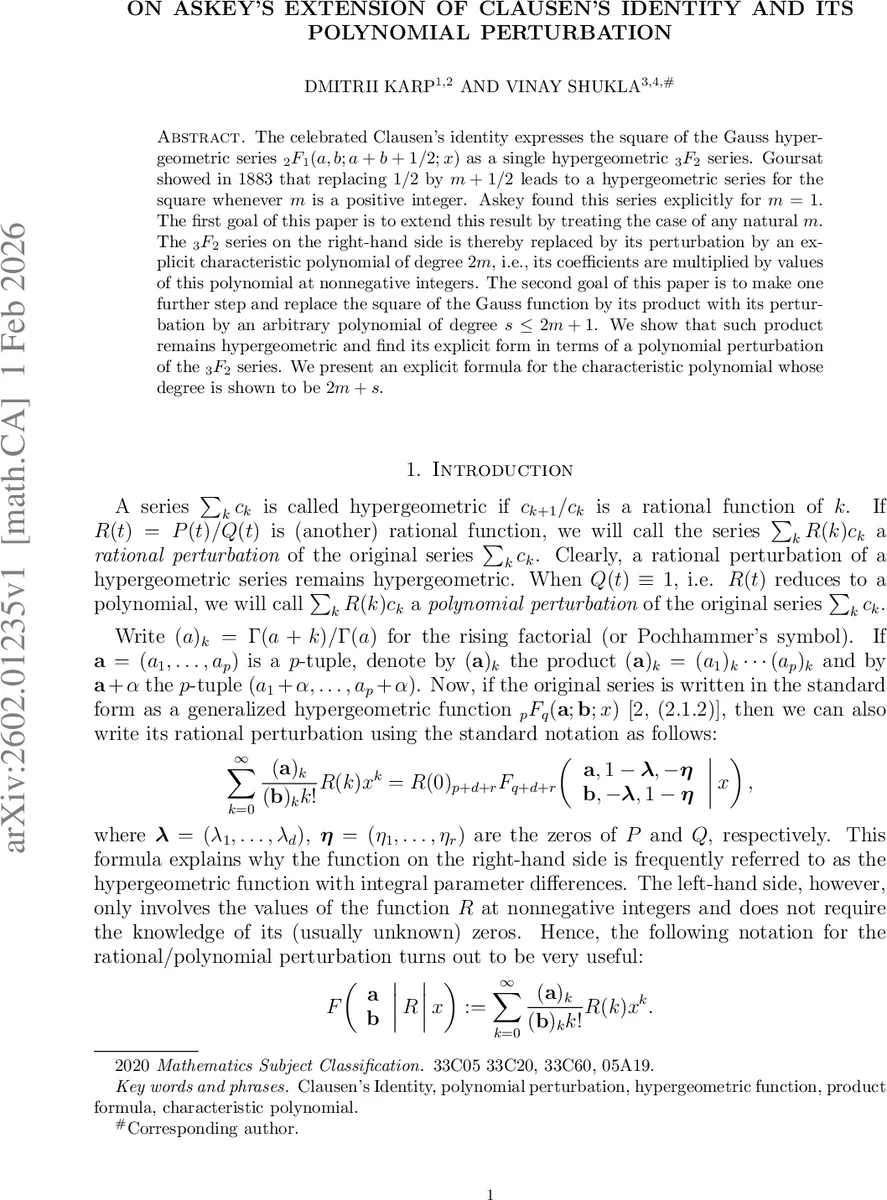
The celebrated Clausen’s identity expresses the square of the Gauss hypergeometric series ${}2F{1}(a,b;a+b+1/2;x)$ as a single hypergeometric ${}_3F_2$ series. Goursat showed in 1883 that replacing $1/2$ by $m+1/2$ leads to a hypergeometric series for the square whenever $m$ is a positive integer. Askey found this series explicitly for $m=1$. The first goal of this paper is to extend this result by treating the case of any natural $m$. The ${}3F{2}$ series on the right-hand side is thereby replaced by its perturbation by an explicit characteristic polynomial of degree $2m$, i.e., its coefficients are multiplied by values of this polynomial at nonnegative integers. The second goal of this paper is to make one further step and replace the square of the Gauss function by its product with its perturbation by an arbitrary polynomial of degree $s\le{2m+1}$. We show that such product remains hypergeometric and find its explicit form in terms of a polynomial perturbation of the ${}_3F_2$ series. We present an explicit formula for the characteristic polynomial whose degree is shown to be $2m+s$.
💡 Research Summary
**
The paper revisits the classical Clausen identity, which expresses the square of a Gauss hypergeometric function ${}_2F_1(a,b;a+b+\tfrac12;x)$ as a single ${}_3F_2$ series, and extends it in two substantial directions.
First, building on Goursat’s 1883 observation that the square remains hypergeometric when the bottom parameter is shifted to $a+b+m+\tfrac12$ (with $m\in\mathbb N$), the authors provide an explicit formula for the case of any natural $m$. The right‑hand side is no longer a plain ${}_3F_2$ but a polynomial perturbation of it: each coefficient of the ${}3F_2$ series is multiplied by the value of a characteristic polynomial $P^{2m}{a,b}(k)$ of degree $2m$ evaluated at the non‑negative integer $k$. The polynomial is given by a finite double sum (formula (2.4)) and can also be written as a product over its $2m$ (negated) zeros. The main result, Theorem 2.1, states \
Comments & Academic Discussion
Loading comments...
Leave a Comment