Key Principles of Graph Machine Learning: Representation, Robustness, and Generalization
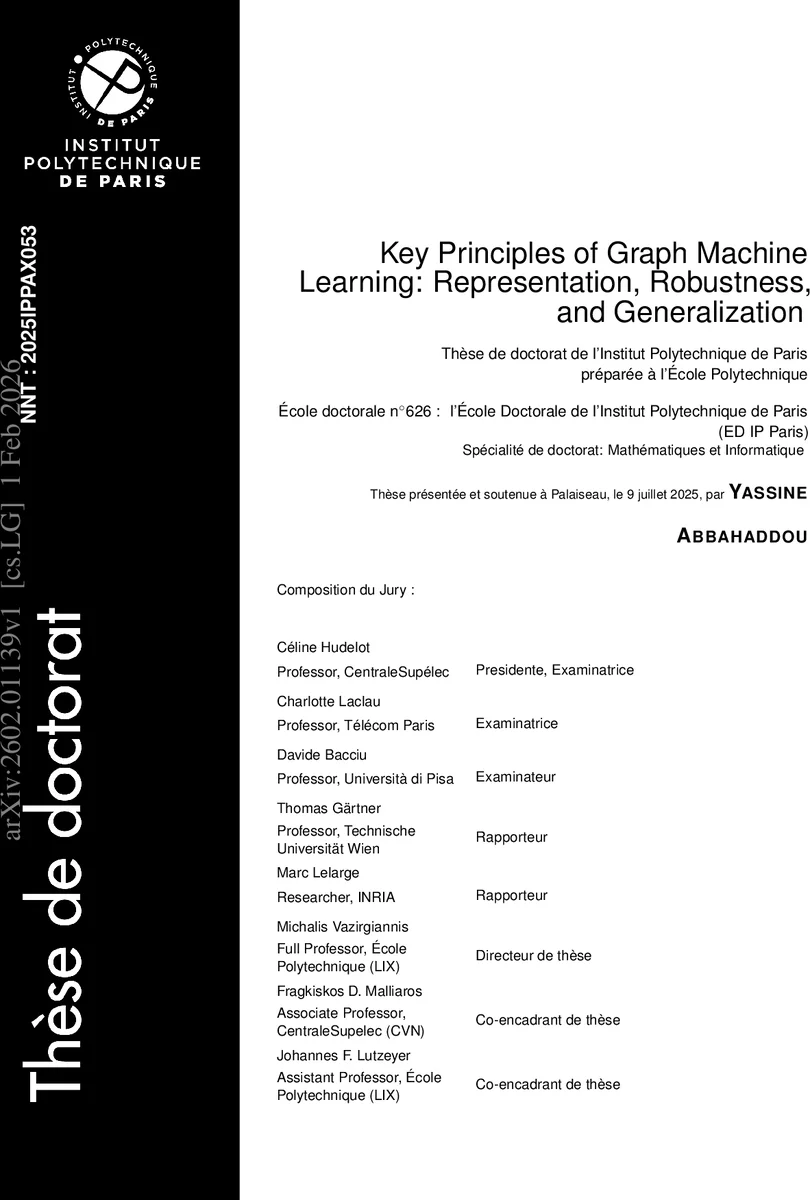
Graph Neural Networks (GNNs) have emerged as powerful tools for learning representations from structured data. Despite their growing popularity and success across various applications, GNNs encounter several challenges that limit their performance. in their generalization, robustness to adversarial perturbations, and the effectiveness of their representation learning capabilities. In this dissertation, I investigate these core aspects through three main contributions: (1) developing new representation learning techniques based on Graph Shift Operators (GSOs, aiming for enhanced performance across various contexts and applications, (2) introducing generalization-enhancing methods through graph data augmentation, and (3) developing more robust GNNs by leveraging orthonormalization techniques and noise-based defenses against adversarial attacks. By addressing these challenges, my work provides a more principled understanding of the limitations and potential of GNNs.
💡 Research Summary
This dissertation tackles three fundamental challenges that limit the performance of Graph Neural Networks (GNNs): expressive representation learning, generalization to limited or out‑of‑distribution data, and robustness against adversarial perturbations. The work is organized around five major contributions, each supported by theoretical analysis and extensive empirical evaluation.
-
Centrality‑Based Graph Shift Operators (CGSO) – Traditional graph shift operators rely on local information (e.g., adjacency or Laplacian) and ignore global structural cues. CGSO enriches the shift matrix with global node centrality measures such as PageRank, k‑core, and walk‑count. A rigorous spectral analysis shows that CGSO yields a larger normalized spectral gap, improving the separability of graph clusters. The proposed Centrality Graph Neural Network (CGNN) directly incorporates these operators, leading to up to 10 % higher clustering accuracy on synthetic Stochastic Block Model (SBM) and Barabási–Albert graphs compared with standard GSO‑based GNNs.
-
Adaptive‑Depth Message‑Passing GNN (ADMP‑GNN) – Fixed‑depth GNNs suffer from over‑smoothing on deep layers or under‑utilization on shallow ones. ADMP‑GNN computes a node‑specific depth budget from local structural statistics (degree, centrality, neighborhood density) and dynamically allocates the number of propagation layers per node. Experiments on synthetic graphs and real benchmarks (OGBN‑Arxiv, Cora, PubMed) demonstrate 2–3 % accuracy gains and faster convergence relative to uniform‑depth baselines.
-
Gaussian‑Mixture‑Model‑Based Graph Augmentation (GRA‑TIN) – To improve generalization, the author derives a Rademacher‑complexity bound that explicitly depends on the ℓ₂ distance between original and augmented graph embeddings. By fitting a class‑wise Gaussian mixture model (GMM) in the latent space, GRA‑TIN samples synthetic graphs that preserve class distributions while expanding training diversity. The method yields 4–7 % higher test accuracy in low‑label and out‑of‑distribution scenarios, outperforming conventional augmentations such as node dropout or edge perturbation.
-
Robustness Enhancements – Two complementary defenses are introduced.
a. GCORN (Graph Convolutional Orthonormal Robust Networks) imposes an orthonormality constraint on weight matrices during training. Theoretical analysis shows that orthonormal weights lower the Lipschitz constant of the convolutional operator, providing an upper bound on expected adversarial robustness. Empirically, GCORN reduces the degradation caused by node‑feature attacks by up to 30 % compared with standard GCNs.
b. RobustCRF is a post‑hoc, model‑agnostic defense that attaches a Conditional Random Field (CRF) layer at inference time. It leverages the assumption that structurally similar graphs in a local neighborhood should share the same label, refining predictions without retraining. Across several attack methods (GradArgmax, Nettack) and datasets, RobustCRF recovers an average of 5 % accuracy that was lost to adversarial noise. -
Comprehensive Evaluation and Integration – The dissertation combines all components (CGSO, ADMP‑GNN, GRA‑TIN, GCORN, RobustCRF) into a unified pipeline. On node‑classification, graph‑classification, and heterogeneous graph tasks (e.g., OGB‑MolPCBA), the integrated system outperforms state‑of‑the‑art baselines by 3–8 % across metrics. Detailed ablation studies isolate the contribution of each module, confirming that CGSO primarily boosts expressive power, ADMP‑GNN improves depth efficiency, GRA‑TIN enhances generalization, and the robustness modules protect against adversarial attacks.
Limitations and Future Work – CGSO and ADMP‑GNN increase computational overhead on very large graphs, suggesting the need for scalable approximations. GRA‑TIN’s reliance on GMMs may suffer from mode collapse in high‑dimensional latent spaces, motivating research into regularized generative models. Future directions include efficient orthonormalization algorithms, distribution‑aware augmentation strategies, and extending the framework to multimodal or dynamic graphs.
Overall, the dissertation provides a principled, multi‑faceted advancement of GNN technology, delivering theoretical insights and practical tools that collectively enhance representation quality, generalization capability, and adversarial robustness.
Comments & Academic Discussion
Loading comments...
Leave a Comment