Estimating Force Interactions of Deformable Linear Objects from their Shapes
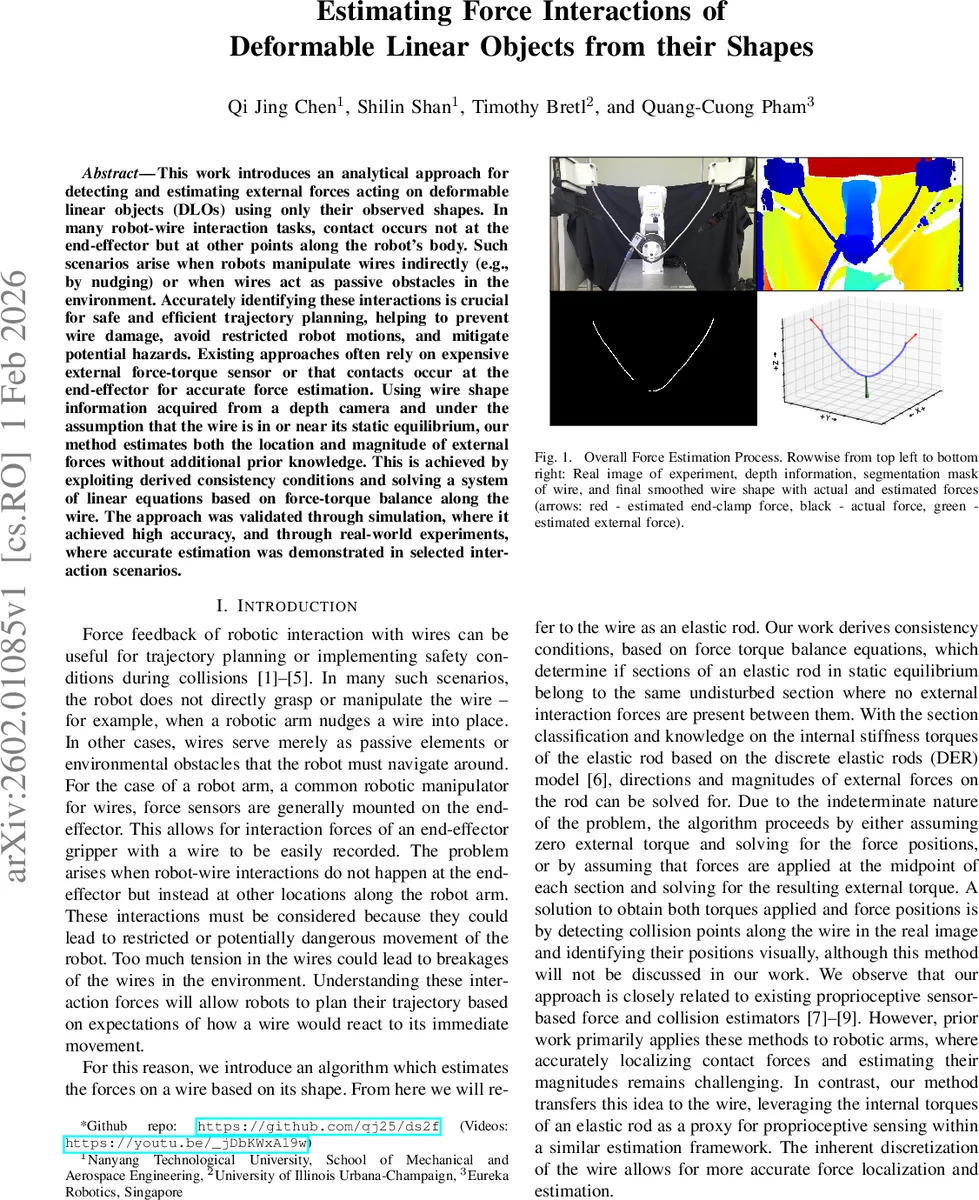
This work introduces an analytical approach for detecting and estimating external forces acting on deformable linear objects (DLOs) using only their observed shapes. In many robot-wire interaction tasks, contact occurs not at the end-effector but at other points along the robot’s body. Such scenarios arise when robots manipulate wires indirectly (e.g., by nudging) or when wires act as passive obstacles in the environment. Accurately identifying these interactions is crucial for safe and efficient trajectory planning, helping to prevent wire damage, avoid restricted robot motions, and mitigate potential hazards. Existing approaches often rely on expensive external force-torque sensor or that contacts occur at the end-effector for accurate force estimation. Using wire shape information acquired from a depth camera and under the assumption that the wire is in or near its static equilibrium, our method estimates both the location and magnitude of external forces without additional prior knowledge. This is achieved by exploiting derived consistency conditions and solving a system of linear equations based on force-torque balance along the wire. The approach was validated through simulation, where it achieved high accuracy, and through real-world experiments, where accurate estimation was demonstrated in selected interaction scenarios.
💡 Research Summary
The paper presents an analytical method for detecting and estimating external forces acting on deformable linear objects (DLOs), such as wires, using only their observed 3‑D shapes captured by a depth camera. The motivation stems from robotic tasks where contact with a wire occurs away from the robot’s end‑effector—e.g., when a robot nudges a wire or when wires serve as passive obstacles. Traditional approaches rely on expensive force‑torque sensors or assume that all contacts happen at the gripper, limiting their applicability in such scenarios.
Problem formulation
The wire is modeled as a discrete elastic rod (DER) consisting of a sequence of nodes and edges. Each edge (e_i = x_{i+1} - x_i) has an associated internal stiffness torque (c_i). The wire is partitioned into two section types: Undisturbed (UD) sections, where no external forces act, and Disturbed (D) sections, which contain one or more external force‑torque pairs ({f_j,\tau_j}). The key assumption is that the wire is in static equilibrium or moves quasistatically, allowing the use of force‑torque balance equations. Additional practical constraints require at least three consecutive UD pieces between any two D sections and that these three pieces are not collinear, ensuring the problem is not underdetermined.
Derivation of consistency conditions
Two consistency conditions are derived to decide whether adjacent pieces belong to the same UD section.
Condition A follows from the equality of internal forces across two neighboring UD pieces: (e_i \cdot c_{i+1} + e_{i+1} \cdot c_i = 0). While necessary, this condition alone is insufficient because it can also be satisfied when an external force lies in the plane spanned by the two edge vectors.
Condition B extends the analysis to three consecutive pieces, constructing a skew‑symmetric matrix (A) from the edge vectors and a vector (C) from the internal torques. Solving the linear system (A F = C) in a least‑squares sense (using the pseudoinverse obtained via singular‑value decomposition) yields a robust test: if the residual is below a manually set threshold, the three pieces are classified as belonging to the same UD section.
Force and torque estimation
Once UD sections are identified, the average internal force (F^*) for each UD segment is computed. For a D section sandwiched between UD sections (k) and (l), the external force is estimated as
\
Comments & Academic Discussion
Loading comments...
Leave a Comment