The generalized volume conjecture for the figure-eight knot parametrized by a complex number with small imaginary part
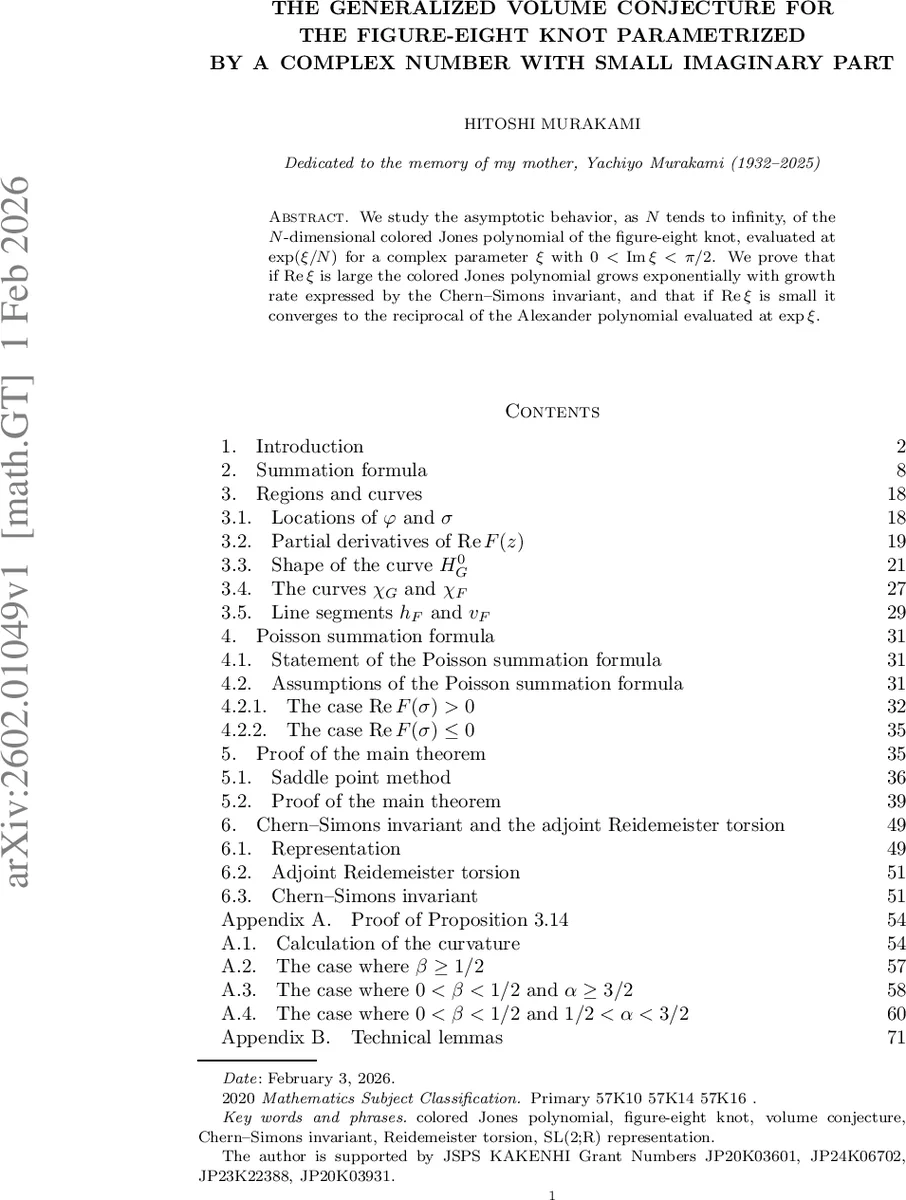
We study the asymptotic behavior, as $N$ tends to infinity, of the $N$-dimensional colored Jones polynomial of the figure-eight knot, evaluated at $\exp(ξ/N)$ for a complex parameter $ξ$ with $0<\mathrm{Im}ξ<π/2$. We prove that if $\mathrm{Re}ξ$ is large the colored Jones polynomial grows exponentially with growth rate expressed by the Chern–Simons invariant, and that if $\mathrm{Re}ξ$ is small it converges to the reciprocal of the Alexander polynomial evaluated at $\expξ$.
💡 Research Summary
This paper investigates the asymptotic behavior of the N‑dimensional colored Jones polynomial of the figure‑eight knot, denoted J_N(E; q), when the quantum parameter q is specialized to e^{ξ/N} with a complex exponent ξ satisfying 0 < Im ξ < π/2. The author fixes ξ = a + i b (a > 0, 0 < b < π/2) and introduces several auxiliary complex functions: ϕ(ξ), defined via a logarithm of a combination of hyperbolic cosines; S(ξ), a combination of dilogarithms and ϕ; and T(ξ), a rational expression in cosh ξ that later appears as the adjoint Reidemeister torsion.
A careful partition of the complex ξ‑plane is performed. The basic admissible region Ξ consists of points with a > 0, 0 < b < π/2 and cosh a cos b > ½. Inside Ξ the author distinguishes a subregion Γ defined by the additional inequality a tanh c − b tan d ≥ 0, where c = Re ϕ(ξ) and d = Im ϕ(ξ). The complement eΓ is defined analogously. Each of Γ and eΓ is further split according to the sign of Re S(ξ)/ξ, yielding Γ⁺ (positive), Γ⁰ (zero), and Γ⁻ (negative). This fine decomposition is essential because the sign determines whether the exponential term exp(N S(ξ)/ξ) grows, stays bounded, or decays.
The main result, Theorem 1.5, gives three distinct asymptotic formulas:
- Growth case (ξ ∈ Γ⁺):
J_N(E; e^{ξ/N}) = √
Comments & Academic Discussion
Loading comments...
Leave a Comment