Minimizing Inequity in Facility Location Games
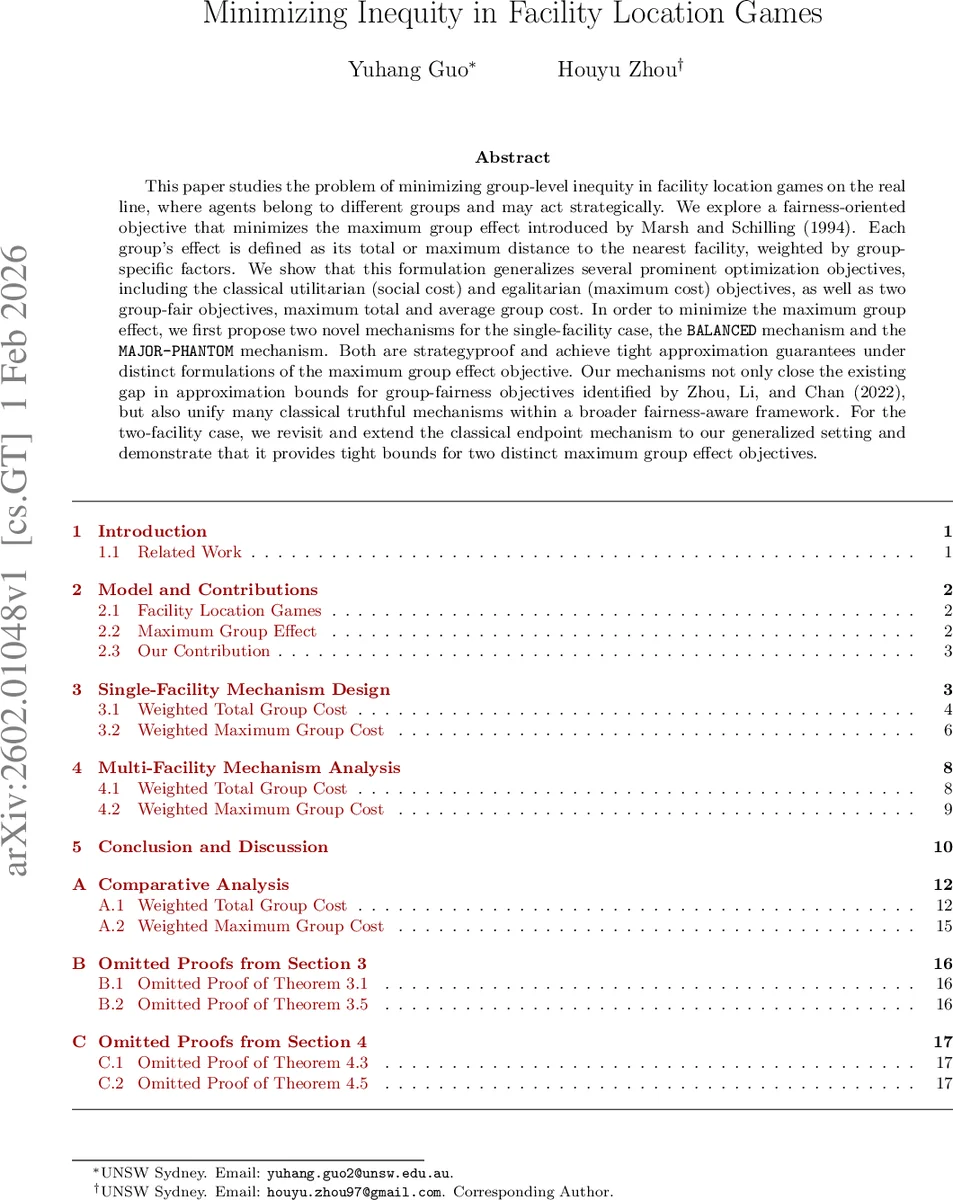
This paper studies the problem of minimizing group-level inequity in facility location games on the real line, where agents belong to different groups and may act strategically. We explore a fairness-oriented objective that minimizes the maximum group effect introduced by Marsh and Schilling (1994). Each group’s effect is defined as its total or maximum distance to the nearest facility, weighted by group-specific factors. We show that this formulation generalizes several prominent optimization objectives, including the classical utilitarian (social cost) and egalitarian (maximum cost) objectives, as well as two group-fair objectives, maximum total and average group cost. In order to minimize the maximum group effect, we first propose two novel mechanisms for the single-facility case, the BALANCED mechanism and the MAJOR-PHANTOM mechanism. Both are strategyproof and achieve tight approximation guarantees under distinct formulations of the maximum group effect objective. Our mechanisms not only close the existing gap in approximation bounds for group-fairness objectives identified by Zhou, Li, and Chan (2022), but also unify many classical truthful mechanisms within a broader fairness-aware framework. For the two-facility case, we revisit and extend the classical endpoint mechanism to our generalized setting and demonstrate that it provides tight bounds for two distinct maximum group effect objectives.
💡 Research Summary
This paper investigates the design of strategy‑proof mechanisms for facility location games on the real line when agents belong to multiple pre‑defined groups and the planner wishes to minimize group‑level inequity. The authors adopt the “maximum group effect” (MGE) metric originally proposed by Marsh and Schilling (1994), which captures the worst‑off group’s burden. For each group j a weight w_j ≥ 0 reflects policy‑driven priority (e.g., socioeconomic status). The group effect E_j is defined in two ways: (1) weighted total group cost (wTGC) E_j = w_j·∑{i∈G_j} c(f(θ),x_i), i.e., the weighted sum of distances of all agents in the group to their nearest facility; and (2) weighted maximum group cost (wMGC) E_j = w_j·max{i∈G_j} c(f(θ),x_i), i.e., the weighted farthest distance within the group. The objective is to minimize mge(θ,f(θ)) = max_j E_j. This formulation subsumes many classic objectives: social cost (sum of all distances), max‑cost (largest individual distance), and the group‑fair objectives maximum total group cost (mtgc) and maximum average group cost (magc).
The paper’s contributions are organized by the number of facilities k.
Single‑facility (k = 1).
Two novel deterministic, strategy‑proof mechanisms are introduced.
BALANCED addresses the wTGC version of MGE. For any candidate location y, the mechanism computes for each group j the weighted number of agents to the left, L_j(y) = w_j·|{i∈G_j : x_i ≤ y}|, and to the right, R_j(y) = w_j·|{i∈G_j : x_i > y}|. It selects the smallest y for which max_j w_j·L_j(y) ≥ max_j w_j·R_j(y). Intuitively, the facility is placed where the heaviest weighted side balances. The authors prove that BALANCED is strategy‑proof and achieves a tight 2‑approximation for minimizing MGE under wTGC. When the weight vector is uniform, BALANCED collapses to the classic median mechanism (optimal for social cost); when the objective is max‑cost, it becomes the left‑most mechanism.
MAJOR‑PHANTOM tackles the wMGC version. It identifies the group G_max with the largest weight w_max, places the real facility at the median of the agents in G_max, and adds |G_max|−1 “phantom” points (virtual facilities) at the same location. This construction equalizes the weighted maximum distance across groups. The mechanism is also strategy‑proof and attains a tight 2‑approximation for the wMGC‑based MGE.
Both mechanisms run in O((n+m)·log n) time via binary search over sorted agent locations.
Two‑facility (k = 2).
The classical ENDPOINT mechanism—placing facilities at the leftmost and rightmost agents—is revisited. For wTGC the mechanism yields an approximation ratio of 1 + (n−2)·(w_max/w_min); for wMGC the ratio is 1 + (w_max/w_min). The paper supplies matching lower bounds, showing these ratios are optimal for deterministic, strategy‑proof, anonymous mechanisms.
Three or more facilities (k ≥ 3).
Building on prior work (Fotakis & Tzamos, 2020), the authors prove that any deterministic, strategy‑proof, anonymous mechanism must have unbounded approximation ratio for both wTGC and wMGC. Hence, the problem becomes intractable under the fairness‑centric MGE objective when many facilities are allowed.
A comprehensive table (Table 1) summarizes all results, highlighting that the new mechanisms close the approximation gaps left open by Zhou, Li, and Chan (2022) for the group‑fair objectives mtgc and magc.
The paper also discusses the broader significance of the MGE framework: by adjusting group partitions and weights, one can recover classic objectives, thereby providing a unified lens for analyzing efficiency versus equity trade‑offs. The authors suggest future directions such as randomized mechanisms, extensions to higher‑dimensional spaces, dynamic group weights, and learning‑based weight estimation.
In summary, the work delivers a rigorous, unified theory for minimizing group inequity in facility location games, introduces two tight, strategy‑proof mechanisms for the single‑facility case, extends the endpoint approach to two facilities, and establishes fundamental impossibility results for larger numbers of facilities. The results advance both the algorithmic mechanism design literature and the practical understanding of how to allocate public services fairly across heterogeneous populations.
Comments & Academic Discussion
Loading comments...
Leave a Comment