Critical Temperatures from Domain-Wall Microstate Counting: A Topological Solution for the Potts Universality Class
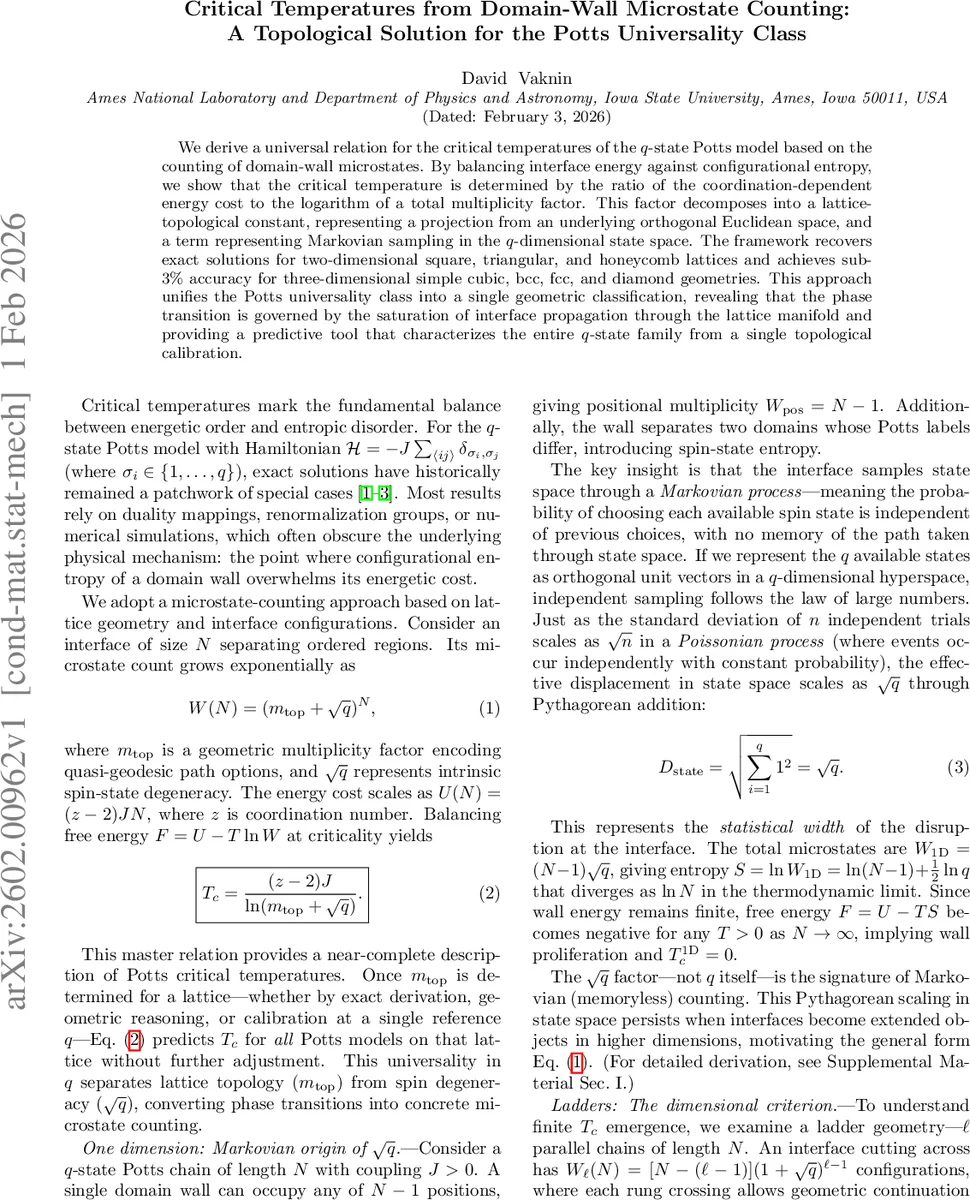
We derive a universal relation for the critical temperatures of the $q$-state Potts model based on the counting of domain-wall microstates. By balancing interface energy against configurational entropy, we show that the critical temperature is determined by the ratio of the coordination-dependent energy cost to the logarithm of a total multiplicity factor. This factor decomposes into a lattice-topological constant, representing a projection from an underlying orthogonal Euclidean space, and a term representing Markovian sampling in the $q$-dimensional state space. The framework recovers exact solutions for two-dimensional square, triangular, and honeycomb lattices and achieves sub-3% accuracy for three-dimensional simple cubic, bcc, fcc, and diamond geometries. This approach unifies the Potts universality class into a single geometric classification, revealing that the phase transition is governed by the saturation of interface propagation through the lattice manifold and providing a predictive tool that characterizes the entire $q$-state family from a single topological calibration.
💡 Research Summary
**
In this paper the author presents a unified and remarkably simple framework for predicting the critical temperatures of the q‑state Potts model on arbitrary lattices. The central idea is to treat a domain wall (the interface separating ordered domains) as a collection of microscopic configurations whose number grows exponentially with the size of the interface. Specifically, for an interface of size N (length in 2 D, area in 3 D) the number of microstates is postulated to be
\
Comments & Academic Discussion
Loading comments...
Leave a Comment